
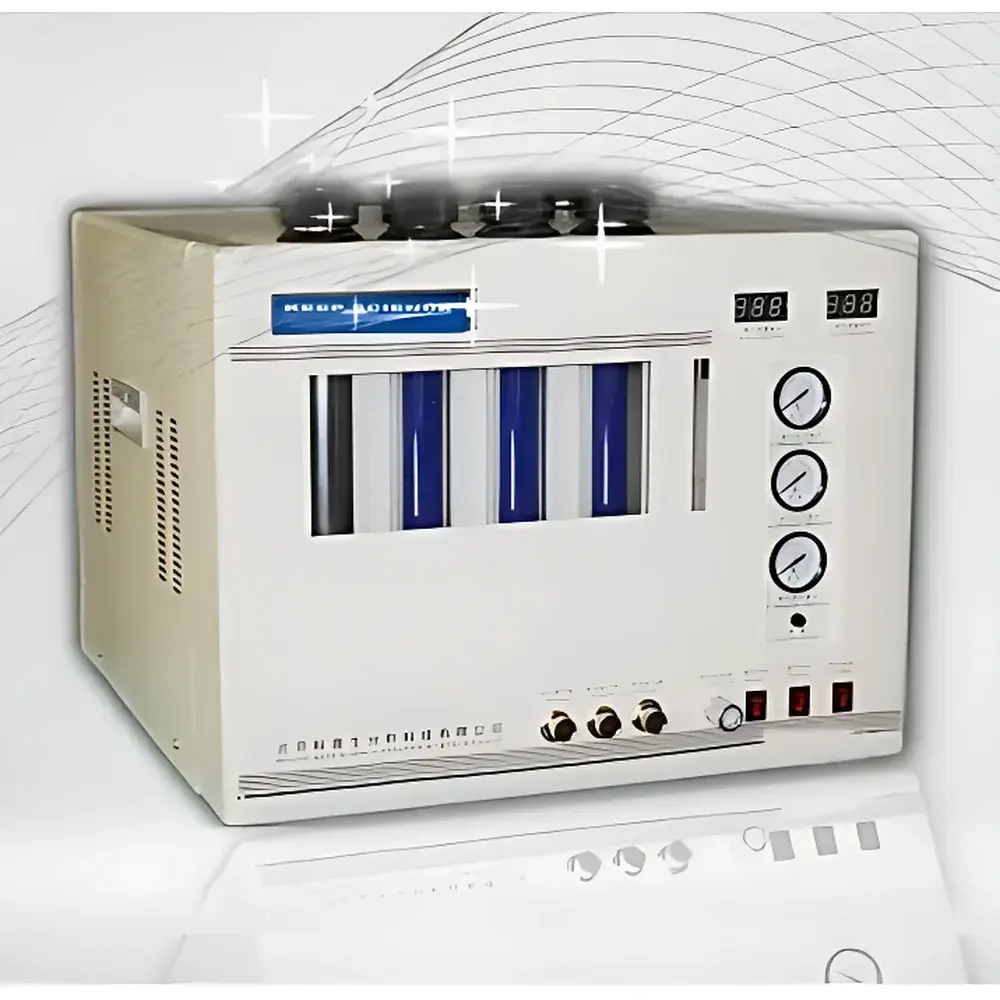
Jiayuan NHA-300 Integrated Nitrogen-Hydrogen-Air Gas Generator
| Brand | Jiayuan |
|---|---|
| Origin | Beijing, China |
| Model | NHA-300 |
| Nitrogen Purity | ≥99.999% (O₂ < 3 ppm, Dew Point: −56 °C) |
| Nitrogen Flow Rate | 0–300 mL/min |
| Nitrogen Pressure | 0–0.4 MPa |
| Hydrogen Purity | ≥99.999% |
| Hydrogen Flow Rate | 0–300 mL/min |
| Hydrogen Pressure | 0–0.4 MPa |
| Air Flow Rate | 0–2000 mL/min |
| Air Pressure | 0–0.4 MPa |
| Power Supply | AC 220 V ±10%, 50 Hz |
| Ambient Humidity | ≤85% RH |
| Noise Level | <40 dB(A) |
| Dimensions (W×D×H) | 500×480×360 mm |
| Weight | 40 kg |
Overview
The Jiayuan NHA-300 Integrated Nitrogen-Hydrogen-Air Gas Generator is an engineered solution for laboratories requiring on-demand, high-purity carrier, fuel, and combustion gases for analytical instrumentation—including gas chromatographs (GC), GC–mass spectrometers (GC–MS), flame ionization detectors (FID), thermal conductivity detectors (TCD), and nitrogen purging applications. Unlike conventional cylinder-based gas supply systems, the NHA-300 employs membrane separation for nitrogen generation, proton exchange membrane (PEM) electrolysis for hydrogen production, and oil-free rotary vane compression with desiccant drying for zero-air synthesis—all housed within a single, compact chassis. This integrated architecture eliminates cross-contamination risks, reduces logistical overhead, and ensures continuous, pressure-stabilized gas delivery with real-time flow modulation in response to instrument demand.
Key Features
- Triple-gas integration: Simultaneous, independent generation of nitrogen (≥99.999% purity), hydrogen (≥99.999% purity), and zero air (hydrocarbon-free, CO/CO₂ scrubbed) from ambient air and deionized water—no external gas cylinders required.
- Intelligent flow tracking: Microprocessor-controlled gas delivery dynamically adjusts output flow rates (N₂/H₂: 0–300 mL/min; air: 0–2000 mL/min) to match real-time instrument consumption, minimizing waste and maintaining stable backpressure across all outlets.
- Modular operational modes: Supports standalone or combined operation—users may activate nitrogen, hydrogen, or air channels independently, enabling flexible deployment across multiple instruments or phased method development.
- Robust safety architecture: Integrated leak detection, over-pressure relief valves, hydrogen concentration monitoring (<1% LEL), automatic shutdown on fault, and CE-compliant electrical isolation ensure compliance with IEC 61010-1 for laboratory equipment.
- Low-maintenance design: PEM electrolyzer stack rated for >10,000 hours MTBF; nitrogen membranes with 5-year service life; desiccant air dryer with visual saturation indicator; no oil, no moving parts in gas path.
Sample Compatibility & Compliance
The NHA-300 is validated for use with GC systems requiring ultra-high-purity carrier gas (per ASTM D6299 and ISO 8573-1 Class 1 for particulates, water, and oil aerosols), FID fuel gas (meeting ASTM D3612 requirements for hydrocarbon-free hydrogen), and zero air for detector combustion (meeting EPA Method TO-15 specifications for total hydrocarbons <0.1 ppm). Its nitrogen stream achieves dew point ≤−56 °C and oxygen residual <3 ppm—compatible with electron capture detectors (ECD) and sensitive trace analysis workflows. The generator conforms to electromagnetic compatibility standards EN 61326-1 and carries RoHS and REACH declarations. While not FDA 21 CFR Part 11–certified out-of-the-box, audit-ready electronic logs (via optional RS-232/USB interface) support GLP/GMP-aligned data integrity protocols when paired with validated LIMS integration.
Software & Data Management
The NHA-300 includes embedded firmware with dual-mode interface: front-panel LCD with tactile navigation for local status monitoring (gas pressures, flow setpoints, maintenance alerts, runtime hours), and optional PC connectivity via USB or RS-232 for remote configuration and event logging. System-generated logs record start/stop timestamps, pressure excursions, purity verification cycles, and fault codes—exportable as CSV for QA review. Firmware supports user-defined alarm thresholds and scheduled self-diagnostics (e.g., weekly membrane integrity check, monthly PEM efficiency validation). No proprietary cloud platform is employed; all data remains resident on-device or host PC, facilitating internal IT policy alignment and avoiding third-party data residency concerns.
Applications
- Carrier gas supply for capillary GC and GC–MS in environmental, pharmaceutical, and food testing labs.
- Fuel gas source for FID, TCD, and photoionization detectors (PID) in routine QC and research settings.
- Zero-air generation for ozone generators, calibration gas dilution systems, and cleanroom purge applications.
- Nitrogen blanketing during sample preparation, solvent evaporation, and inert-atmosphere synthesis.
- Hydrogen supply for portable GC field units, hydrogenation reactors, and fuel cell R&D test benches.
FAQ
What is the expected lifetime of the PEM electrolyzer stack?
The PEM stack is rated for ≥10,000 operating hours under nominal load (≤250 mL/min H₂ at 0.3 MPa); actual service life depends on feed water quality and duty cycle.
Can the NHA-300 meet USP requirements for nitrogen used in pharmaceutical manufacturing?
While the NHA-300 delivers nitrogen meeting USP purity criteria (O₂ <10 ppm, H₂O <10 ppm), final qualification requires site-specific validation per ICH Q5C and user-defined risk assessment—generator output must be verified against in-line analyzers per your facility’s PQ protocol.
Is external cooling or ventilation required?
No dedicated HVAC is needed; the unit operates reliably at ambient temperatures of 10–35 °C with ≥100 mm clearance on all sides for passive convection cooling.
How often must the desiccant in the air generation module be replaced?
Under typical lab conditions (≤60% RH ambient), replacement is recommended every 12–18 months; the integrated humidity indicator changes color at saturation threshold.
Does the generator support 24/7 continuous operation?
Yes—the system is designed for unattended, continuous duty; thermal management and pressure regulation circuits are rated for indefinite operation with periodic preventive maintenance per the service manual.



