
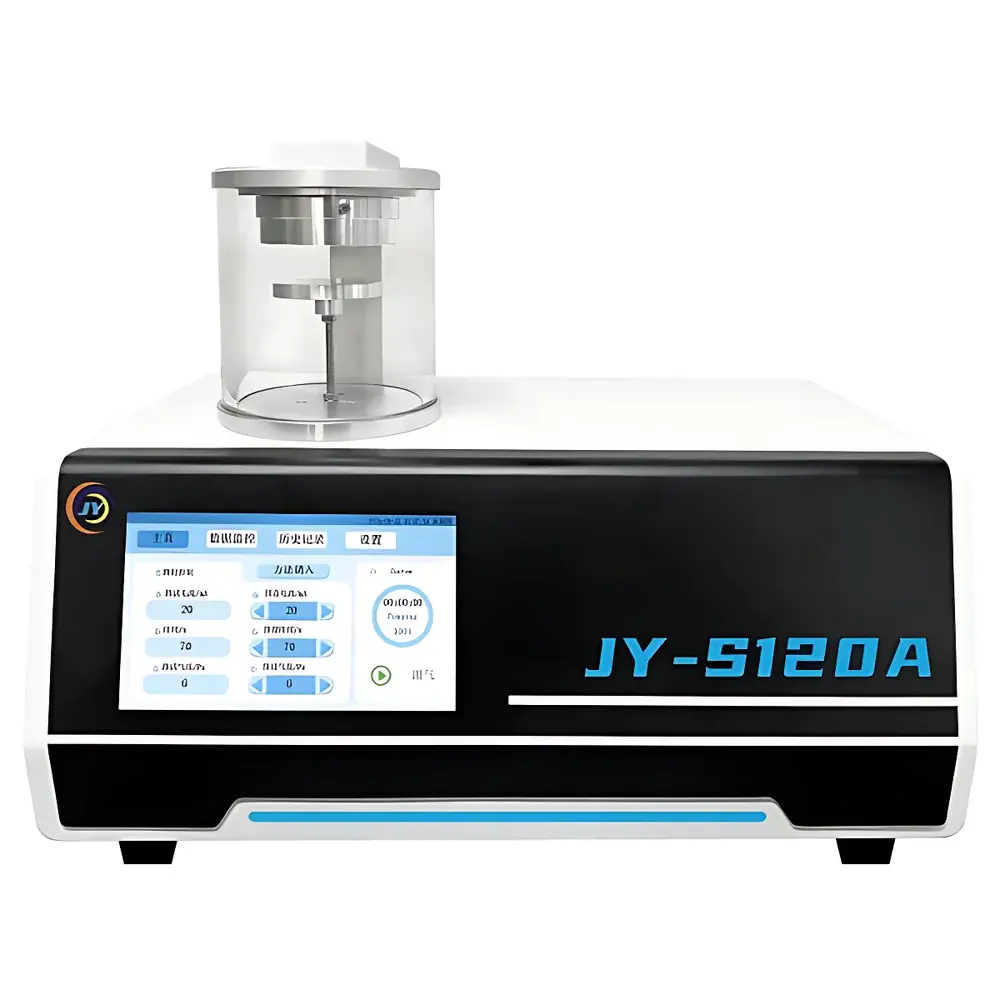
Jingying JY-S120A Automatic Ion Sputter Coater
| Brand | Guangzhou Jingying |
|---|---|
| Origin | Guangdong, China |
| Manufacturer Type | Direct Manufacturer |
| Country of Origin | China |
| Model | JY-S120A |
| Target Materials | Au, Pt, Au/Pd, Pd, Ag, Pt/Pd |
| Target Diameter | 57 mm |
| Control Mode | Fully Automatic |
| Sample Stage Diameter | 63 mm |
| Sputtering Gases | Argon (Ar) and Air |
| Operating Vacuum Range | 3–15 Pa (1 Pa step) |
| Sputtering Current | 3–40 mA (1 mA step) |
| Sputtering Time | 1–999 s (1 s step) |
| Chamber Material | Borosilicate Glass (Ø120 × 120 mm) |
| Pump Speed | 8 m³/h (2.2 L/s) |
| Ultimate Vacuum | 5 × 10⁻² Pa |
| Power Consumption | 80 W (coater), 400 W (pump) |
| Noise Level | 56 dB(A) |
| Display | Touch-enabled IPS LCD with Chinese/English UI |
| Preset Programs | 6 user-configurable protocols |
| Vacuum Gauge Type | Digital Pirani sensor |
| Current Regulation | Digital closed-loop control |
| Data Logging | Real-time I-t & P-t curves |
Overview
The Jingying JY-S120A Automatic Ion Sputter Coater is a benchtop DC magnetron sputtering system engineered for high-fidelity conductive coating of non-conductive specimens prior to scanning electron microscopy (SEM) imaging. It operates on the principle of low-pressure plasma generation in an inert or semi-inert atmosphere—primarily argon—to physically eject atoms from a metallic target via ion bombardment. These sputtered atoms deposit uniformly onto sample surfaces as nanoscale conductive films, minimizing charging artifacts, enhancing secondary electron yield, and preserving fine topographic detail. Designed for routine laboratory use in materials science, geology, biology, and failure analysis labs, the JY-S120A integrates vacuum engineering, digital current regulation, and intuitive human-machine interaction to deliver reproducible 1–10 nm metal coatings with sub-micron thickness control.
Key Features
- Fully Automated Process Sequence: One-touch initiation executes chamber evacuation, gas purging (argon or air), pressure stabilization, current ramp-up, timed sputtering, and controlled venting—eliminating manual intervention and operator-dependent variability.
- Digital Closed-Loop Current Control: Independent of chamber pressure fluctuations, maintaining consistent sputtering rate and film morphology across repeated runs—even at low operating pressures (3–15 Pa).
- Borosilicate Glass Vacuum Chamber: Ø120 × 120 mm transparent chamber enables real-time visual monitoring of target erosion, arcing events, and sample coverage without breaking vacuum.
- Modular Target Compatibility: Accepts standard 57 mm diameter targets—including Au, Pt, Au/Pd (80/20), Pd, Ag, and Pt/Pd—with tool-free mounting and alignment, supporting rapid method switching for different contrast or conductivity requirements.
- Real-Time Parameter Monitoring: Simultaneous graphical display of sputtering current vs. time and chamber pressure vs. time during operation; all parameters logged with timestamped session records.
- Intuitive Touch Interface: 7-inch IPS LCD with bilingual (English/Chinese) menu navigation, haptic feedback, optional audio prompts, and six programmable presets for standardized workflows (e.g., “Au-30s-15mA”, “Pt-60s-25mA”).
Sample Compatibility & Compliance
The JY-S120A accommodates up to twelve 12.7 mm SEM stubs on its Ø63 mm motorized or manually adjustable stage (height range: 25–65 mm), enabling optimal source-to-sample distance control for uniformity. It supports fragile biological tissues, ceramic powders, polymers, and insulating geological sections without thermal damage due to its low-power (<80 W) DC discharge design. While not certified to ISO/IEC 17025 or GLP out-of-the-box, the system’s deterministic process logging (including current, pressure, time, and target usage count), audit-ready session archives, and repeatable parameter recall support compliance with internal SOPs aligned with ASTM E1558 (Standard Guide for Preparation of Specimens for SEM) and ISO 22309:2021 (Scanning electron microscopy — Guidelines for specimen preparation).
Software & Data Management
No external PC software is required—the embedded firmware handles all operational logic, data acquisition, and storage. Session logs are retained internally (non-volatile memory) and include: date/time stamp, selected program ID, final vacuum level, average and peak sputtering current, total deposition time, and cumulative target usage (in seconds and cycles). Logs can be reviewed directly on-screen or exported via USB (optional firmware update path). The system supports FDA 21 CFR Part 11–aligned practices through password-protected parameter editing, immutable run records, and user-level access control (admin/operator modes)—facilitating integration into regulated QA/QC environments where traceability is mandated.
Applications
- Preparation of non-conductive biological specimens (e.g., pollen, diatoms, insect cuticles) for high-resolution SEM imaging with minimal edge artifacts.
- Routine coating of fractured polymer composites and battery electrode cross-sections to suppress charging during EDS mapping.
- Thin-film deposition for X-ray microanalysis standards requiring known stoichiometry and surface homogeneity.
- Quick metallization of forensic evidence (e.g., textile fibers, paint chips) under controlled, documented conditions.
- Teaching laboratories requiring robust, low-maintenance sputter coaters with visual process transparency and safety interlocks (vacuum/pump status, door switch, over-current cutoff).
FAQ
What gases are compatible with the JY-S120A?
Argon is the recommended sputtering gas for optimal film quality and target lifetime. Air may be used for rapid preliminary coating but results in higher oxide content and reduced conductivity—particularly unsuitable for high-magnification or EDS work.
Can the system operate without a dedicated exhaust line?
Yes. The integrated 8 m³/h oil-free rotary vane pump features recirculating filtration and meets ISO 8573-1 Class 4 purity standards; no external venting is required for standard lab use.
Is remote monitoring or network connectivity supported?
Not natively. All operation and diagnostics occur locally via the touchscreen interface. Future firmware updates may introduce USB-host data export or RS-232 serial logging capability.
How is target utilization tracked?
The system increments a cumulative runtime counter each time the target is energized, stored per-target ID. Users may manually reset counters after target replacement to maintain accurate lifetime estimation.
What maintenance intervals are recommended?
Vacuum pump oil should be replaced every 500 operating hours; chamber O-rings inspected quarterly; glass viewport cleaned with isopropanol before each session to prevent residue buildup affecting plasma stability.



