
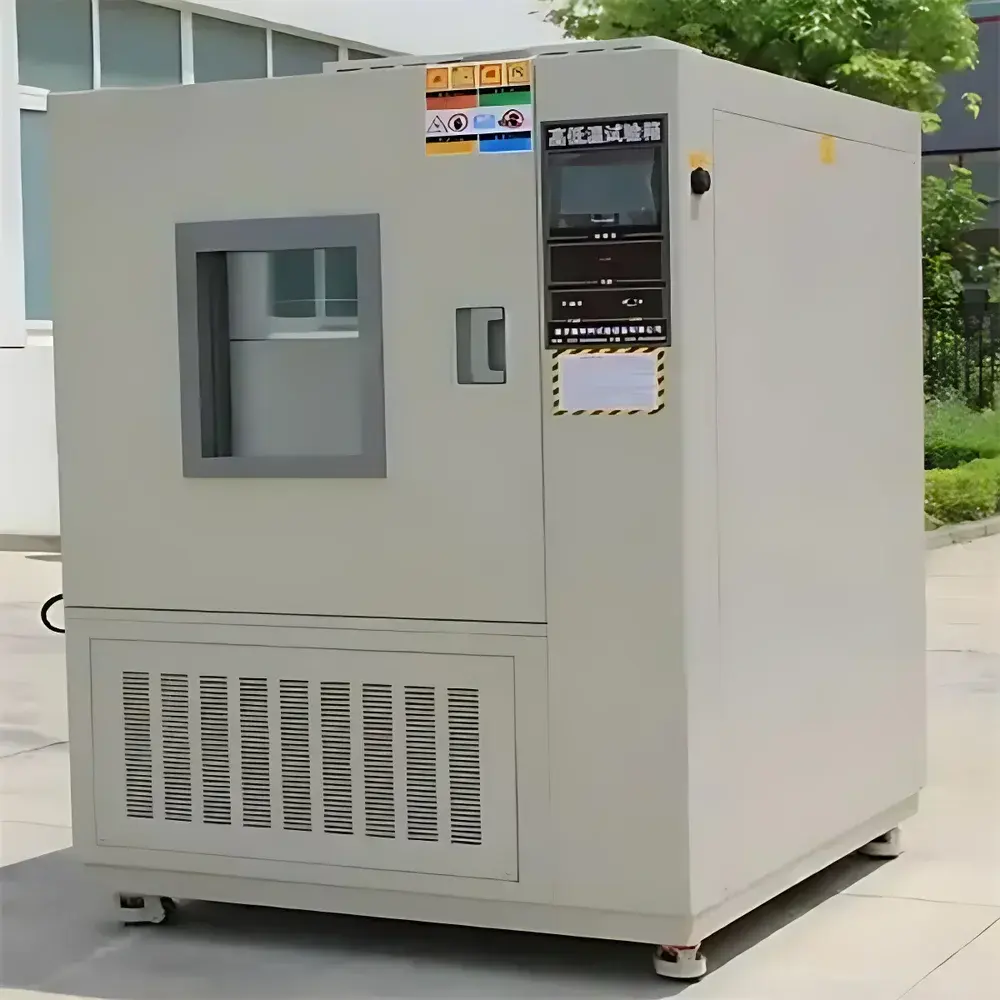
Jinhoo JTSE Series Thermal Shock Test Chamber
| Brand | Jinhoo |
|---|---|
| Origin | Shanghai, China |
| Manufacturer Type | Authorized Distributor |
| Product Category | Domestic |
| Model | JTSE Series |
| Price Range | USD 1,400 – 14,000 (FOB Shanghai) |
| High-Temperature Range | +150 °C |
| Low-Temperature Range | −70 °C |
| Thermal Shock Range | −70 °C to +150 °C |
| Temperature Stability | ±0.5 °C (steady-state) |
| Temperature Uniformity | ±1.5 °C (at 60% load, per IEC 60068-3-5) |
| Heating Rate | ≥10 °C/min (typical, 20 °C to +150 °C) |
| Cooling Rate | ≥12 °C/min (typical, 20 °C to −70 °C) |
| Humidity Control Capability | Optional integrated humidity module (5–95% RH, dew point ≤ −75 °C at −70 °C operation) |
| Compressor System | Dual-stage hermetic scroll compressors (Emerson Copeland ZB series or Danfoss HPU series, OEM-specified) |
| Calibration | Full-range CNAS-accredited calibration available (−70 °C to +150 °C, 10–95% RH), traceable to NIM (National Institute of Metrology, China) |
Overview
The Jinhoo JTSE Series Thermal Shock Test Chamber is an engineered environmental test system designed for rapid, high-fidelity thermal cycling across extreme temperature boundaries. Based on the two-chamber (hot/cold) gas-transfer principle—compliant with IEC 60068-2-14, MIL-STD-810H Method 503.5, and GB/T 2423.22—this chamber subjects specimens to abrupt transitions between independently controlled high- and low-temperature zones via pneumatic lift mechanisms. Unlike single-chamber ramp-based systems, the JTSE architecture eliminates thermal inertia delays, enabling sub-second transfer times (<10 s) and minimizing dwell-induced thermal lag. It is purpose-built for accelerated reliability validation of electronic assemblies (e.g., solder joint integrity per IPC-9701), automotive ECUs, aerospace avionics, and semiconductor packaging where cumulative thermal stress must be quantified under repeatable, auditable conditions.
Key Features
- Independent dual-zone design: Separate hot (+150 °C) and cold (−70 °C) chambers with stainless-steel insulated walls (150 mm polyurethane foam, λ ≤ 0.022 W/m·K) and vacuum-sealed observation windows.
- High-speed transfer mechanism: Pneumatically actuated specimen carrier with position feedback sensors ensures <10 s transfer time and repeatability within ±0.3 s (per ASTM E1545).
- Dynamic temperature control: PID+ fuzzy logic algorithm with real-time 16-channel thermocouple monitoring (Type T, Class 1, ±0.5 °C uncertainty); dynamic fluctuation ≤ ±1.0 °C during transition phases.
- Uniformity assurance: Dual axial-flow centrifugal fans with honeycomb flow straighteners; validated uniformity of ±1.5 °C across working volume (60% load, per IEC 60068-3-5 Annex B).
- Low-temperature humidity management: Optional integrated dual-pressure humidity generation system with desiccant rotor (Mitsubishi Rotor DRY) enabling dew point control down to −75 °C at −70 °C operating point—critical for moisture-sensitive wafer-level testing.
- Core component transparency: Standard-fit Emerson Copeland ZB54KCE-TFD or Danfoss HPU122 compressors; modular mounting allows field replacement in ≤30 minutes without refrigerant recovery.
Sample Compatibility & Compliance
The JTSE accommodates samples up to 500 mm × 500 mm × 500 mm (W×D×H) and supports non-intrusive mounting via ISO-standard test fixtures. Internal chamber surfaces are electropolished SUS304 stainless steel (Ra ≤ 0.4 µm) to minimize outgassing and corrosion—validated per ASTM D4956 for cleanroom-compatible operation. All electrical safety conforms to IEC 61000-6-2/6-4 and GB 4793.1. The system meets full-spectrum regulatory readiness requirements: CNAS-accredited calibration certificates cover the entire operational range (−70 °C to +150 °C, 5–95% RH), including uncertainty budgets per ISO/IEC 17025:2017. Optional 21 CFR Part 11-compliant audit trail and electronic signature modules support GLP/GMP validation in pharmaceutical and medical device labs.
Software & Data Management
Jinhoo’s proprietary WinTest Pro v4.2 software provides real-time multi-channel data acquisition at 1 Hz sampling rate, with synchronized timestamping traceable to GPS-synced NTP servers. Raw datasets export in CSV and HDF5 formats; trend analysis includes slope calculation, dwell deviation metrics, and pass/fail flagging against user-defined limits (e.g., “stabilization time ≤ 20 min at −70 °C”). The system logs all operator actions, parameter changes, and alarm events with immutable SHA-256 hashing—enabling full forensic reconstruction for FDA or ISO 13485 audits. Remote monitoring via TLS 1.3-secured HTTPS interface supports integration into enterprise LIMS and MES platforms through RESTful API endpoints.
Applications
- Electronics reliability: Solder fatigue assessment (JEDEC JESD22-A104), wire bond pull strength degradation, and MEMS package delamination under repeated ΔT > 200 °C cycles.
- Automotive qualification: ECU thermal shock endurance per AEC-Q200 Rev D; battery module cell-level thermal runaway propagation studies.
- Aerospace components: Composite material matrix cracking evaluation in turbine blade housings exposed to −55 °C/+125 °C cycling.
- Photonics & optoelectronics: Laser diode wavelength drift characterization and fiber optic connector ferrule expansion hysteresis analysis.
- Biomedical devices: Sterilization-resistant polymer housing integrity verification after 500+ cycles between −40 °C and +85 °C.
FAQ
Does the JTSE provide real-time dynamic temperature profiles during thermal transitions?
Yes—WinTest Pro records all 16 thermocouple channels at 1 Hz during transfer and stabilization phases. Exportable .csv files include timestamps, zone temperatures, and carrier position status.
Can the system maintain ±1.5 °C uniformity with a 60% volumetric load?
Verified per IEC 60068-3-5 using 16-point thermocouple mapping under representative load (aluminum mass simulating typical PCB assembly density). Report available upon request.
Is full-range CNAS calibration included in standard delivery?
CNAS-accredited calibration (−70 °C to +150 °C, 5–95% RH) is optional but recommended; certificate includes expanded uncertainty (k=2) and traceability to NIM.
What compressor brands are used, and is field replacement supported?
Standard fitment: Emerson Copeland ZB54KCE-TFD or Danfoss HPU122. Modular chassis design enables compressor swap without refrigerant evacuation—tools and torque specs provided in service manual.
How is condensation and frost prevented during sub-zero operation?
The optional dual-pressure humidity system maintains dew point ≥5 °C below chamber setpoint; molecular sieve rotor dehumidification operates continuously at −70 °C, verified by chilled mirror hygrometer (Vaisala HMW90).



