
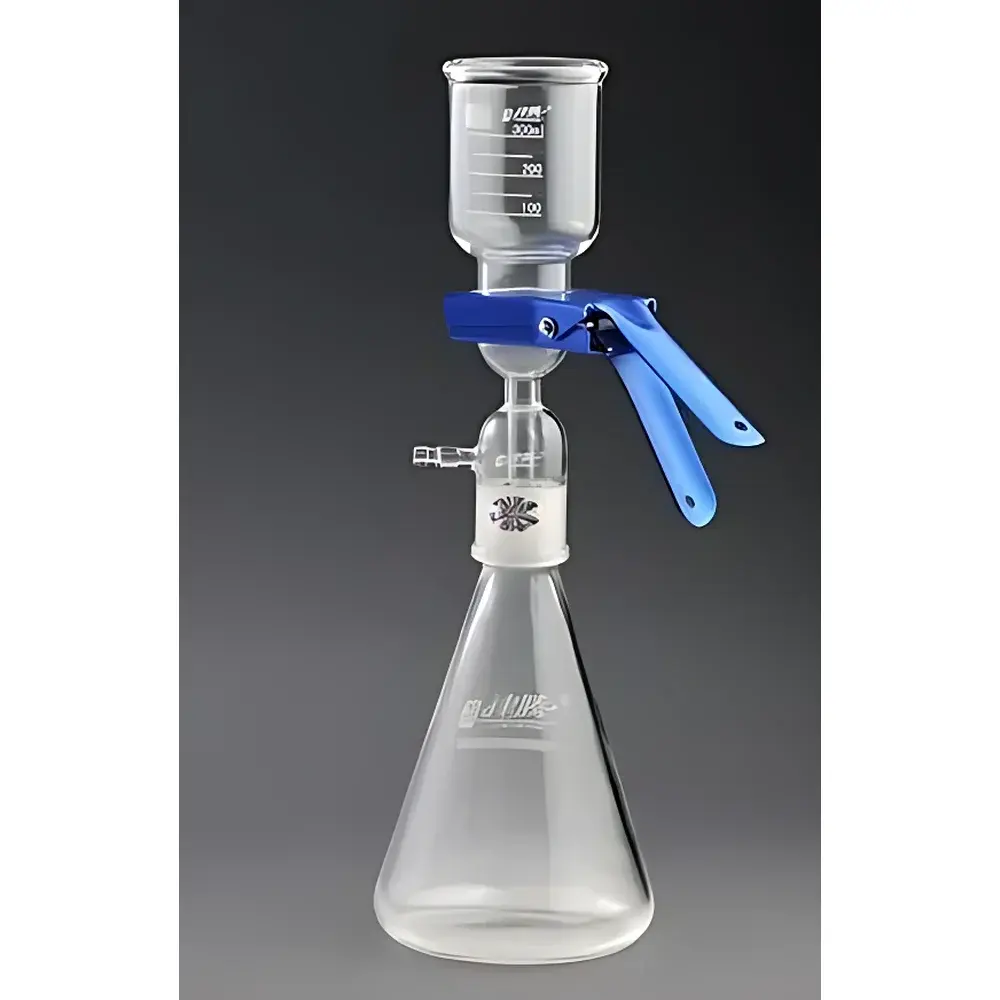
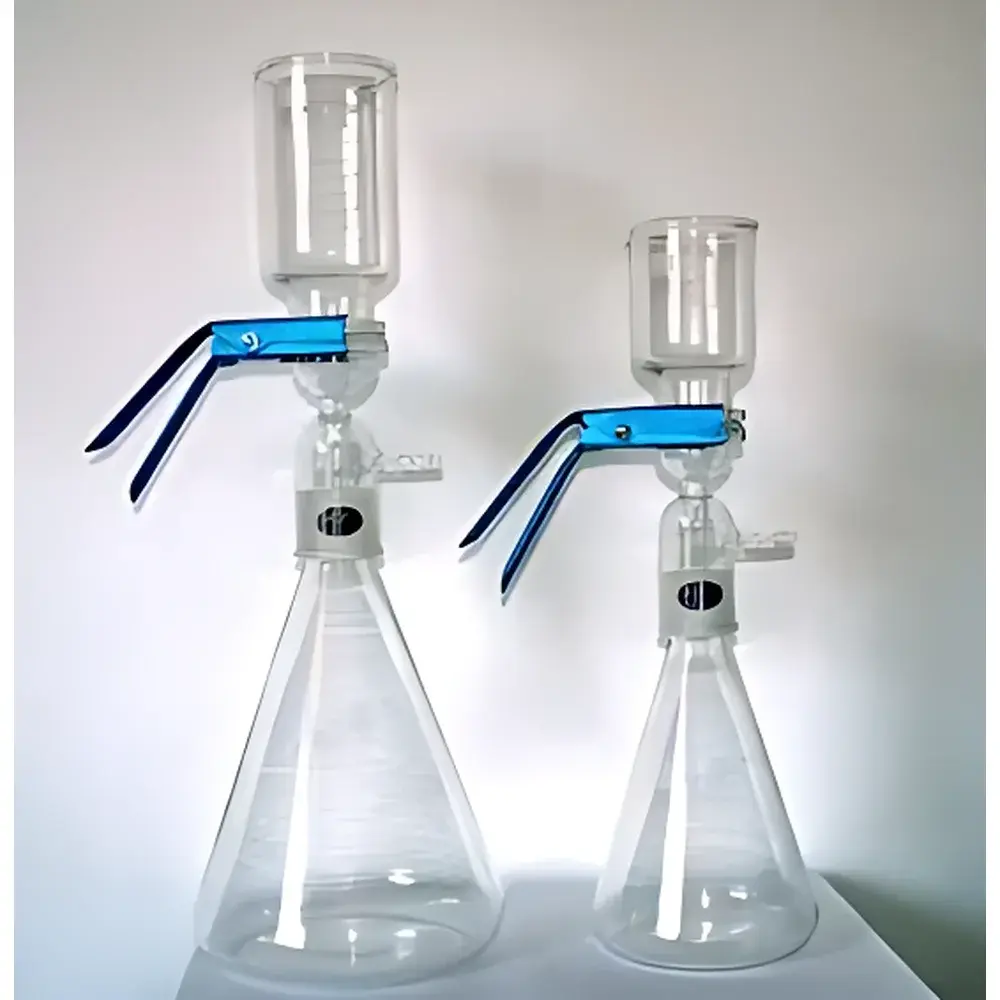
JINTENG T-50 Solvent Filtration System
| Brand | JINTENG |
|---|---|
| Origin | Tianjin, China |
| Manufacturer Type | Authorized Distributor |
| Product Origin | Domestic (China) |
| Model | T-50 (1000 mL Capacity) |
| Filter Cup Volume | 300 mL |
| Filter Head Diameter | 50 mm |
| Filter Head Pore Size | 10 µm |
| Filter Head Material | High-Borosilicate Glass |
| Receiving Bottle Capacity | 1000 mL |
| Compatible Membrane Diameter | 47 mm or 50 mm |
| Seal Interface | Ground-Glass Joint |
| Optional Variant | T-50-PTFE (20 µm PTFE Filter Head, Acid/Base-Compatible) |
| Sterilization | Autoclavable at 121 °C for 20–30 min |
| Clamp Material | Anodized Aluminum Alloy |
Overview
The JINTENG T-50 Solvent Filtration System is a precision-engineered vacuum-driven filtration assembly designed for rigorous analytical and preparative applications in life science laboratories. It operates on the principle of gravity-assisted vacuum filtration—where negative pressure applied to the receiving bottle draws sample solution through a supported microporous membrane housed within a sealed, chemically inert filter head and cup assembly. This configuration ensures consistent flow rates, minimal membrane clogging, and high recovery of analytes—critical for HPLC mobile phase preparation, particulate analysis, microbial enumeration, and trace contaminant isolation. Unlike pressurized systems, the T-50 eliminates risk of membrane rupture under variable inlet pressures and provides visual process monitoring through its transparent borosilicate glass construction. Its modular design supports rapid membrane exchange and accommodates standard 47 mm and 50 mm diameter membranes—including hydrophilic PVDF, hydrophobic PTFE, nylon, cellulose acetate, and mixed ester types—enabling method flexibility across aqueous, organic, and aggressive solvent matrices.
Key Features
- High-borosilicate glass filter cup and head (ISO 3585-compliant), offering exceptional thermal shock resistance (−80 °C to +500 °C intermittent), low extractables, and optical clarity for real-time filtration observation.
- Ground-glass joint interface (ISO 1773 standard taper) between cup, head, and receiving bottle ensures leak-tight sealing without gaskets or lubricants—reducing contamination risk and enabling repeatable assembly.
- Anodized aluminum alloy clamp with calibrated torque retention maintains uniform compression force across the membrane-sieve plate interface, preventing channeling and ensuring full-surface utilization.
- Interchangeable filter heads: Standard 10 µm borosilicate glass head for general-purpose use; optional PTFE head (T-50-PTFE variant) with 20 µm pore geometry for highly corrosive media including concentrated acids (e.g., 6 M HCl), bases (e.g., 1 M NaOH), and halogenated solvents.
- Autoclavable configuration: All glass and metal components withstand steam sterilization at 121 °C for 20–30 minutes per ISO 17665-1, supporting GLP/GMP workflows requiring documented bioburden control.
Sample Compatibility & Compliance
The T-50 system demonstrates broad chemical compatibility across Class I–III solvents per ASTM D471 and USP . It is routinely deployed for filtering HPLC-grade water, acetonitrile, methanol, THF, DMF, and buffer solutions containing up to 0.1% TFA. The PTFE variant extends compatibility to oxidizing agents (e.g., HNO₃/H₂SO₄ mixtures) and strong chelators (e.g., EDTA solutions). All configurations comply with ISO 8549 (laboratory filtration equipment specifications) and meet material safety requirements outlined in EU Regulation EC No. 1935/2004 for food contact–relevant analyses. When used with certified low-protein-binding membranes, the system supports USP particulate matter testing protocols.
Software & Data Management
As a manual vacuum filtration platform, the T-50 requires no embedded firmware or proprietary software. However, its standardized dimensions and reproducible assembly enable seamless integration into validated laboratory workflows governed by 21 CFR Part 11. Users may document filtration parameters—including membrane lot number, batch ID, vacuum pressure (via external gauge), filtration time, and volume processed—in electronic lab notebooks (ELNs) such as LabArchives or Benchling. Traceability is reinforced through physical labeling of receiving bottles and filter assemblies prior to autoclaving, satisfying audit requirements for ISO/IEC 17025-accredited testing laboratories.
Applications
- HPLC and UHPLC mobile phase degassing and particulate removal prior to system priming—reducing column fouling and pump seal wear.
- Pre-filtration of environmental water samples (e.g., EPA Method 1603) for E. coli enumeration using membrane filtration techniques.
- Clarification of cell lysates and protein solutions prior to SEC or IEX chromatography—minimizing column clogging without denaturation.
- Recovery of nanoscale precipitates (e.g., metal-organic frameworks or liposomal suspensions) using track-etched polycarbonate membranes.
- Validation of sterile filtration processes in pharmaceutical QC labs per USP and Ph. Eur. 5.1.1.
FAQ
Can the T-50 be used with aggressive solvents like chloroform or concentrated sulfuric acid?
Yes—the standard borosilicate glass configuration is compatible with most organic solvents; for concentrated mineral acids or oxidizers, the optional PTFE filter head (T-50-PTFE) must be selected.
Is the 10 µm glass frit in the standard head replaceable?
No—the 10 µm sintered glass frit is integral to the filter head and not user-replaceable; however, it is chemically resistant and cleanable via sonication in dilute nitric acid followed by DI water rinse.
What is the maximum recommended vacuum pressure?
Operational vacuum should not exceed −0.9 bar (90 kPa) to prevent membrane collapse or glass fracture; use a vacuum regulator or controller for critical applications.
Does the system include a vacuum hose or vacuum pump?
No—the T-50 is supplied as a filtration assembly only; users must provide a compatible vacuum source (e.g., diaphragm pump with oil-free operation) and appropriate tubing (e.g., silicone or Viton-rated for solvent resistance).
Are replacement membranes and sieve plates available as consumables?
Yes—JINTENG supplies certified 47 mm and 50 mm membranes (PVDF, PTFE, nylon) and stainless steel or PTFE-coated sieve plates as catalog items with full traceability documentation.




