
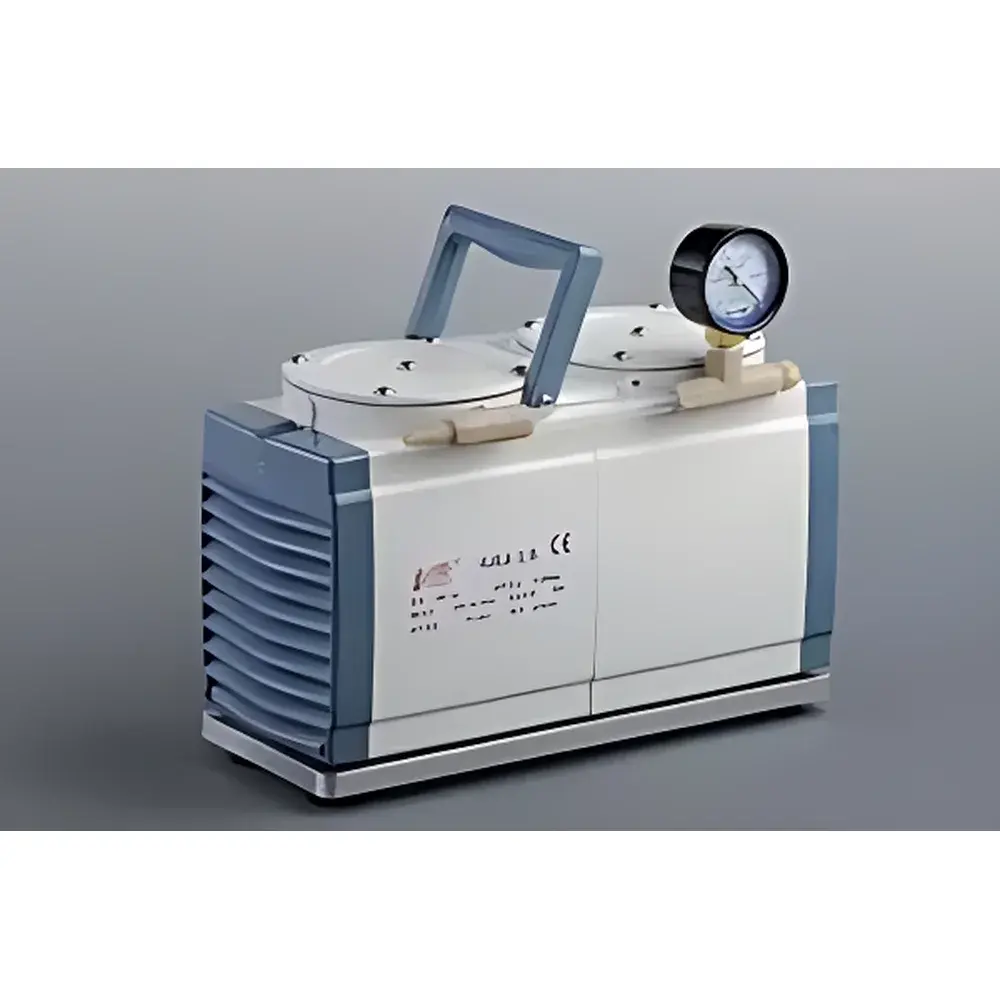
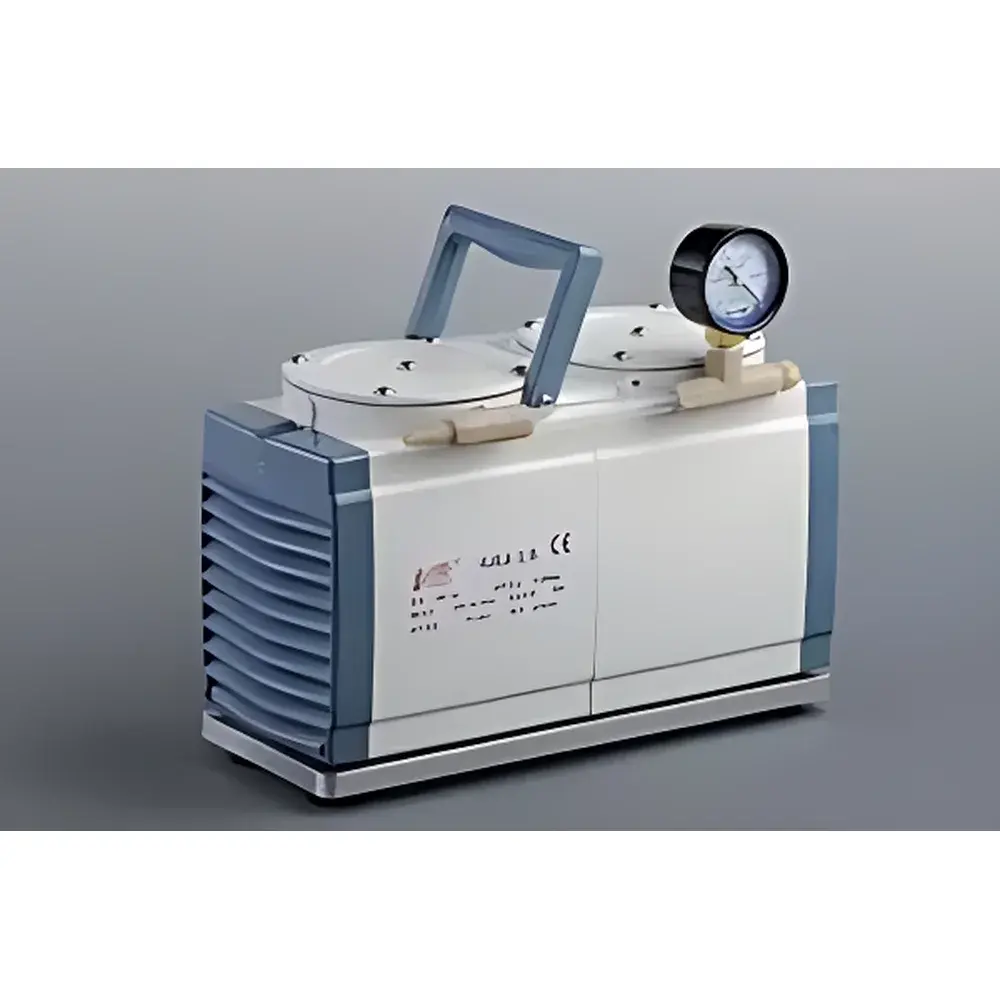
JINTENG GM-1.0A (GM-1.00) Dual-Mode Oil-Free Diaphragm Vacuum Pump
| Brand | JINTENG |
|---|---|
| Origin | Tianjin, China |
| Model | GM-1.0A (GM-1.00) |
| Pump Type | Diaphragm Vacuum Pump |
| Oil-Free Design | Yes |
| Dual-Mode Operation | Vacuum & Positive Pressure |
| Ultimate Vacuum | ≤ −0.075 MPa (≤ 75 kPa absolute) |
| Maximum Flow Rate | 60 L/min |
| Motor Power | 120 W |
| Dimensions (L×W×H) | 282 × 155 × 200 mm |
| Weight | 10 kg |
| Operating Temperature Range | 7–40 °C |
| Noise Level | < 55 dB(A) |
| Inlet/Outlet Port Diameter | Ø6 mm |
| Cooling | Self-contained air-cooling system |
| Continuous Duty Rating | Yes |
Overview
The JINTENG GM-1.0A (GM-1.00) is a dual-mode, oil-free diaphragm vacuum pump engineered for precision laboratory applications requiring both stable vacuum generation and controlled positive-pressure airflow. Unlike rotary vane or piston-based systems, this pump operates on a dry, non-contact diaphragm displacement principle—where an elastomeric diaphragm oscillates via electromagnetic or cam-driven actuation to alternately expand and compress the gas chamber. This mechanism eliminates lubricant contamination, prevents hydrocarbon outgassing, and ensures chemically inert operation—critical for analytical instrumentation such as gas chromatography (GC), mass spectrometry (MS) sample introduction, vacuum filtration, solvent evaporation, and vacuum drying ovens. Its integrated dual-function architecture enables seamless switching between vacuum and pressure modes without hardware modification, reducing instrument footprint and operational complexity in resource-constrained lab environments.
Key Features
- Dual-mode functionality: Simultaneously supports vacuum generation (down to ≤ −0.075 MPa absolute) and positive-pressure output (up to ≥ 30 psi), eliminating the need for separate vacuum and air compression units.
- Oil-free, contaminant-free operation: No internal lubricants or sealing oils—ensuring compliance with ISO 8573-1 Class 0 air purity requirements for sensitive analytical workflows.
- Corrosion-resistant construction: Housing fabricated from die-cast aluminum with electrophoretic coating, offering high resistance to organic solvents, acidic vapors, and ambient humidity.
- Thermally optimized design: Integrated passive airflow cooling channels and low-friction diaphragm kinematics maintain pump head temperature below 60 °C during continuous 24/7 operation.
- Low-noise performance: Acoustic enclosure and vibration-damped mounting reduce operational noise to < 55 dB(A) at 1 m distance—suitable for shared benchtop use in QC labs and academic research facilities.
- Adjustable pressure regulation: Built-in proportional control valve allows fine-tuning of vacuum level or discharge pressure across the full operational range, supporting method-specific parameter reproducibility.
Sample Compatibility & Compliance
The GM-1.0A is compatible with standard laboratory glassware (e.g., Büchner funnels, rotary evaporator manifolds, vacuum desiccators) and modular analytical interfaces (e.g., GC carrier gas supply lines, vacuum manifold adapters). Its chemically inert wetted path—comprising EPDM or Viton®-lined diaphragms and stainless-steel valve plates—resists degradation from common solvents including acetone, methanol, ethyl acetate, and dilute acids/bases. While not certified to IEC 61000-6-2/6-4 for EMC or UL/CSA for safety, the unit conforms to general-purpose laboratory equipment expectations under ISO/IEC 17025:2017 clause 6.4 (equipment suitability) when operated within specified environmental limits (7–40 °C, non-condensing humidity ≤ 80%). It supports GLP-compliant documentation practices through traceable calibration records and maintenance logs.
Software & Data Management
This is a standalone analog-operated pump with no embedded microcontroller, digital display, or communication interface (e.g., RS-232, USB, or Ethernet). All operational parameters—including vacuum setpoint, pressure mode selection, and runtime—are manually adjusted via front-panel mechanical controls. As such, it does not generate electronic audit trails or support FDA 21 CFR Part 11 compliance natively. However, its deterministic mechanical behavior and repeatable performance characteristics make it suitable for integration into validated systems where external process controllers (e.g., PLCs or LabVIEW-based DAQ systems) monitor inlet/outlet pressure via analog 0–10 V or 4–20 mA transducers. Calibration certificates for associated pressure sensors may be maintained per ISO/IEC 17025 requirements.
Applications
- Vacuum-assisted filtration in pharmaceutical quality control (e.g., membrane filtration of sterile injectables per USP <71>).
- Rotary evaporation of thermolabile compounds in synthetic organic chemistry laboratories.
- Sample preparation for HPLC and GC-MS, including solid-phase extraction (SPE) manifold evacuation.
- Controlled atmosphere packaging validation studies in food science research.
- Forensic toxicology workflows requiring clean, oil-free vacuum for volatile compound concentration.
- Cell culture hood auxiliary vacuum supply and aspiration line backup in biosafety Level 2 facilities.
FAQ
Is the GM-1.0A suitable for use with aggressive solvents such as chloroform or THF?
Yes—provided appropriate diaphragm material (e.g., Viton®) is specified and inlet gas stream is pre-scrubbed to remove condensable vapors. Consult JINTENG’s chemical compatibility chart prior to deployment.
Can this pump achieve high vacuum levels required for electron microscopy sample preparation?
No—it is rated for rough vacuum only (≤ −0.075 MPa). For high-vacuum applications (< 10⁻³ mbar), a turbomolecular or diffusion pump cascade is required.
Does the pump include an automatic thermal cutoff switch?
Yes—a bimetallic thermal protector is integrated into the motor winding circuit to prevent overheating under sustained load or restricted airflow conditions.
What maintenance intervals are recommended for extended service life?
Diaphragm replacement every 6,000–8,000 operating hours; inlet filter cleaning every 200 hours in dusty environments; annual inspection of valve seating integrity.
Is the GM-1.0A compliant with CE or RoHS directives?
The unit meets RoHS 2011/65/EU material restrictions. CE marking is not applied, as it falls outside the scope of the EU Machinery Directive (2006/42/EC) for self-contained laboratory pumps without hazardous motion zones.



