
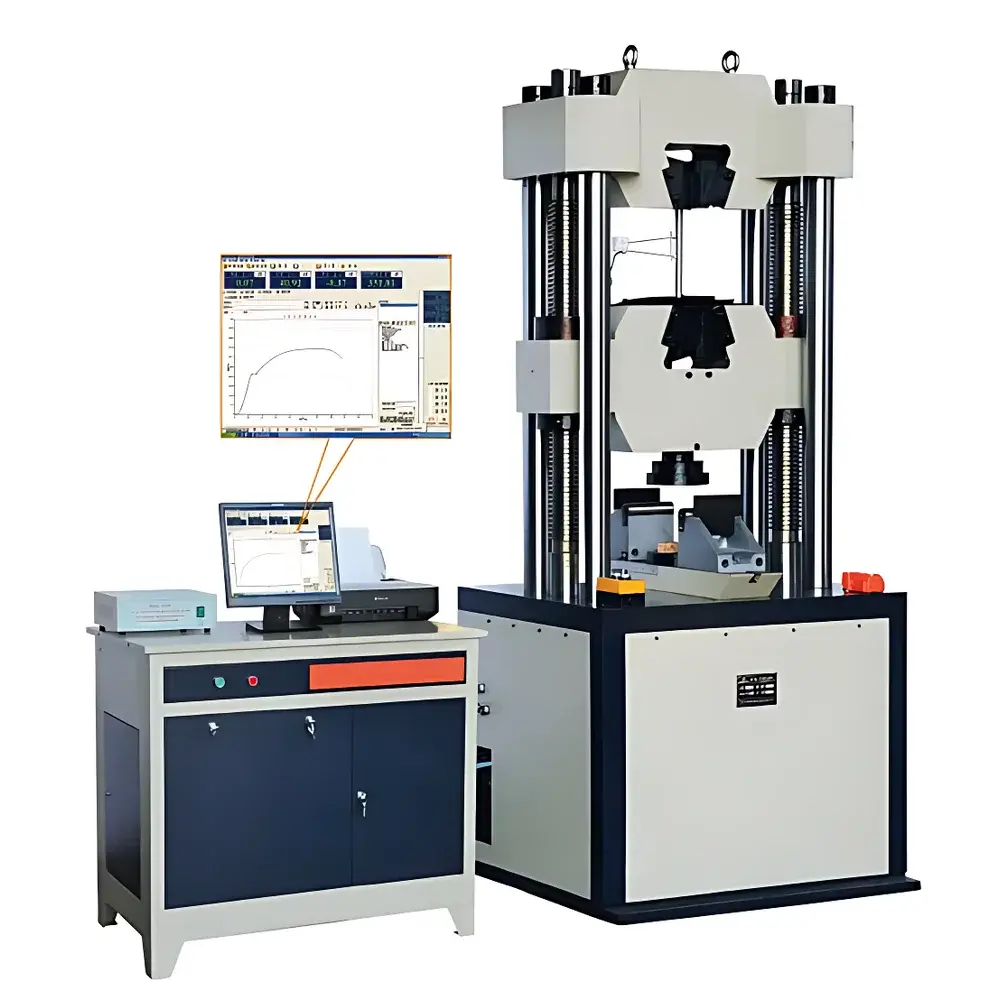
Jiubin Instruments JB/WEW-1000D Microcomputer-Controlled Hydraulic Universal Testing Machine
| Brand | Jiubin Instruments |
|---|---|
| Origin | Shanghai, China |
| Manufacturer Type | Authorized Distributor |
| Country of Origin | China |
| Model | JB/WEW-1000D |
| Instrument Type | Hydraulic Universal Testing Machine |
| Max Test Force | 1000 kN |
| Force Measurement Range | 50–1000 kN |
| Force Accuracy | ≤ ±1% of reading |
| Force Resolution | 0.01 kN |
| Displacement Resolution | 0.01 mm |
| Deformation Measurement Accuracy | 0.01 mm |
| Tensile Test Space | 750 mm |
| Compression Space | 380 mm |
| Piston Stroke | 150 mm |
| Round Specimen Clamping Diameter | Φ13–Φ40 mm |
| Flat Specimen Clamping Thickness | 0–15 mm |
| Flat Specimen Jaw Width | 75 mm |
| Compression Platen Diameter | φ160 mm |
| Bend Span (Max Distance Between Supports) | 450 mm |
| Bend Support Roller Width | 140 mm |
| Bend Support Roller Diameter | Φ40 mm |
| Piston Speed | 50 mm/min |
| Clamping Method | Automatic Hydraulic Clamping |
| Host Dimensions (W×D×H) | 900×710×2200 mm |
| Control Cabinet Dimensions (W×D×H) | 1000×700×1400 mm |
Overview
The Jiubin Instruments JB/WEW-1000D is a microcomputer-controlled, oil-cylinder-underneath hydraulic universal testing machine engineered for high-load static mechanical property evaluation of metallic and non-metallic materials. Operating on the principle of servo-controlled hydraulic actuation with load cell-based force feedback and high-resolution encoder-based displacement tracking, the system delivers repeatable, traceable, and standards-compliant results across tensile, compression, bending, and shear loading modes. Designed for structural integrity verification in industrial QA/QC, academic materials research, and third-party certification laboratories, the JB/WEW-1000D conforms to core mechanical testing methodologies defined in ASTM E4, ASTM E8/E8M, ISO 6892-1, ISO 37, ISO 178, and GB/T 228.1–2021. Its robust architecture integrates a dual-loop closed control system—simultaneously regulating hydraulic pressure and piston position—to ensure stable loading rates and minimal hysteresis during ramp-hold tests.
Key Features
- Full-scale capacity of 1000 kN with extended low-force sensitivity down to 50 kN (5% FS), enabling accurate characterization of both high-strength alloys and lower-strength composites or polymers.
- Automatic hydraulic clamping system with dual-range round specimen jaws (Φ13–Φ26 mm and Φ26–Φ40 mm) and flat specimen grips (0–15 mm thickness, 75 mm width), minimizing operator-induced preload variability.
- High-fidelity measurement subsystem comprising a calibrated load cell (Ningbo Zhenhai), precision extensometer (YYU-25/50, Beijing Iron and Steel Research Institute), and optical encoder for displacement feedback at 0.01 mm resolution.
- Dual-channel data acquisition synchronized at ≥1 kHz sampling rate, supporting real-time force–displacement, stress–strain, and time-series plotting with full digital filtering and zero-drift compensation.
- Modular test sequence programming interface allowing creation, import/export, and versioning of test methods—including multi-step ramp-hold-relax profiles compliant with ASTM E2309 and ISO 1099.
- Role-based access control with administrator and tester accounts, enforcing audit trail generation per GLP/GMP requirements and supporting FDA 21 CFR Part 11–compliant electronic signatures when paired with validated software configuration.
Sample Compatibility & Compliance
The JB/WEW-1000D accommodates standardized specimens per ISO 6892-1 (tensile bars), ISO 178 (flexural bars), ISO 37 (dumbbell-shaped elastomers), and ASTM C39 (concrete cylinders). Its φ160 mm compression platen and 450 mm adjustable bending span with Φ40 mm support rollers meet dimensional tolerances required for ISO 7438 and ASTM D790. All force and displacement measurements are traceable to national metrological standards via factory calibration certificates issued under CNAS (China National Accreditation Service) accreditation. The system supports compliance documentation packages including IQ/OQ protocols, uncertainty budgets (k=2), and periodic verification reports aligned with ISO/IEC 17025:2017 clause 6.5.
Software & Data Management
The proprietary Jiubin TestMaster™ software provides a Windows-based GUI with native Excel export functionality—enabling fully customizable report templates without macro dependencies. Raw data files (.tdf) store all analog and digital channels with timestamped metadata (operator ID, environmental conditions, calibration status). Built-in analysis tools compute Rp0.2, Rm, A5, E, n-value, and plastic strain ratio (r-value) per ISO 10275 and ASTM E646. Audit logs record every parameter change, test execution, and user login event with immutable timestamps. Optional add-ons include automated PDF report generation with embedded digital signatures and networked database integration (ODBC-compatible) for LIMS synchronization.
Applications
This system is routinely deployed in steel mill quality assurance labs for hot-rolled plate tensile validation; in aerospace component suppliers for Ti-6Al-4V fastener shear strength verification; in civil engineering institutes for reinforced concrete cylinder compression testing; and in polymer R&D centers for thermoplastic flexural modulus mapping across temperature gradients. Its 750 mm vertical clearance and 380 mm compression height accommodate large-section structural members, while the 50 mm/min piston speed range supports both quasi-static ASTM D695 and slow-strain-rate SCC testing per ASTM G129.
FAQ
What standards does the JB/WEW-1000D comply with for tensile testing?
It supports ASTM E8/E8M, ISO 6892-1, GB/T 228.1–2021, and EN 10002-1, with method templates preloaded in TestMaster™.
Is the extensometer included in the base configuration?
Yes—the YYU-25/50 axial extensometer (25 mm gauge length, 50 mm travel) is supplied as standard equipment.
Can the system perform cyclic loading or fatigue tests?
No—it is designed exclusively for static monotonic and stepwise loading; fatigue capability requires a dedicated electrodynamic or servo-hydraulic fatigue system.
Does the software support multi-user environments with permission tiers?
Yes—two-tier role management (administrator/tester) with password enforcement, session timeout, and granular permissions over method editing, result deletion, and calibration access.
What maintenance intervals are recommended for hydraulic components?
Oil filtration and system pressure check every 500 operational hours; full hydraulic fluid replacement and seal inspection every 2,000 hours or biannually, whichever occurs first.
Related Products



