
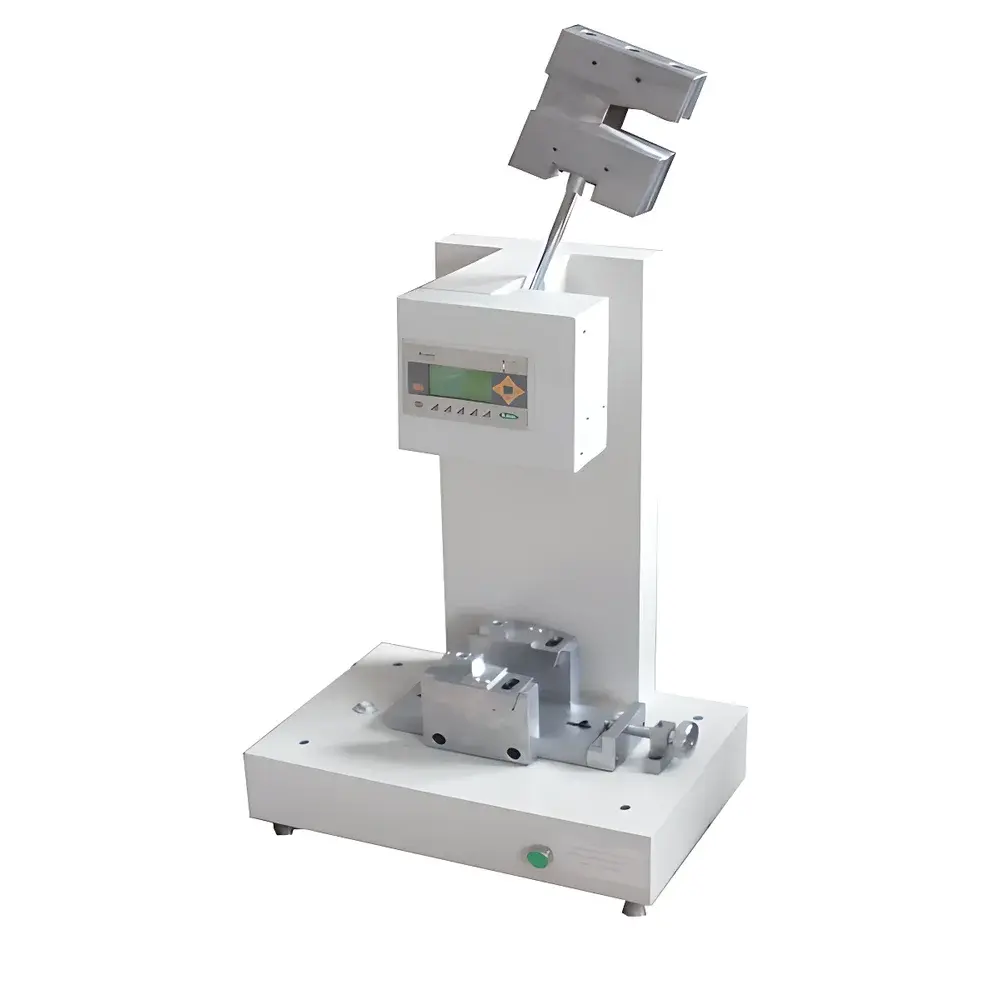
Jiubin Instruments JB/XJJ-5B Digital Charpy Impact Tester
| Brand | Jiubin Instruments |
|---|---|
| Origin | Shanghai, China |
| Model | JB/XJJ-5B |
| Impact Energy | 5 J |
| Impact Velocity | 2.9 m/s |
| Pendulum Radius (Impact Constant) | R = 2 ± 0.5 mm |
| Maximum Lifting Height | 62 mm |
| Support Span Options | 40, 60, 62, 70, 95 mm |
| Pendulum Angle | 160° |
| Hammer Blade Radius | R = 2 ± 0.5 mm |
| Anvil Radius | R = 1 ± 0.1 mm |
| Blade Included Angle | 30 ± 1° |
| Energy Loss (Empty Swing) | ≤0.5% for 4–5 J, ≤1% for 2 J, ≤2% for 0.5–1 J |
Overview
The Jiubin Instruments JB/XJJ-5B Digital Charpy Impact Tester is a precision-engineered pendulum-type impact testing system designed to determine the notched and unnotched impact resistance of rigid plastics, fiber-reinforced composites (e.g., glass-reinforced polyester), thermosetting resins, and engineering polymers under standardized Charpy (simply supported beam) conditions. Based on the principle of gravitational potential energy conversion—where a calibrated pendulum is raised to a defined height and released to fracture a standardized specimen—the instrument delivers repeatable, traceable impact energy values in accordance with ISO 179-1, GB/T 1043.1, GB/T 2612, JB/T 8762, and GB 4742. Its modular design enables rapid configuration for multiple support spans and impact energies (0.5 J to 5 J), making it suitable for routine quality control labs, R&D centers, and third-party testing facilities operating under GLP or ISO/IEC 17025 frameworks.
Key Features
- Microprocessor-controlled digital display with real-time energy readout (resolution: 0.01 J), eliminating parallax error associated with analog dials.
- Interchangeable pendulum hammers pre-calibrated for 0.5 J, 1 J, 2 J, 4 J, and 5 J nominal impact energies—each certified to meet ISO 179 Annex B repeatability requirements (±0.5% energy loss during empty swing for 4–5 J range).
- Adjustable anvil span system supporting standard distances of 40 mm, 60 mm, 62 mm, 70 mm, and 95 mm; fine-tuned positioning ensures compliance with specimen geometry tolerances per ISO 179-2.
- Hardened steel impact blade with precisely ground 30 ± 1° included angle and R = 2 ± 0.5 mm tip radius—certified to ASTM D6110 and ISO 179 dimensional specifications.
- Robust cast-iron base with vibration-damping feet and rigid column assembly, minimizing energy dissipation outside the specimen and ensuring high test-to-test reproducibility (CV < 1.2% across 10 replicate tests on ABS reference specimens).
- Manual release mechanism with mechanical safety latch and angular position indicator (160° fixed lift angle), enabling consistent potential energy input independent of operator technique.
Sample Compatibility & Compliance
The JB/XJJ-5B accommodates rectangular bars per ISO 179 Type 1 (80 × 10 × 4 mm) and Type 2 (80 × 10 × 5 mm), as well as custom geometries within width (10 ± 0.2 mm) and thickness (3–10 mm) limits. Specimens may be notched using standardized milling fixtures (not included) meeting ISO 179-2 notch geometry (A, B, or C type). The system supports both unnotched and notched Charpy impact evaluation, delivering results directly comparable to international material datasheets and regulatory submissions. All mechanical components—including pendulum shaft, bearing housing, and anvil surfaces—are manufactured to ISO 2768-mK general tolerances. Calibration certificates (traceable to NIM, China) are provided with each unit, and periodic verification aligns with ISO/IEC 17025 clause 6.6 requirements for measurement equipment.
Software & Data Management
While the JB/XJJ-5B operates as a standalone instrument with embedded digital display, optional RS-232 or USB interface modules enable direct data export to laboratory information management systems (LIMS) or statistical process control (SPC) platforms. Exported datasets include test ID, date/time stamp, energy value (J), specimen dimensions, span setting, and operator ID—structured to support audit-ready documentation per FDA 21 CFR Part 11 (when paired with validated software). Internal memory retains up to 100 test records with timestamping. For full compliance with GMP/GLP environments, users may integrate the tester with third-party calibration management software that logs maintenance history, calibration due dates, and uncertainty budgets per ISO/IEC 17025:2017 Annex A.3.
Applications
- Quality assurance of injection-molded polypropylene (PP), acrylonitrile-butadiene-styrene (ABS), polycarbonate (PC), and polyamide (PA6/PA66) components in automotive and consumer electronics supply chains.
- Evaluation of impact modification efficacy in toughened polymer blends (e.g., EPDM-modified PP) per ASTM D6110 protocols.
- Batch release testing of glass-fiber-reinforced thermosets used in electrical enclosures and structural housings.
- Material screening during formulation development for biodegradable polymers (e.g., PLA, PHA) where low-energy fracture behavior dictates end-use performance.
- Academic research on temperature-dependent ductile-to-brittle transitions in amorphous polymers using environmental chambers (compatible with external temperature-controlled specimen holders).
FAQ
What standards does the JB/XJJ-5B comply with?
It conforms to ISO 179-1 (Charpy impact testing of plastics), GB/T 1043.1 (Chinese national standard equivalent), ASTM D6110 (for plastics), and JB/T 8762 (Chinese mechanical industry standard for impact testers).
Can the tester accommodate non-standard specimen spans?
Yes—the anvil support distance is manually adjustable across five discrete positions (40, 60, 62, 70, 95 mm) and can be further customized via machined spacers to meet proprietary or research-specific configurations.
Is calibration traceability provided?
Each unit ships with a factory calibration certificate traceable to the National Institute of Metrology (NIM), China, including pendulum moment of inertia, impact velocity verification, and energy linearity assessment across the full 0.5–5 J range.
What maintenance is required for long-term accuracy?
Biannual verification of pendulum bearing friction, blade edge wear (using optical profilometry), and anvil alignment is recommended. Lubrication of pivot points with ISO VG 32 mineral oil every 6 months ensures minimal energy loss drift.
Does the system support GLP-compliant electronic records?
When equipped with the optional data interface and validated third-party software, it supports electronic signatures, audit trails, and secure data archiving aligned with FDA 21 CFR Part 11 and EU Annex 11 requirements.



