
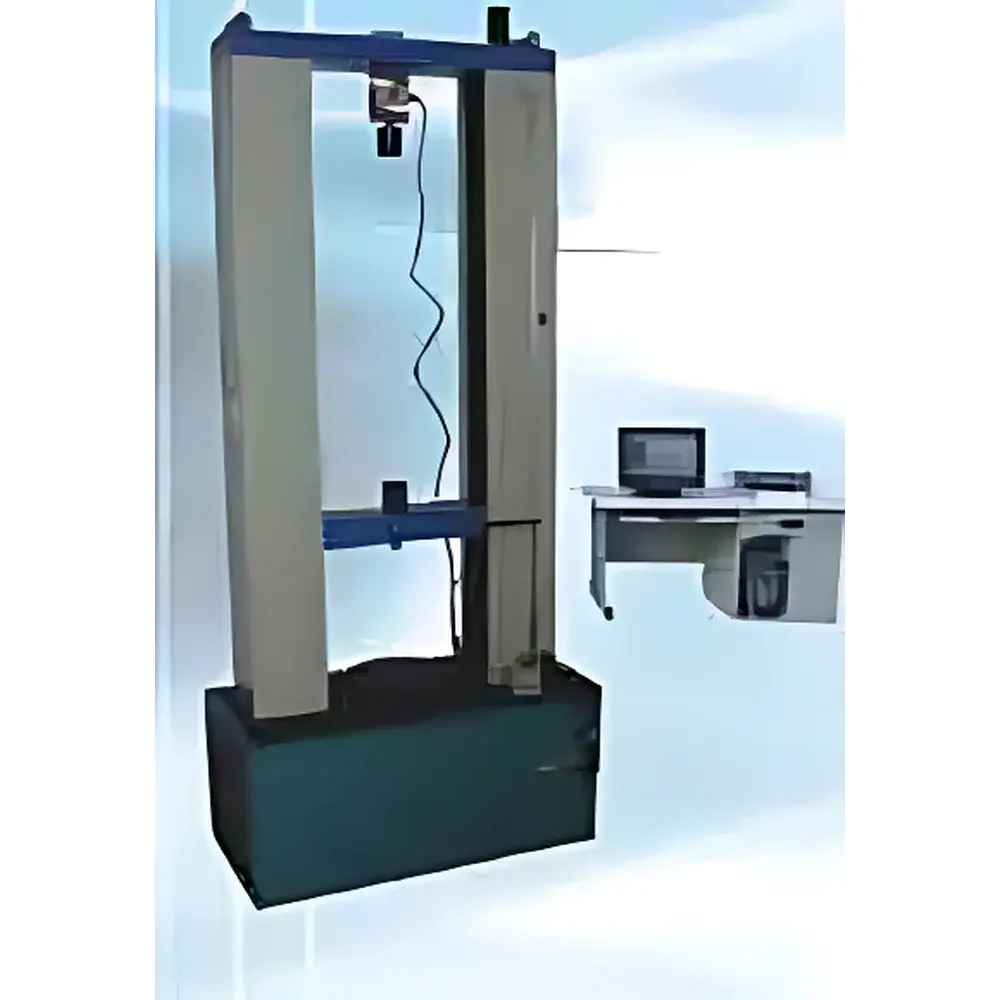
Jiubin JB-124A/B Dual-Column Computer-Controlled Universal Testing Machine
| Brand | Jiubin (JByq) |
|---|---|
| Origin | Taiwan |
| Model | JB-124A / JB-124B |
| Load Capacity | 0–5 kN (user-selectable) |
| Load Cell | High-precision U.S.-made load cell |
| Load Accuracy | ≤ ±0.5% of full scale |
| Effective Test Width | 380 mm |
| Max. Tensile Travel | 1000 mm |
| Drive System | Servo motor (Japan-made) + AC motor (Taiwan-made) |
| Mechanical Transmission | High-precision ball screw (Taiwan-made) + high-strength backlash-free screw (Korea-made) |
| Test Speed Range | 0.001–500 mm/min (infinitely variable, two selectable ranges: 0.001–500 and 5–500 mm/min) |
| Displacement Resolution | 1/200,000 |
| Displacement Accuracy | ±0.005% of reading |
| Safety Features | Upper/lower mechanical limits, emergency stop button |
| Display Interface | Dual-mode — PC-based software + embedded microcomputer display |
| Unit Options | g, kg, N, kN, lb, lbf |
| Power Supply | 220 V / 380 V, 50 Hz |
| Net Weight | 1080–1180 kg |
| Dimensions (W×D×H) | 1280 × 950 × 1800 mm |
| Standard Configuration | One pair of user-specified fixtures |
| Optional Accessories | PC workstation, desktop thermal printer, extensometer (two-point), proprietary test software |
Overview
The Jiubin JB-124A/B Dual-Column Computer-Controlled Universal Testing Machine is an electromechanical materials testing system engineered for precision mechanical property evaluation across R&D laboratories, QC departments, and production environments. It operates on the fundamental principle of controlled force application via servo-driven linear motion, coupled with real-time load and displacement measurement using traceable high-fidelity transduction. The system conforms to core mechanical testing paradigms defined in ASTM E4, ASTM E8/E8M (tension), ASTM D695 (compression), ASTM D790 (flexure), and ISO 6892-1 for metallic materials—enabling standardized execution of tensile, compressive, three-point bend, shear, peel, and tear tests. Its dual-column, floor-standing architecture provides structural rigidity essential for minimizing frame deflection during high-load testing up to 5 kN, ensuring measurement integrity under dynamic and static loading conditions.
Key Features
- Modular dual-drive architecture integrating a Japan-sourced servo motor for high-resolution low-speed control (0.001 mm/min) and a Taiwan-sourced AC motor for robust high-speed operation (up to 500 mm/min), supporting both fine material characterization and rapid production-line verification.
- U.S.-manufactured high-accuracy load cell calibrated to ≤ ±0.5% full-scale error, compliant with ISO 376 Class 0.5 requirements for force measurement uncertainty.
- Taiwan- and Korea-sourced precision transmission components—including preloaded ball screws and backlash-free lead screws—ensure long-term repeatability and minimal hysteresis across >100,000 test cycles.
- Dual-display interface: Embedded microcomputer panel for standalone operation and real-time parameter monitoring; synchronized PC-based software for advanced data acquisition, curve overlay analysis, and report generation.
- Comprehensive safety system featuring dual mechanical end-limit switches, redundant emergency stop circuitry, and automatic load cutoff upon exceeding user-defined thresholds—meeting CE machinery directive (2006/42/EC) and OSHA 1910.212 compliance expectations.
- Resolution of 1 part in 200,000 for displacement measurement, enabling sub-micron-level strain resolution when paired with optional extensometers—critical for modulus determination in elastomers and thin films.
Sample Compatibility & Compliance
The JB-124A/B accommodates specimens ranging from fine-diameter wires (<0.1 mm) to rigid metal bars (up to 380 mm wide × 1000 mm gauge length). Fixture adaptability supports standardized geometries per ASTM E8, ISO 6892-1, ISO 178 (flexure), and ISO 1133 (melt flow index correlation). Optional accessories—including pneumatic wedge grips, compression platens, and peel test fixtures—extend applicability to polymers, composites, textiles, adhesives, and biomedical tubing. All firmware and software modules are designed to support audit-ready documentation, including timestamped test logs, operator ID tagging, and electronic signature capability—facilitating alignment with GLP, GMP, and FDA 21 CFR Part 11 requirements where configured with validated software packages.
Software & Data Management
The proprietary Windows-based test software provides ISO/IEC 17025-aligned data handling: automatic calibration certificate import, configurable test method templates (pre-loaded with ASTM/ISO protocols), real-time stress–strain curve plotting, and multi-curve statistical comparison (mean, SD, CV%). Raw data exports in CSV, Excel, and XML formats ensure compatibility with LIMS and enterprise QA databases. Built-in report editors allow customization of headers, footers, pass/fail criteria, and graphical annotations—supporting internal SOPs and third-party certification submissions. Audit trails record all parameter changes, test starts/stops, and user logins, preserving data integrity throughout the product lifecycle.
Applications
This system is routinely deployed for mechanical validation in electronics (connector pull strength, solder joint shear), automotive (gasket compression set, hose burst resistance), medical devices (catheter tensile yield, suture breaking strength), packaging (peel adhesion of laminates, seal strength), and polymer manufacturing (tensile modulus of PP/PE films, flexural stiffness of ABS housings). Its versatility makes it suitable for incoming raw material inspection, in-process quality gate checks, and final product release testing—particularly where reproducibility, traceability, and regulatory documentation are mandatory.
FAQ
What standards does the JB-124A/B comply with for force calibration?
It meets ISO 376 Class 0.5 accuracy requirements, with factory calibration traceable to NIST-equivalent national metrology institutes.
Can the system be integrated into a networked QA environment?
Yes—via Ethernet or USB, with support for shared database logging, centralized user management, and automated report distribution to designated network folders.
Is extensometer compatibility available as a factory option?
Two-point clip-on and non-contact video extensometers are supported; installation and calibration services are provided under extended warranty packages.
Does the software support multi-language UI and report generation?
English and Chinese interfaces are standard; additional language packs (German, Japanese, Korean) are available upon request for global deployment.
What maintenance intervals are recommended for long-term accuracy retention?
Annual recalibration of load cell and displacement encoder is advised; preventive maintenance (lubrication, belt tension check, screw preload verification) every 6 months ensures optimal performance under continuous operation.



