
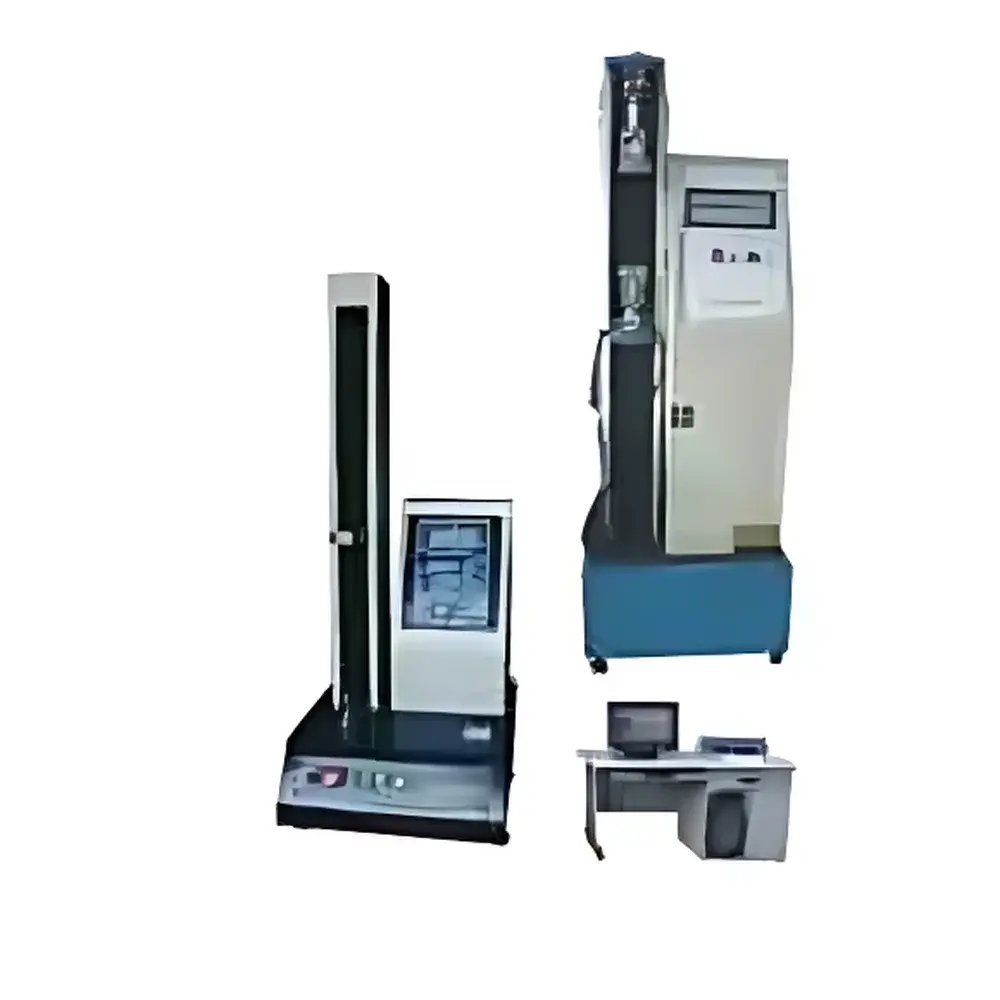
Jiubin JB-126 Universal Testing Machine (Tensile, Compression, and 3-Point Bending Tester)
| Brand | Jiubin (JByq) |
|---|---|
| Origin | Taiwan |
| Model | JB-126 |
| Load Capacity | 0–200 kg (user-selectable) |
| Load Cell Accuracy | ±0.5% |
| Effective Test Width | 380 mm |
| Max. Extension Travel | 1000 mm |
| Test Speed Range | 0.001–500 mm/min (infinitely variable) |
| Displacement Accuracy | ±0.005% |
| Resolution | 1/200,000 |
| Control System | Japanese servo motor |
| Mechanical Drive | Taiwanese high-precision ball screw |
| Safety Features | Upper/lower mechanical limits, emergency stop switch |
| Display | Dual-mode (PC + microcomputer LCD) |
| Power Supply | 220 V, 50 Hz |
| Net Weight | 160 kg |
| Dimensions (W×D×H) | 450 × 450 × 900 mm |
| Unit Options | g, kg, N, kN, lb, lbf |
Overview
The Jiubin JB-126 Universal Testing Machine is an electromechanically integrated materials testing system engineered for precision mechanical property evaluation under tension, compression, shear, and three-point bending configurations. Based on the fundamental principles of force transduction via calibrated load cells and displacement measurement through high-resolution encoder feedback on a ball-screw-driven crosshead, the JB-126 delivers repeatable, traceable mechanical data compliant with standard test methodologies including ASTM E8/E9 (tensile/compression of metallic materials), ISO 6892-1, ISO 178 (flexural properties), and ASTM D790 (flexural strength of plastics). Designed as a floor-standing, modular platform, it supports standardized specimen geometries across metals, polymers, elastomers, composites, textiles, leather, wires, terminals, and insulating components—enabling laboratories to perform routine QC verification, R&D material characterization, and process validation within a single instrument architecture.
Key Features
- High-fidelity load measurement using U.S.-sourced precision load cells with ±0.5% full-scale accuracy and 1/200,000 internal resolution.
- Infinitely variable speed control (0.001–500 mm/min) powered by a Japan-sourced servo motor, ensuring stable velocity profiles across low-strain-rate creep tests and high-speed rupture evaluations.
- Taiwan-manufactured ground ball screw transmission system guarantees minimal backlash, long-term dimensional stability, and consistent axial alignment during cyclic or monotonic loading.
- Dual-display interface: embedded microcomputer LCD for real-time force/displacement monitoring and PC-based software for advanced curve analysis, report generation, and parameter scripting.
- Comprehensive mechanical safety architecture, including dual-position mechanical end stops, redundant emergency stop circuitry, and programmable software-defined travel limits.
- Modular fixture compatibility—standardized mounting interfaces accommodate user-supplied or OEM-designed grips, bend fixtures, compression platens, and shear adapters per ISO 20806, ASTM D638, or customer-specific geometries.
Sample Compatibility & Compliance
The JB-126 accommodates specimens ranging from thin polymer films (≥0.1 mm thickness) to structural metal bars (up to 380 mm wide and 1000 mm gauge length). Its 200 kg capacity covers common tensile yield strengths for aluminum alloys (e.g., 6061-T6: ~240 MPa at 10 mm² cross-section), thermoplastic elastomers (1–50 MPa), and textile yarns (0.5–50 N). All hardware and firmware comply with CE electromagnetic compatibility (EMC) directives and meet electrical safety standards IEC 61000-6-2/-4. The system supports audit-ready operation under GLP and GMP environments when paired with optional 21 CFR Part 11-compliant software modules, including electronic signatures, change logs, and secure data archiving.
Software & Data Management
The included Windows-based testing software provides real-time plotting of stress–strain, load–displacement, and flexural moment–deflection curves. Users may define multi-step test protocols—including preload hold, ramp-to-load, constant-rate extension, and relaxation segments—with automatic detection of yield point, ultimate tensile strength, modulus (secant/tangent), elongation at break, and flexural modulus per ISO 527 or ASTM D790. Raw ASCII data export (.csv, .txt), PDF report templating, batch statistical summaries (mean, SD, CV%), and overlay comparison of up to 16 curves are supported. Optional add-ons include automated report signing, database integration (ODBC), and networked instrument management for multi-station labs.
Applications
- Mechanical validation of injection-molded plastic housings (ASTM D638/D790)
- Tensile strength and elongation testing of textile fibers and woven fabrics (ISO 13934-1)
- Compression resistance of rubber gaskets and foam insulation (ISO 3386-1)
- Three-point flexural performance of PCB substrates and ceramic tiles (ISO 14125)
- Peel and shear adhesion assessment of pressure-sensitive tapes and laminates (ASTM D3330/D1002)
- Terminal crimp integrity and wire bond pull testing in electronics manufacturing
- Quality conformance checks for footwear outsoles, leather straps, and synthetic leathers per ISO 20344/EN 13287
FAQ
What standards does the JB-126 support out-of-the-box?
It natively implements test routines aligned with ASTM E8, E9, D638, D790, D1002; ISO 6892-1, 178, 527, 14125, and 20806. Custom method templates can be created for proprietary or industry-specific protocols.
Can the system be integrated into a LIMS or MES environment?
Yes—via TCP/IP or RS-232 serial communication, the JB-126 supports bidirectional data exchange with laboratory information management systems using ASTM E1384 or HL7-compatible structured output formats.
Is calibration certification provided with shipment?
Each unit ships with a factory calibration certificate traceable to NIST-equivalent national metrology institutes in Taiwan, covering load cell and displacement encoder verification at three points across the 0–200 kg range.
What maintenance intervals are recommended?
Ball screw lubrication every 6 months; annual recalibration of load cell and encoder; periodic verification of emergency stop functionality and mechanical limit switches per ISO/IEC 17025 preventive maintenance guidelines.



