
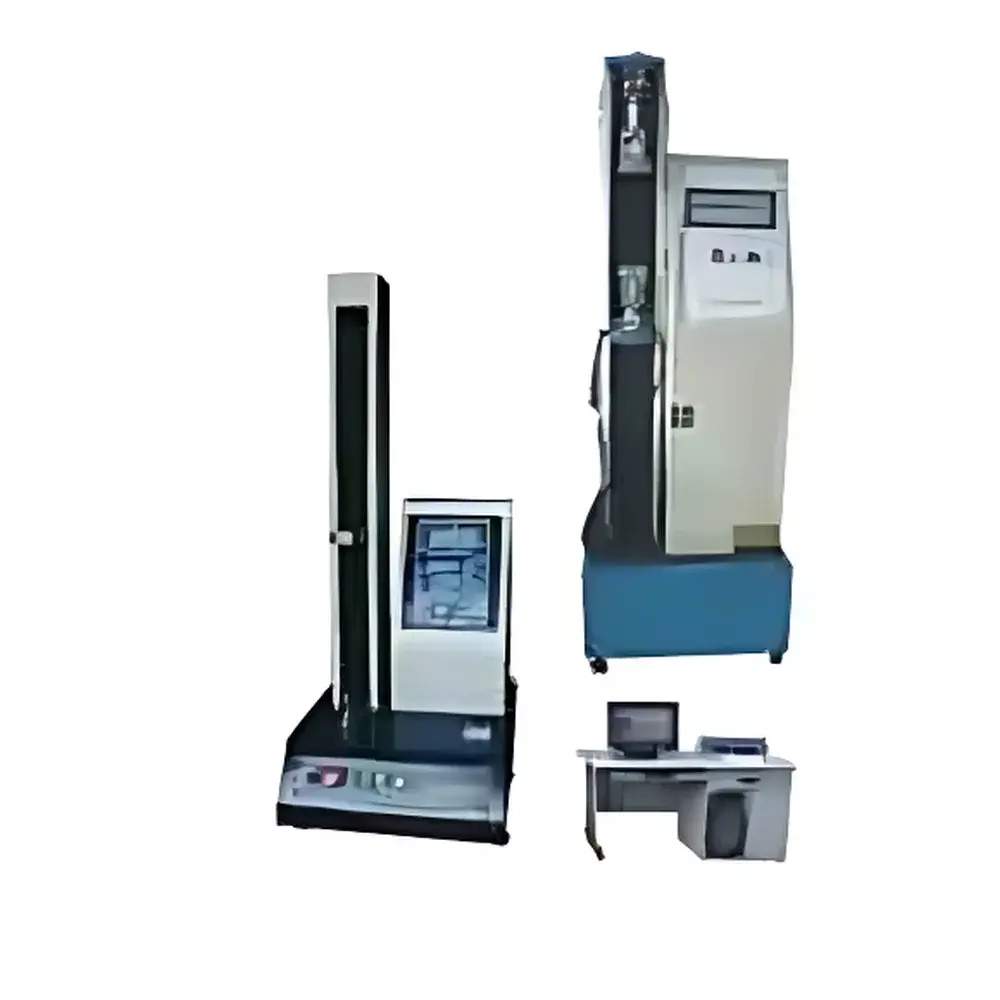
Jiubin JB-126A Universal Testing Machine
| Brand | Jiubin (JByq) |
|---|---|
| Origin | Taiwan |
| Model | JB-126A |
| Load Capacity | 0–200 kg (user-selectable) |
| Force Accuracy | ±0.5% of full scale |
| Effective Test Width | 380 mm |
| Max. Stroke/Extension Range | 1000 mm |
| Test Speed Range | 0.001–500 mm/min (infinitely variable, closed-loop servo control) |
| Displacement Resolution | 0.005% of full scale |
| Force Resolution | 1/200,000 full scale |
| Drive System | Japanese servo motor + Taiwanese high-precision recirculating ball screw |
| Load Cell | U.S.-manufactured high-accuracy strain-gauge transducer |
| Safety Features | Upper/lower mechanical limits, emergency stop button |
| Display Interface | Dual-mode — embedded microcomputer + PC-based software interface |
| Power Supply | 220 V, 50 Hz |
| Net Weight | 160 kg |
| Dimensions (W×D×H) | 450 × 450 × 900 mm |
| Compliance | Designed for ASTM E4, ISO 7500-1, GB/T 228.1, and JIS Z 2241 alignment |
| Software Options | Optional GLP-compliant test reporting module with audit trail, data export (CSV, PDF, XML), and multi-curve overlay analysis |
Overview
The Jiubin JB-126A Universal Testing Machine is an electromechanically integrated materials testing system engineered for precision mechanical property evaluation across R&D laboratories, quality control departments, and production environments. It operates on the principle of controlled uniaxial force application—measuring tensile, compressive, flexural (3-point bending), shear, peel, tear, and puncture responses under programmable displacement or load control. Its architecture conforms to fundamental metrological standards for static mechanical testing, including ISO 7500-1 (class 0.5 accuracy for force measurement) and ASTM E4 (verification of force-measuring systems). The machine employs a closed-loop servo-controlled drive system, enabling repeatable, low-drift testing across its full speed range—from quasi-static creep assessments at 0.001 mm/min to dynamic structural response screening at 500 mm/min.
Key Features
- High-fidelity force measurement using a U.S.-sourced strain-gauge load cell, certified to ±0.5% full-scale accuracy per ISO 7500-1.
- Precision motion control via a Japanese servo motor coupled with a Taiwanese recirculating ball screw assembly, ensuring minimal backlash and thermal drift over extended operation.
- Dual-display architecture: real-time local monitoring via embedded microcomputer interface, plus comprehensive test orchestration and post-processing through Windows-based software.
- Modular safety system including dual mechanical end-limit switches, redundant emergency stop circuitry, and programmable software-defined travel boundaries.
- Configurable resolution: 1 part in 200,000 for force detection and 0.005% linearity for displacement feedback—enabling reliable characterization of both stiff metallic alloys and compliant elastomers.
- Standardized mounting interface supports interchangeable fixtures (tensile grips, compression platens, bend supports, shear adapters) tailored to ASTM D638, ISO 527, ASTM D790, ISO 178, and GB/T 228.1 specimen geometries.
Sample Compatibility & Compliance
The JB-126A accommodates specimens up to 380 mm wide and 1000 mm in effective stroke length, supporting flat, round, tubular, and irregular cross-sections from metals, polymers, composites, textiles, leather, rubber, and laminated assemblies. Fixture selection—including pneumatic, wedge-action, vise-type, and custom-designed tooling—is determined by material modulus, failure mode, and standard compliance requirements. The system meets essential regulatory expectations for documented traceability: calibration certificates reference NIST-traceable standards; software options support 21 CFR Part 11–compliant electronic records (with user authentication, audit trail, and signature verification) when configured with optional GLP/GMP modules. It aligns with ISO/IEC 17025 documentation protocols for accredited testing laboratories.
Software & Data Management
The integrated test software provides full lifecycle data handling—from parameter definition and sequence programming to real-time curve visualization, statistical summarization, and report generation. Users define test methods per ASTM, ISO, or internal SOP templates; configure hold steps, ramp rates, break detection thresholds, and conditional branching logic. All raw data (load, displacement, time, extensometer if connected) are timestamped and stored in encrypted binary format. Export functions support CSV (for spreadsheet analysis), PDF (print-ready reports with header/footer metadata), and XML (for LIMS integration). Multi-curve overlay enables comparative analysis across batches, aging conditions, or formulation variants. Audit logs record operator ID, method version, calibration status, and modification timestamps—meeting GLP audit readiness requirements.
Applications
- Tensile strength and elongation-at-break evaluation of metal strips, polymer films, and composite laminates per ASTM D638 / ISO 527.
- Compressive yield and modulus determination for foams, ceramics, and biomedical scaffolds per ASTM D3574 / ISO 844.
- Flexural stiffness and fracture toughness assessment of rigid plastics and fiber-reinforced panels per ASTM D790 / ISO 178.
- Peel adhesion quantification of pressure-sensitive tapes, medical device laminates, and packaging seals per ASTM D903 / FINAT FTM 1.
- Shear strength validation of bonded joints, riveted assemblies, and solder interfaces per ASTM D1002 / ISO 4587.
- Quality conformance screening in automotive trim, footwear sole bonding, textile seam integrity, and wire insulation pull-out tests.
FAQ
What standards does the JB-126A comply with for force calibration?
It adheres to ISO 7500-1 Class 0.5 and ASTM E4 requirements, with calibration traceable to national metrology institutes via certified load cells and periodic verification procedures.
Can the system perform tests requiring environmental conditioning?
The base configuration operates at ambient temperature; however, it is mechanically compatible with third-party environmental chambers (temperature/humidity) when equipped with feedthrough-rated load cell and extensometer cabling.
Is test method scripting supported?
Yes—the software allows creation and storage of reusable test sequences with multiple segments, conditional triggers, and pass/fail criteria based on slope, plateau, or peak detection.
What data security features are available for regulated industries?
Optional software modules provide 21 CFR Part 11 compliance, including role-based access control, electronic signatures, immutable audit trails, and secure data archiving.
How is maintenance and recalibration managed?
Preventive maintenance intervals are defined in the operator manual; load cell and displacement sensor recalibration is performed using external traceable standards—certificates include uncertainty budgets and as-found/as-left data.



