
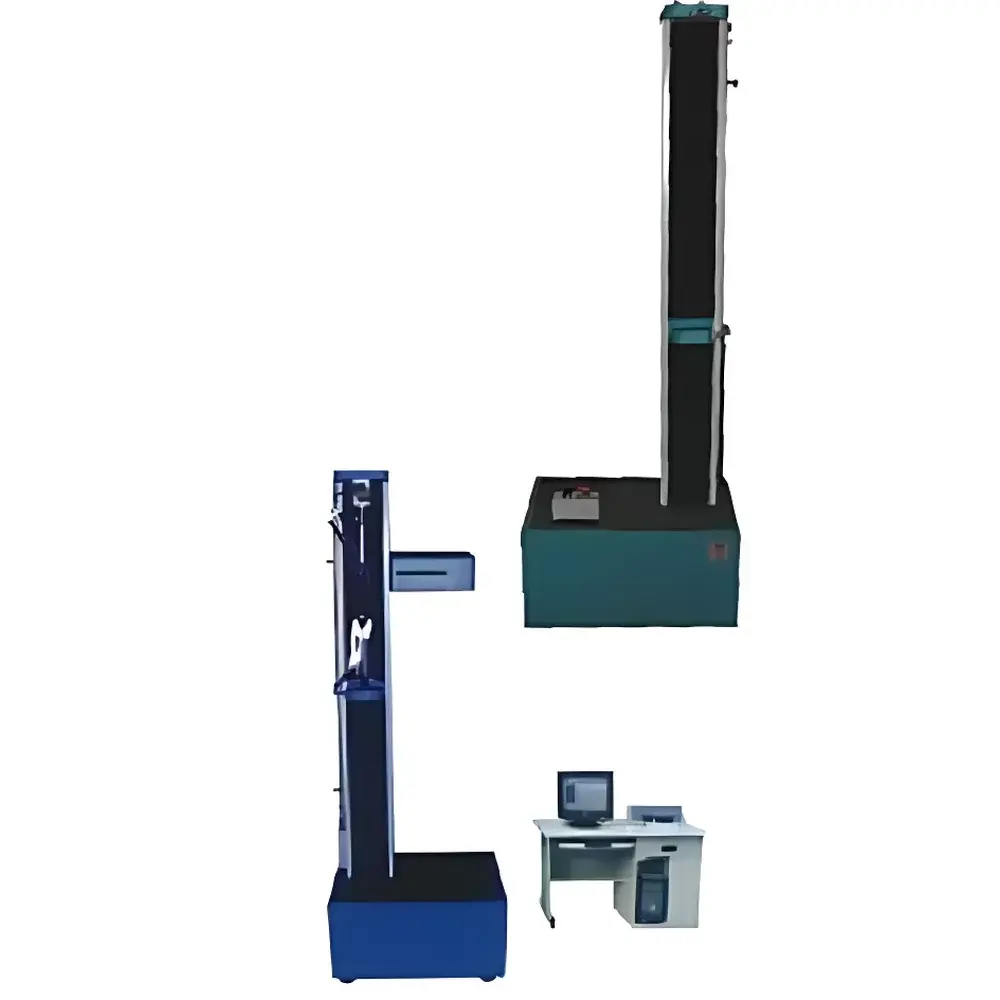
Jiubin JB-126A Universal Testing Machine
| Brand | Jiubin (JByq) |
|---|---|
| Origin | Taiwan, China |
| Type | Electronic Universal Testing Machine |
| Capacity | 0–200 kg (user-selectable) |
| Load Cell | High-precision U.S.-made load cell |
| Load Accuracy | ±0.5% |
| Effective Test Width | 380 mm |
| Max. Extension Travel | 1000 mm |
| Drive System | Japanese servo motor |
| Mechanical Transmission | Taiwan-made precision ball screw |
| Test Speed Range | 0.001–500 mm/min (infinitely variable, constant-speed selectable) |
| Displacement Accuracy | ±0.005% |
| Resolution | 1/200,000 |
| Safety Features | Upper/lower mechanical limits, emergency stop switch |
| Display | Dual-mode — PC-based software interface + embedded microcomputer display |
| Unit Options | g, kg, N, kN, lb |
| Power Supply | 220 V, 50 Hz |
| Net Weight | 160 kg |
| Dimensions (W×D×H) | 450 × 450 × 900 mm |
| Fixture | One standard set (customizable per sample geometry) |
| Optional Accessories | Desktop PC, inkjet printer, extensometer, proprietary test software |
Overview
The Jiubin JB-126A Universal Testing Machine is an electromechanical static testing system engineered for precision mechanical property evaluation of solid materials under uniaxial tensile, compressive, flexural, and shear loading conditions. Based on the fundamental principles of Hooke’s Law and stress–strain continuum mechanics, the instrument applies controlled displacement or force via a servo-driven ball-screw actuator while continuously measuring load and displacement with traceable metrology-grade transducers. Its modular architecture integrates a high-fidelity U.S.-sourced load cell (±0.5% full-scale accuracy), a Japan-manufactured servo motor with closed-loop velocity regulation, and a Taiwan-fabricated preloaded ball-screw transmission—ensuring minimal backlash, thermal drift stability, and long-term repeatability across thousands of test cycles. Designed as a floor-standing unit, the JB-126A conforms to ISO 7500-1 Class 1 calibration requirements for force measurement systems and meets mechanical safety standards per IEC 61000-6-2 (EMC) and IEC 60204-1 (machine safety). It serves as a foundational platform for QC laboratories, R&D centers, and contract testing facilities requiring compliance-ready documentation for ISO/IEC 17025, ASTM E4, ASTM E8/E9, ISO 6892-1, ISO 37, and EN 10002-1.
Key Features
- Electromechanical dual-control architecture supporting both load-controlled and displacement-controlled test modes
- User-configurable capacity range (0–200 kg) with automatic range switching and auto-zeroing function
- Infinitely variable speed control from 0.001 to 500 mm/min, programmable in increments of 0.001 mm/min for creep, relaxation, and ramp-hold protocols
- Dual-display operation: embedded microcontroller panel for quick setup and real-time monitoring, plus PC-based GUI for advanced curve analysis and report generation
- High-resolution data acquisition at 1/200,000 internal count resolution, enabling sub-micron displacement detection and millinewton-level force sensitivity
- Comprehensive mechanical safeguarding including dual-axis hard-limit switches, fail-safe emergency stop circuitry, and overload cut-off logic
- Modular fixture interface compliant with ASTM D3330, ISO 8510-2, and DIN 53357 standards for tensile grips, compression platens, and three-point bend fixtures
Sample Compatibility & Compliance
The JB-126A accommodates specimens ranging from thin polymer films (≥0.05 mm thick) to metallic rods (≤25 mm diameter) and composite laminates (up to 380 mm wide × 1000 mm travel length). Standard configurations support ASTM D638 Type I–V tensile bars, ISO 527-2 multipurpose specimens, ASTM D790 rectangular beams, and ISO 178 flexural test pieces. All hardware—including clamping jaws, compression anvils, and bending supports—is manufactured to ISO 2768-mK general tolerances and surface-hardened for wear resistance. The system complies with GLP documentation requirements through audit-trail-enabled software, supports 21 CFR Part 11 electronic signature readiness (when paired with validated PC configuration), and maintains full traceability to NIST-traceable force calibration certificates.
Software & Data Management
The bundled Windows-compatible test software provides ISO 17025-aligned data integrity features: time-stamped raw data logging (1 kHz sampling rate), automatic metadata capture (operator ID, environmental conditions, calibration status), and version-controlled test method templates. Users may define multi-step test sequences (e.g., preload → ramp → hold → unload), apply real-time filtering (Butterworth low-pass), and generate comparative overlays of up to 32 curves per chart. Export formats include CSV, PDF (with embedded digital signatures), and XML for LIMS integration. Audit logs record all parameter modifications, file deletions, and user login events—retained for ≥18 months per internal QA policy. Optional extensometer input enables true strain measurement per ASTM E83 Class B-2 specifications.
Applications
- Tensile characterization of thermoplastics, elastomers, adhesives, and textile yarns per ISO 527 and ASTM D638
- Compression testing of foams, ceramics, and packaging materials per ISO 844 and ASTM D3574
- Three-point flexural analysis of PCB substrates, fiber-reinforced composites, and biomedical polymers per ISO 178 and ASTM D790
- Peel and shear strength assessment of laminated structures, pressure-sensitive tapes, and medical device bonding interfaces per ASTM D903 and ISO 8510
- Quality conformance verification for automotive gaskets, aerospace fasteners, and wire-and-cable insulation per SAE J2238 and UL 1581
FAQ
What calibration standards does the JB-126A support?
It accepts third-party calibration using Class M1 deadweight standards per ISO 376 and is compatible with accredited calibration services traceable to NIST, PTB, or NIM.
Can the system perform cyclic fatigue testing?
No—the JB-126A is designed for static and quasi-static tests only; dynamic or high-cycle fatigue requires a dedicated electrodynamic testing system.
Is the software compliant with FDA 21 CFR Part 11?
Yes, when deployed on a validated Windows environment with role-based access control, electronic signatures, and immutable audit trails enabled.
What is the warranty coverage and service response time?
Standard warranty covers parts and labor for 24 months; technical support is available via remote diagnostics during business hours (GMT+8), with on-site service dispatched within 5 business days for critical failures.
How is test data backed up and archived?
The software supports scheduled automated backups to network drives or cloud storage (AWS S3, Azure Blob); raw data files are stored in non-proprietary binary format with embedded CRC-32 checksums for integrity verification.
Related Products



