
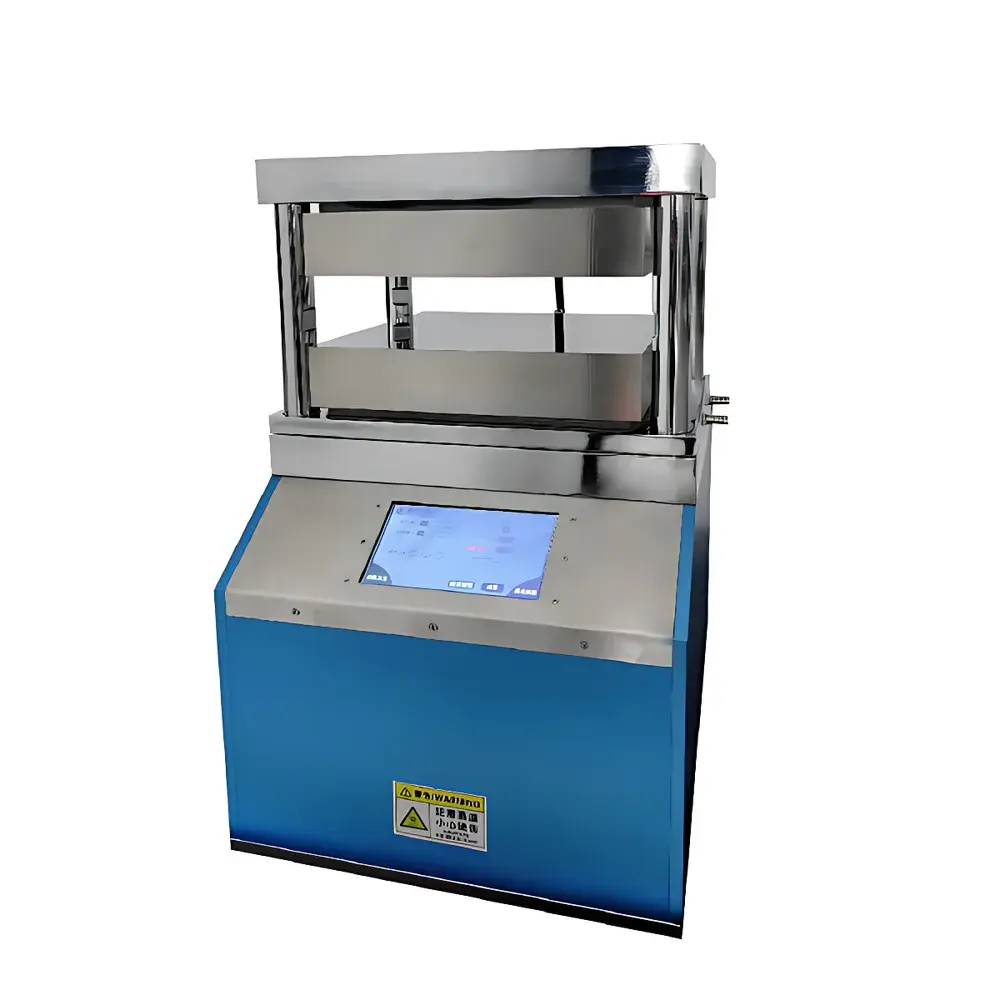
Jiubin JB-600Z Fully Automated Hot Press
| Brand | Jiubin / JByq |
|---|---|
| Origin | Shanghai, China |
| Manufacturer Type | Authorized Distributor |
| Country of Origin | China |
| Model | JB-600Z |
| Price Range | USD 2,800 – 7,000 |
| Max. Pressure | 50 T (adjustable in 0.1 T increments) |
| Piston Diameters | Ø110 mm / Ø130 mm / Ø150 mm |
| Heating Range | RT–300 °C (±0.1 °C), optional RT–500 °C |
| Platen Dimensions | 180×180 mm to 400×400 mm |
| Control System | XNNETS 7-inch capacitive touchscreen (multi-language UI, USB firmware upgrade, optional remote control) |
| Pressure & Temperature Programming | 5-segment programmable ramp/soak profiles |
| Pressure Control Modes | Auto-pressurization → Hold → Precision pressure compensation → Timed depressurization |
| Platen Configuration | Dual-flat, fixed upper platen with polished surface |
| Heating Element | Aluminum core (copper core optional for 500 °C version) |
| Cooling | Natural convection (forced-air or water-cooling optional) |
| Thermal Insulation | Imported high-efficiency insulation board (stainless steel water-cooled variant for 500 °C operation) |
| Power Supply | 220 V AC, 50/60 Hz, with RCD protection |
| Compliance | Designed per ISO 17025 laboratory environment requirements |
Overview
The Jiubin JB-600Z Fully Automated Hot Press is an integrated, dual-platen laboratory-scale hot press engineered for reproducible high-temperature, high-pressure sample consolidation and preparation. It operates on the fundamental principle of simultaneous thermal and mechanical energy application—where controlled conductive heating across parallel platens, combined with programmable hydraulic force delivery, enables precise densification, sintering, or polymer film lamination under defined thermomechanical conditions. Unlike manual or semi-automated systems, the JB-600Z implements closed-loop pressure regulation and multi-stage temperature ramping to ensure process fidelity across repeated runs—critical for spectroscopic calibration standards, FTIR/KBr pellet fabrication, polymer composite preforming, ceramic green body consolidation, and battery electrode sheet fabrication. Its architecture adheres to industrial-grade mechanical stability requirements, featuring a rigid C-frame construction, precision-ground platens, and calibrated hydraulic actuation capable of maintaining setpoint pressure within ±0.5% full scale during extended holds.
Key Features
- Dual-flat platen design with fixed upper platen and polished stainless-steel contact surfaces for uniform heat transfer and minimal sample distortion.
- Five-segment programmable pressure profile: automatic pressurization, dynamic hold with real-time pressure compensation, and timed depressurization—each segment independently configurable for duration and target load (0.1 T resolution up to 50 T).
- Five-stage programmable temperature profile: independent ramp rates, soak durations (N-second resolution), and cooling protocols—including auto-termination at ambient temperature.
- Real-time MPa calculation engine: automatically converts applied tonnage into sample-specific pressure (MPa) based on user-input mold area or platen dimensions.
- XNNETS 7-inch industrial touchscreen HMI with dual-language interface (English/Chinese), USB-based firmware updates, and optional Ethernet/Wi-Fi remote monitoring capability.
- Modular thermal configuration: standard aluminum-core heating (RT–300 °C) or copper-core upgrade (RT–500 °C), paired with either high-efficiency composite insulation or actively cooled stainless steel shielding for elevated temperature stability.
Sample Compatibility & Compliance
The JB-600Z accommodates a broad spectrum of solid-state materials including but not limited to: inorganic powders (e.g., KBr, NaCl, BaSO₄), polymeric granules (PE, PP, PTFE), metal oxide precursors, graphite composites, and thin-film laminates. Its platen size options—from 180 × 180 mm to 400 × 400 mm—support both small-batch R&D samples and larger QA/QC validation coupons. All operational parameters are logged with timestamped metadata, enabling alignment with ISO/IEC 17025 documentation requirements for testing laboratories. When configured with optional audit-trail software, the system supports 21 CFR Part 11–compliant electronic records—including user authentication, change history, and immutable export of pressure/temperature/time datasets for regulatory submissions.
Software & Data Management
The embedded XNNETS control firmware provides native support for process parameter archiving via USB mass storage. Each run generates a CSV-formatted log containing synchronized time-series data for pressure (T), temperature (°C), and elapsed cycle time (s), with column headers compliant with ASTM E2918-22 for thermal-mechanical test reporting. Optional PC-based software extends functionality to batch report generation, statistical process control (SPC) charting, and integration with LIMS environments via OPC UA or Modbus TCP. Firmware updates preserve all user-defined method libraries and calibration offsets, ensuring continuity across maintenance cycles without requalification.
Applications
- Preparation of infrared-transparent pellets for FTIR quantitative analysis (e.g., pharmaceutical APIs, polymers, geological samples).
- Densification of ceramic and metallurgical green bodies prior to sintering trials.
- Lamination of multilayer battery electrodes and solid-state electrolyte membranes under inert atmosphere-compatible tooling.
- Thermoforming of thermoplastic films for optical characterization substrates.
- Accelerated aging studies requiring simultaneous thermal stress and compressive loading.
- Calibration standard manufacturing for XRF, XRD, and SEM-EDS quantification workflows.
FAQ
What is the maximum recommended operating temperature for standard configuration?
The base model is rated for continuous operation up to 300 °C using aluminum-core heating elements and high-performance composite insulation.
Can the JB-600Z be integrated into a nitrogen-purged glovebox environment?
Yes—custom feedthrough configurations for power, control signals, and optional cooling lines are available upon request; platen access ports comply with standard glovebox flange specifications (KF40/KF50).
Is pressure calibration traceable to national standards?
Factory calibration is performed using NIST-traceable deadweight testers; users may perform field verification with certified load cells and documented SOPs aligned with ISO 376.
Does the system support external temperature sensor inputs (e.g., thermocouples embedded in molds)?
The standard configuration includes two internal Type K inputs; additional channels can be enabled via optional I/O expansion module supporting PT100, thermistor, or millivolt sources.
How is thermal uniformity across the platen verified?
Platen uniformity is characterized per ASTM E220–22 using a 9-point thermocouple grid; typical deviation is ≤ ±1.5 °C at 300 °C and ≤ ±2.5 °C at 500 °C across the central 80% area.



