
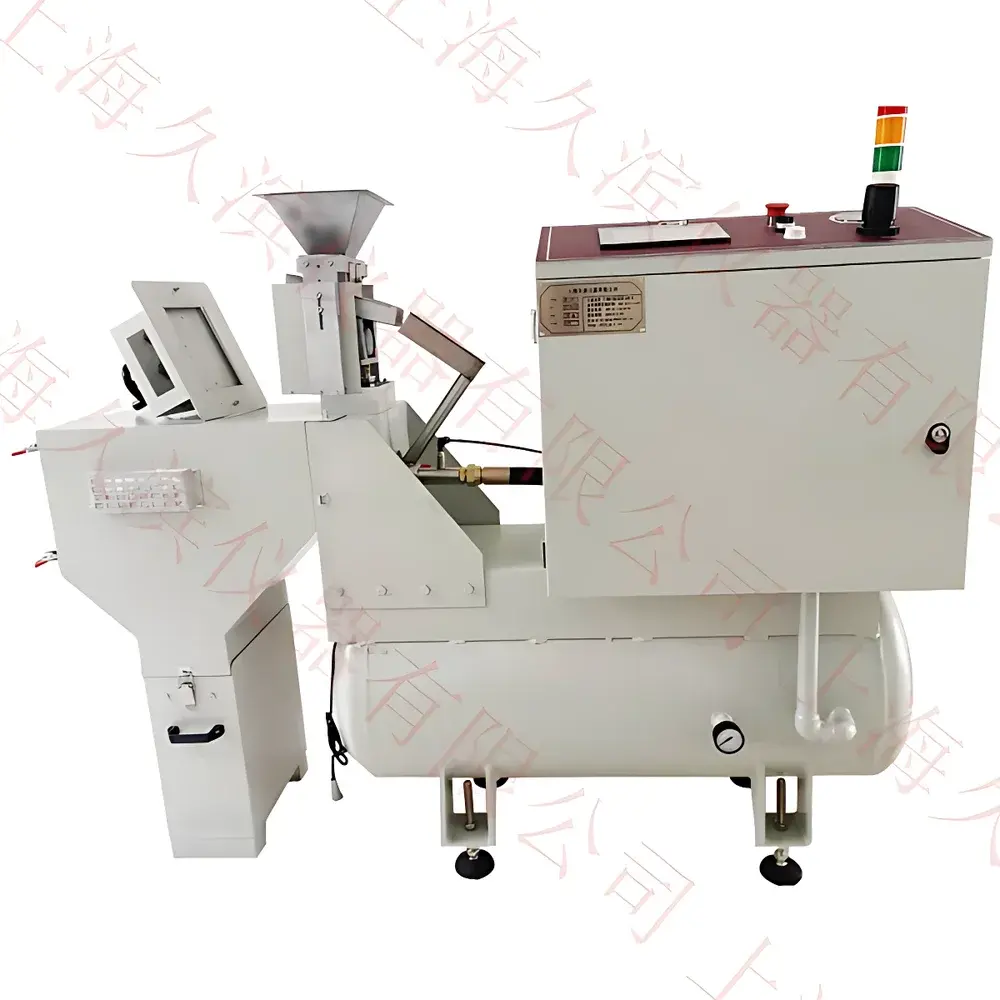
Jiubin JB-JM5 Stone Chip Impact Tester for Automotive Glass
| Brand | Jiubin |
|---|---|
| Model | JB-JM5 |
| Type | Stone Chip / Gravel Impact Tester |
| Pressure Range | 0–0.8 MPa (adjustable) |
| Test Media | Gravel, Sand, Calibrated Stone Chips |
| Nozzle Internal Diameter | 30 mm / 53 mm |
| Air Reservoir Volume | 136 L |
| Compressed Air Inlet ID | 15 mm / 20 mm |
| Sample Orientation | 45°, 54°, or 90° (flat specimens) |
| Operating Mode | Continuous-duty cycle |
| Noise Level | ≤120 dB(A) (hearing protection required) |
| Feed Control | Electromagnetic vibratory feeder |
| Airflow Regulation | Manual pressure regulator valve |
| Required External Air Supply | ≥2 m³/min at 0–0.8 MPa (air compressor not included) |
| Compliance | Designed per ISO 20567-1, ASTM D3170/D3171, SAE J400, and GB/T 20374 |
Overview
The Jiubin JB-JM5 Stone Chip Impact Tester is an engineered system for simulating and quantifying the mechanical resistance of automotive glazing materials—including laminated glass, tempered glass, and polymer-based transparent substrates—against high-velocity gravel and stone chip impact under controlled pneumatic conditions. Based on the principle of accelerated abrasion and dynamic brittle fracture initiation, the tester propels calibrated abrasive media through a convergent nozzle at regulated pressure and flow rate, replicating real-world road-debris strike events encountered during vehicle operation. Its design adheres to internationally recognized test protocols for evaluating coating adhesion, interlayer delamination, substrate chipping resistance, and edge-chip propagation in safety-critical glazing systems. Unlike generic impact testers, the JB-JM5 integrates precise angular positioning, repeatable feed-rate modulation, and volumetric air reservoir stabilization to ensure measurement consistency across multiple test cycles and specimen configurations.
Key Features
- Triple-angle sample mounting platform supporting 45°, 54°, and 90° incidence orientations—enabling correlation with OEM-specific test specifications (e.g., Ford WSS-M99P1111-A, GMW14872).
- Dual-nozzle configuration (30 mm and 53 mm internal diameter) optimized for varying particle size distributions and impact energy density profiles.
- 136-liter stabilized air reservoir ensures consistent pressure delivery during extended-duration tests, minimizing transient fluctuations that compromise repeatability.
- Electromagnetically driven vibratory feeder enables stepless regulation of gravel feed rate (typically 0.5–5.0 kg/min), critical for simulating low- vs. high-density debris exposure scenarios.
- Modular 3D test chamber accommodates non-planar specimens such as curved windshields or A-pillar glazing modules without requiring custom fixtures.
- Integrated acoustic shielding and standardized hearing-protection interface comply with OSHA 29 CFR 1910.95 and EU Directive 2003/10/EC occupational noise exposure limits.
Sample Compatibility & Compliance
The JB-JM5 accepts flat and contoured glass specimens up to 600 × 600 mm, including laminated, heat-strengthened, and polyvinyl butyral (PVB)-interlayered assemblies. It supports evaluation of both bare substrates and multi-layer coated systems—such as hydrophobic SiO₂ topcoats, anti-reflective stacks, and conductive ITO layers—under identical impact conditions. The system is configured to meet the procedural requirements of ISO 20567-1 (Paints and varnishes — Determination of stone-chip resistance), ASTM D3170 (Standard Test Method for Chip Resistance of Coatings), ASTM D3171 (Standard Test Method for Adhesion of Organic Coatings by the Tape Test), SAE J400 (Surface Finish Evaluation – Gravelometer Test), and China’s GB/T 20374 (Automotive Safety Glass Impact Resistance Test Method). All operational parameters—including pressure decay monitoring, feed-rate logging, and angle verification—are traceable and support GLP-compliant audit trails when integrated with external data acquisition hardware.
Software & Data Management
While the JB-JM5 operates via analog control interfaces for core pneumatic and feed functions, it includes dedicated I/O ports (RS-485, 0–10 V analog output) for integration with third-party SCADA or LIMS platforms. Optional digital upgrade kits provide timestamped event logging of pressure setpoints, feed duration, and actuation cycles—enabling full compliance with FDA 21 CFR Part 11 when paired with validated electronic signature modules. Raw impact data (e.g., chip count, crack length distribution, delamination area via image analysis) are typically processed offline using ASTM E1316-defined defect classification algorithms or ISO 20567-2-compliant assessment templates.
Applications
- Quantitative assessment of edge-chip resistance in automotive side windows and sunroofs under simulated highway gravel impact.
- Evaluation of interfacial adhesion strength between PVB interlayers and glass substrates after thermal cycling or humidity exposure.
- Screening of anti-scratch hardcoat formulations applied to polycarbonate glazing used in EV panoramic roofs.
- Validation of coating durability for HUD-integrated windshield assemblies subjected to repeated low-energy stone strikes.
- Comparative testing of recycled-content glass substrates versus virgin float glass in terms of microcrack nucleation threshold.
FAQ
Is an air compressor included with the JB-JM5?
No. Users must supply an external oil-free air compressor capable of delivering ≥2 m³/min at pressures up to 0.8 MPa.
Can the JB-JM5 be used for non-automotive applications?
Yes—it is routinely adapted for aerospace transparent dome testing, architectural laminated glass qualification, and protective visor development, provided test parameters align with applicable standards.
What particle size distribution is recommended for calibration?
ISO 20567-1 specifies crushed granite chips graded between 0.5–2.0 mm; alternative media (e.g., steel shot, ceramic beads) require method validation per ASTM E2821.
Does the system support automated image-based damage analysis?
Not natively—but the test chamber features standardized lighting ports and mounting rails compatible with industrial machine vision systems (e.g., Keyence CV-X series) for post-test surface inspection.
What maintenance intervals are recommended for the electromagnetic feeder and pressure regulators?
Bi-weekly visual inspection and quarterly calibration of pressure transducers and feed-rate sensors are advised per manufacturer’s service manual (Revision 3.2, 2023).



