
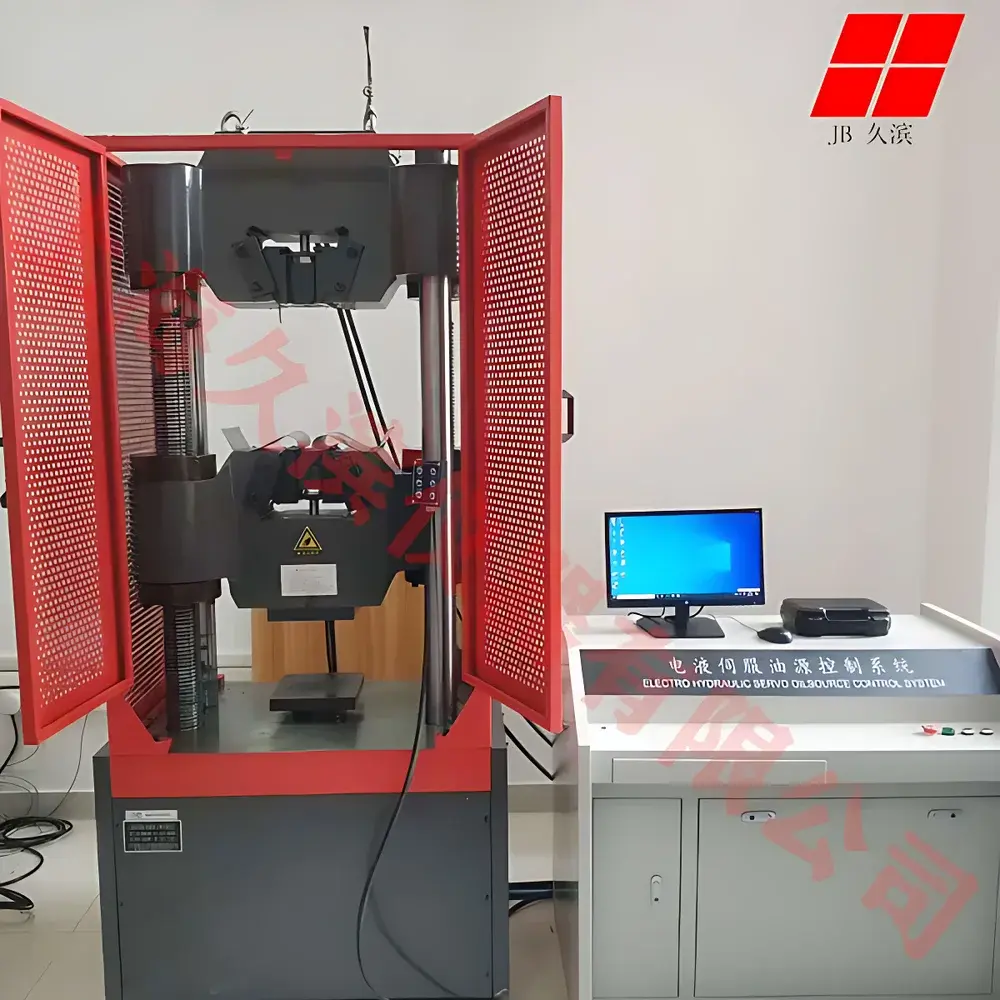
Jiubin JB/WAW-600KN Hydraulic Universal Testing Machine for Thread Relaxation Testing of Galvanized Steel Wire
| Brand | Jiubin |
|---|---|
| Model | JB/WAW-600KN |
| Type | Hydraulic Universal Testing Machine |
| Maximum Load Capacity | 600 kN |
| Origin | Shanghai, China |
| Instrument Category | Domestic |
| Manufacturer Status | Authorized Distributor |
| Application-Specific Configuration | Thread Relaxation Test Fixture for Galvanized Steel Wire |
| Compliance Framework | Designed to support ISO 6892-1, ASTM E8/E21, and GB/T 228.1 test methodologies |
Overview
The Jiubin JB/WAW-600KN Hydraulic Universal Testing Machine is a precision-engineered static mechanical testing system specifically adapted for long-term thread relaxation characterization of galvanized steel wire under sustained axial load. Unlike standard tensile testers optimized for short-duration yield and ultimate strength evaluation, this configuration integrates a high-stiffness load frame, servo-controlled hydraulic actuation with pressure-compensated holding capability, and dedicated fixture tooling to maintain constant force over extended durations (up to 1,000 hours) while continuously monitoring axial displacement with micrometer-level resolution. The machine operates on the principle of controlled load maintenance in accordance with the creep-relaxation paradigm defined in ISO 6934-4 and EN 10138-3 for prestressed steel products. Its structural rigidity (frame deflection < 0.02 mm/kN), thermally stable hydraulic oil circuitry, and low-drift load cell calibration ensure measurement stability essential for quantifying time-dependent stress decay in zinc-coated wire specimens subjected to ≥70% of their nominal tensile strength.
Key Features
- 600 kN rated capacity hydraulic loading system with closed-loop pressure regulation and real-time load hold accuracy ±0.5% of full scale over 100-hour intervals
- Dedicated thread relaxation test fixture assembly: includes self-aligning grips with serrated hardened steel jaws, adjustable specimen length stops, and integrated temperature-compensated extensometer mounting rails
- High-resolution displacement measurement: digital encoder-based crosshead position tracking with 0.1 µm resolution and thermal drift compensation algorithm
- Robust cast-iron frame with four-column preloaded design, achieving frame stiffness > 1.2 × 10⁶ N/mm per ISO 7500-1 Class 0.5 certification requirements
- Hydraulic power unit equipped with dual-stage filtration (β₁₀ ≥ 200), oil temperature stabilization within ±2°C over ambient range of 10–35°C
- Compliance-ready control architecture supporting audit trails, user access levels, and electronic signature functionality per FDA 21 CFR Part 11 guidelines
Sample Compatibility & Compliance
The JB/WAW-600KN accommodates galvanized steel wire specimens conforming to ASTM A475, EN 10217-3, and GB/T 343 standards, with diameters ranging from 1.0 mm to 8.0 mm and minimum gauge lengths of 500 mm. Specimen preparation follows ISO 15630-3 protocols, including controlled uncoiling, straightening without plastic deformation, and surface inspection for zinc coating continuity prior to clamping. The system supports testing under ambient laboratory conditions or optional environmental chamber integration (−20°C to +80°C). All test procedures align with ISO 6934-4 Annex B for relaxation testing of prestressing steels and are traceable to national metrology institutes via NIST-traceable load cell calibration certificates.
Software & Data Management
Control and data acquisition are managed through Jiubin’s TMS-Studio v4.2 software platform, compliant with GLP and GMP documentation requirements. The interface provides synchronized acquisition of load, displacement, time, and optional environmental parameters (temperature, humidity) at configurable sampling rates (1 Hz to 100 Hz). Raw data is stored in encrypted .tdms format with embedded metadata (operator ID, calibration date, specimen ID, test standard reference). Automated report generation includes relaxation rate curves (σ/σ₀ vs. log t), percentage stress loss tables at standardized intervals (1 h, 10 h, 100 h, 1000 h), and statistical summaries across replicate tests. Audit trail logs record all parameter modifications, data exports, and user login/logout events with timestamp and IP address.
Applications
- Quantification of relaxation behavior in galvanized steel wire used in suspension bridge cables, guy wires, and seismic retrofitting tendons
- Quality assurance validation for wire producers supplying to ISO 15630-3–certified construction material supply chains
- R&D investigations into zinc coating thickness effects on interfacial stress transfer and hydrogen embrittlement susceptibility during long-term loading
- Comparative assessment of relaxation performance between hot-dip galvanized and electrogalvanized wire grades under identical thermal-mechanical histories
- Supporting technical submissions for CE marking under EN 10080 and certification by notified bodies such as TÜV Rheinland or SGS
FAQ
What standards does this system support for galvanized wire relaxation testing?
ISO 6934-4, EN 10138-3, ASTM A475 Annex A, and GB/T 21839-2019.
Can the system perform both relaxation and conventional tensile tests?
Yes — the base WAW-600KN platform supports ASTM E8/E21 tensile testing; relaxation functionality requires the optional thread-specific fixture and software module.
Is third-party calibration documentation included?
Each unit ships with a factory calibration certificate traceable to CNAS-accredited laboratories; NIST-traceable recalibration services available upon request.
What is the maximum test duration supported for continuous relaxation monitoring?
Uninterrupted operation up to 1,000 hours is validated; system uptime exceeds 99.2% under continuous load-hold mode per internal reliability testing.
Does the software meet regulatory requirements for pharmaceutical or medical device testing?
TMS-Studio v4.2 includes 21 CFR Part 11-compliant features (electronic signatures, audit trails, role-based access), though application suitability must be verified per site-specific validation protocols.



