
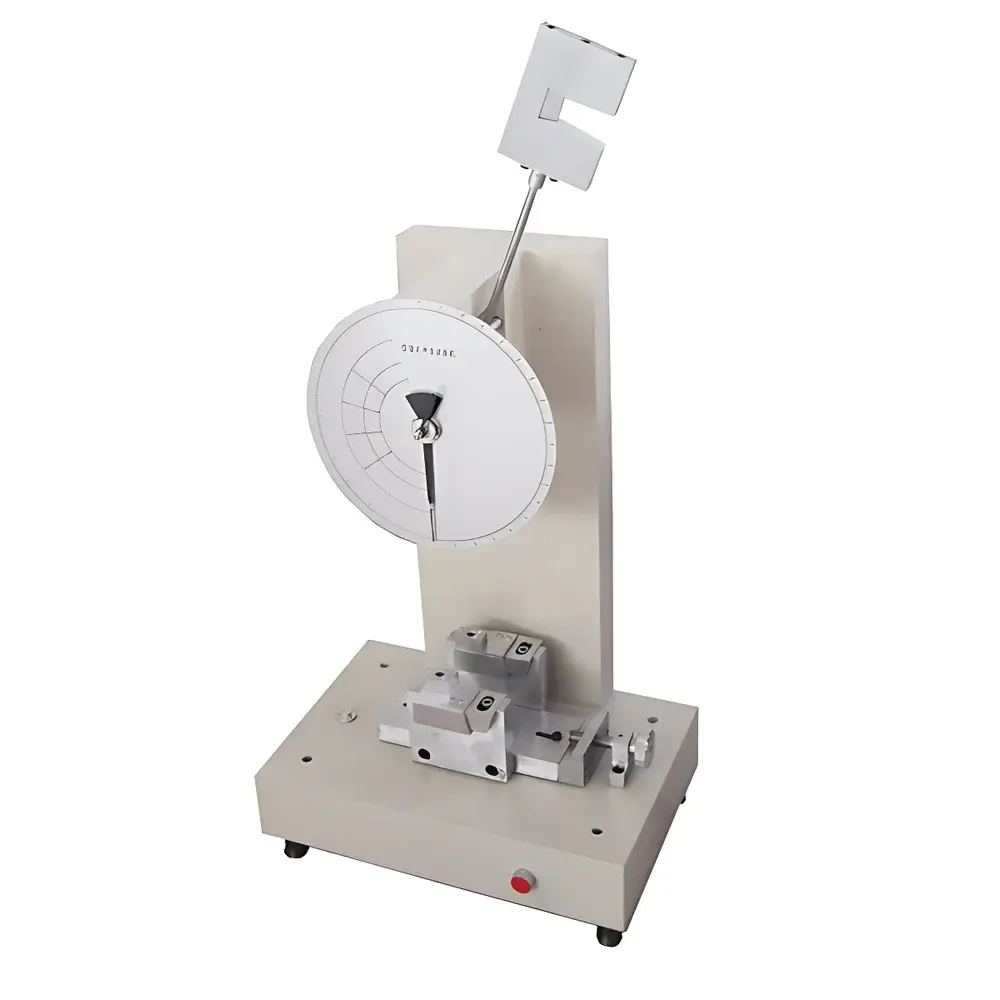
Jiubin JB/XJJ-5 Dial-Type Charpy Impact Tester
| Brand | Jiubin |
|---|---|
| Origin | Shanghai, China |
| Model | JB/XJJ-5 |
| Instrument Type | Pendulum Impact Tester |
| Impact Energy | 5 J |
| Impact Velocity | 2.9 m/s |
| Pendulum Radius (Impact Constant) | R = 2 ± 0.5 mm |
| Maximum Lifting Height | 62 mm |
| Support Span Options | 40 mm, 60 mm, 62 mm, 95 mm |
| Hammer Blade Angle | 30° ± 1° |
| Anvil & Hammer Nose Radius | R = 1 ± 0.1 mm (anvil), R = 2 ± 0.5 mm (blade) |
| Scale Resolution | 1/100 division |
| Energy Loss in No-Load Swing | ≤0.5% |
| Compliance | ISO 179-1, GB/T 1043.1, GB/T 21189, GB/T 4742, GB/T 2611 |
Overview
The Jiubin JB/XJJ-5 Dial-Type Charpy Impact Tester is a manually operated pendulum impact testing system engineered for standardized Charpy-type (simply supported beam) impact resistance evaluation of rigid and semi-rigid materials. It operates on the classical principle of gravitational potential energy conversion: a calibrated pendulum is raised to a fixed height, released, and allowed to strike a notched specimen supported at two points. The energy absorbed during fracture—calculated from the difference between initial and residual pendulum height—is directly indicated on a high-resolution analog dial scale with 1/100 division accuracy. Designed in strict accordance with ISO 179-1 (Plastics — Determination of Charpy impact properties) and GB/T 1043.1 (Chinese national standard equivalent), this instrument delivers repeatable, traceable mechanical impact data without reliance on electronic sensors or software-based signal processing. Its mechanical simplicity ensures long-term stability, minimal maintenance, and immunity to electromagnetic interference—critical attributes for accredited quality control laboratories operating under GLP or ISO/IEC 17025 frameworks.
Key Features
- Mechanically robust cast-iron frame with precision-machined anvil and clamp assemblies ensuring consistent specimen alignment and support span repeatability across 40 mm, 60 mm, 62 mm, and 95 mm configurations
- Calibrated 5 J pendulum with nominal impact velocity of 2.9 m/s and defined blade geometry: 30° ± 1° included angle, nose radius R = 2 ± 0.5 mm, conforming to ISO 179-1 Annex A specifications
- Dual-radius anvil design: R = 1 ± 0.1 mm for precise notch support, minimizing stress concentration artifacts and enabling compliance with GB/T 4742 (ceramic impact toughness) requirements
- High-visibility analog dial scale with 1/100 resolution, eliminating digital drift or calibration dependency associated with load-cell-based systems
- Verified no-load energy loss ≤ 0.5%, meeting GB/T 21189-2007 verification criteria for pendulum impact tester performance
- Modular pendulum interchange capability—compatible with optional 0.5 J, 1 J, and 2 J hammers (sold separately)—enabling full-range Charpy testing without hardware redesign
Sample Compatibility & Compliance
The JB/XJJ-5 accommodates standardized rectangular specimens per ISO 179-1 (e.g., 80 × 10 × 4 mm) and GB/T 1043.1, including notched variants for brittle and ductile polymer evaluation. It is routinely deployed for impact assessment of thermoplastics (e.g., ABS, PC, PP), fiber-reinforced composites (GFRP, CFRP), engineering ceramics, tempered glass, and high-performance nylon grades. All mechanical dimensions—including support span tolerances, blade geometry, and anvil radii—are verified against ISO 179-1, GB/T 21189-2007 (verification standard), GB/T 2611-2007 (general testing machine requirements), and JB/T 6147-2007 (packaging and transport specifications). While not equipped with digital data logging, its analog output satisfies audit requirements for non-instrumented impact testing under ASTM D6110 and USP when paired with documented calibration records and operator training logs.
Software & Data Management
This is a purely mechanical, analog-readout impact tester with no embedded electronics, firmware, or proprietary software. Data acquisition relies entirely on operator reading of the dial scale and manual transcription into laboratory notebooks or LIMS-compatible spreadsheets. As such, it inherently complies with FDA 21 CFR Part 11 requirements for systems where electronic records are not generated—eliminating validation overhead related to audit trails, electronic signatures, or data integrity controls. Calibration certificates (traceable to NIM or CNAS-accredited labs) and periodic verification reports (per GB/T 21189) constitute the formal metrological documentation. Users retain full ownership and archival control of raw test records without vendor lock-in or subscription dependencies.
Applications
- Quality conformance testing of injection-molded plastic components against ISO 179-1 pass/fail thresholds in automotive and consumer electronics supply chains
- Evaluation of thermal aging effects on impact strength retention in polymeric insulators per IEC 60674-2
- Batch release testing of ceramic substrates used in semiconductor packaging, referencing GB/T 4742-1984 methodology
- Teaching laboratories in materials science curricula—demonstrating fundamental energy-absorption mechanics without abstraction layers introduced by digital instrumentation
- Pre-screening of composite laminate formulations prior to advanced instrumented impact validation (e.g., ASTM D7136)
- Third-party inspection agencies performing accredited Charpy testing under CNAS accreditation scope (ISO/IEC 17025:2017, clause 6.4.10)
FAQ
Is the JB/XJJ-5 compliant with international standards for export-oriented testing?
Yes—its mechanical design, dimensional tolerances, and verification protocols align with ISO 179-1, ASTM D6110 (non-instrumented mode), and GB/T 21189. Calibration certificates can be issued with CMC statements traceable to national metrology institutes.
Can it be used for both plastics and ceramics?
Yes—support span and anvil geometry meet the distinct requirements of GB/T 1043.1 (plastics) and GB/T 4742 (ceramics). Specimen preparation must follow respective standard notching guidelines.
Does it require annual recalibration?
Per GB/T 21189 and ISO/IEC 17025, verification of pendulum energy loss, scale linearity, and support span accuracy is recommended at least annually—or after any mechanical impact to the frame or pendulum assembly.
Are replacement pendulums available for other energy levels?
Yes—0.5 J, 1 J, and 2 J pendulums are available as accessories, allowing full coverage of the Charpy energy range while maintaining identical kinematic behavior and compliance.
What maintenance is required?
Routine cleaning of pivot bearings, lubrication of the release mechanism (with ISO VG 32 mineral oil), and visual inspection of blade edge wear every 500 tests. No firmware updates or sensor recalibrations are necessary.



