
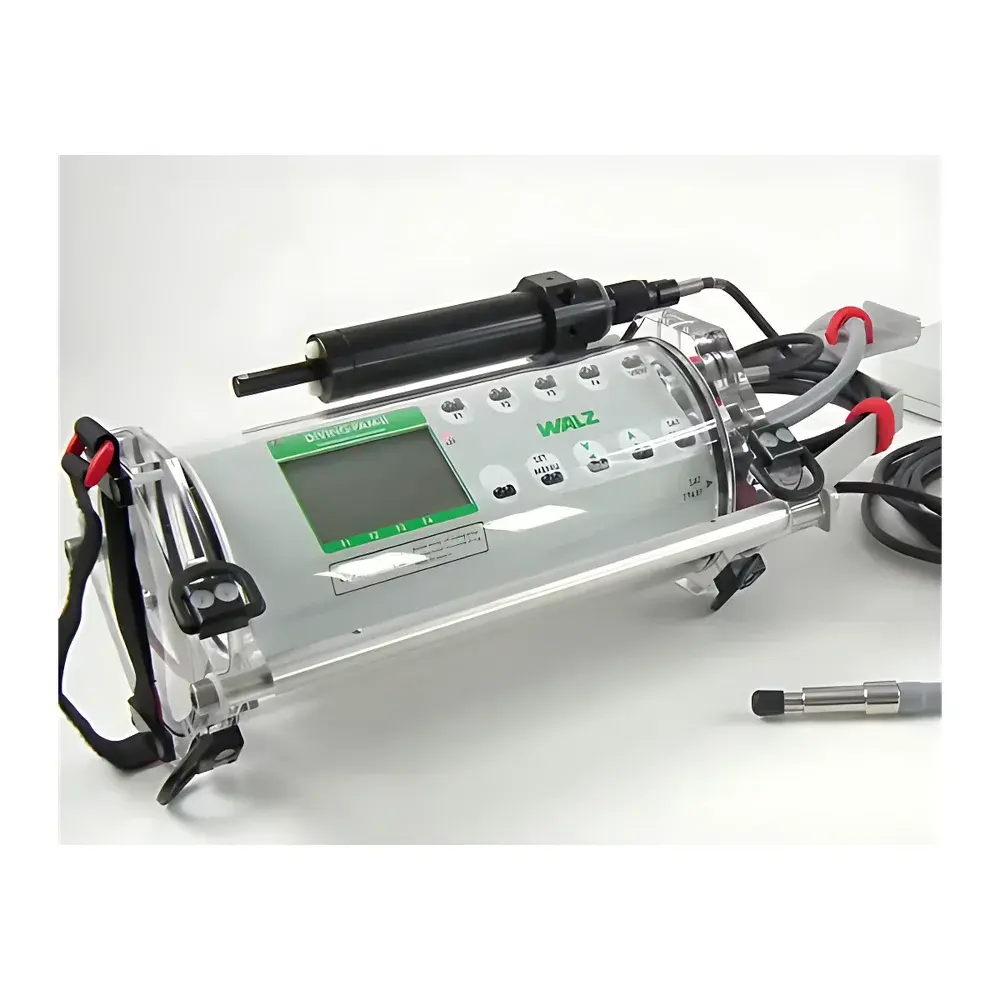
WALZ DIVING-PAM-II Submersible Pulse-Amplitude-Modulated Chlorophyll Fluorometer
| Brand | WALZ |
|---|---|
| Origin | Germany |
| Model | DIVING-PAM-II |
| Housing | Fully Submersible (50 m Depth Rating) |
| Excitation Wavelengths | 470 nm (blue) and 655 nm (red) LEDs |
| Measuring Light Intensity | 0.05 µmol·m⁻²·s⁻¹ |
| Actinic Light Max | 3000 µmol·m⁻²·s⁻¹ (continuous) |
| Saturation Pulse Max | 6000 µmol·m⁻²·s⁻¹ |
| Far-Red LED Peak | 735 nm |
| Detector | PIN photodiode with long-pass/short-pass interference filters and lock-in amplifier |
| Data Storage | 8 MB SD card (≈27,000 measurement sets) |
| Battery Life | ≥1000 saturation pulses per charge |
| Measured Parameters | Fo, Fm, Fv/Fm, F, Fm′, Y(II), qP, qN, NPQ, Y(NO), Y(NPQ), rETR, water depth, water temperature, PAR |
| Spectral Capability | In situ incident and reflected spectral irradiance (via integrated optical sensors) |
| Interface | Touch-sensitive, pressure-resistant membrane keypad |
| Display | High-contrast, sunlight-readable color LCD |
Overview
The WALZ DIVING-PAM-II is a fully submersible, field-deployable pulse-amplitude-modulated (PAM) chlorophyll fluorometer engineered for quantitative, non-invasive assessment of photosynthetic performance in aquatic and semi-aquatic environments. Based on the principle of modulated fluorometry, it applies precisely timed measuring light, actinic illumination, and saturating pulses to resolve kinetic parameters of Photosystem II (PSII) photochemistry—including quantum yield, electron transport rate, and energy dissipation pathways—under natural hydrostatic pressure up to 50 meters. Unlike surface-based fluorometers, the DIVING-PAM-II integrates optical, thermal, and hydrostatic sensing directly into its waterproof architecture, enabling concurrent acquisition of chlorophyll fluorescence, photosynthetically active radiation (PAR), water temperature, and depth data during in situ operation. Its dual-wavelength LED excitation system (470 nm blue and 655 nm red) allows species-specific optimization for diverse photoautotrophs—from scleractinian corals and macroalgae to submerged angiosperms and benthic microphytobenthos.
Key Features
- Fully sealed, pressure-rated housing certified for continuous operation at depths up to 50 m (5 bar), compliant with IP68 and DIN EN 60529 standards.
- Integrated environmental sensor suite: calibrated thermistor for water temperature (±0.2 °C), piezoresistive pressure transducer for depth (±0.1 m), and cosine-corrected silicon photodiode for PAR (400–700 nm, ±5 %).
- Dual-band LED excitation system with independently controllable 470 nm (blue) and 655 nm (red) sources—optimized for differential absorption by chlorophyll a and accessory pigments in marine vs. freshwater taxa.
- High-fidelity optical detection path featuring a PIN photodiode coupled with interference-filtered long-pass (>720 nm) and short-pass (60 dB in turbid or low-light conditions.
- Optimized underwater human interface: tactile, optically isolated membrane keypad with haptic feedback; high-luminance, anti-reflective color LCD display visible under direct sunlight and at depth.
- Onboard data logging with 8 MB embedded SD memory supporting ≥27,000 complete fluorescence induction curves, RLCs, or quenching kinetics datasets—including timestamp, GPS-tagged location (when paired with external GNSS module), and full parameter metadata.
Sample Compatibility & Compliance
The DIVING-PAM-II is validated for use with attached or sessile aquatic photoautotrophs including coral symbionts (Symbiodiniaceae), seagrass leaves (e.g., Posidonia oceanica, Zostera marina), macroalgal thalli (e.g., Macrocystis pyrifera, Ulva lactuca), and benthic diatom biofilms. It supports standardized measurement protocols aligned with ASTM E2964-14 (Standard Guide for Chlorophyll Fluorescence Measurements in Aquatic Systems) and ISO 10260:2021 (Water quality — Determination of photosynthetic efficiency using PAM fluorometry). While suitable for rain-saturated terrestrial leaves (e.g., tropical understory species during monsoon periods), it is not designed for planktonic suspensions due to optical path length limitations and lack of flow-cell integration. All firmware and data export formats comply with FAIR principles (Findable, Accessible, Interoperable, Reusable) and support GLP-compliant audit trails when used with WALZ’s PAMWin software (v4.0+).
Software & Data Management
Data acquisition, real-time visualization, and post-processing are performed via WALZ PAMWin v4.x software running on Windows 10/11 platforms. The software implements automated curve fitting for OJIP transients, calculates standardized quenching coefficients (NPQ, qP, qN), and computes relative electron transport rates (rETR) using user-defined absorption cross-sections. Export options include CSV, MATLAB .mat, and HDF5 formats—with embedded metadata fields for instrument calibration history, sensor drift correction factors, and environmental context. When connected via USB-C, the DIVING-PAM-II supports bidirectional firmware updates and secure data synchronization without requiring proprietary drivers. All exported datasets retain native time-stamping synchronized to UTC via onboard RTC, and optional NMEA 0183 input enables georeferencing with external GNSS receivers meeting IEC 61162-1 compliance.
Applications
- In situ monitoring of coral bleaching thresholds and recovery dynamics across reef transects, including diel-scale Y(II) and NPQ tracking under variable solar irradiance.
- Quantitative assessment of macroalgal photophysiological plasticity along intertidal gradients—integrating tidal height, emersion duration, and UV exposure history.
- Lake and reservoir benthic primary production studies, particularly for evaluating light limitation in deep-water Chara meadows or sediment-associated cyanobacterial mats.
- Ecotoxicological screening of herbicide impacts on submerged vascular plants under controlled mesocosm conditions, with dose-response analysis of Fv/Fm depression kinetics.
- Seasonal acclimation studies of freshwater macrophytes in floodplain systems, where transient submergence triggers rapid reorganization of PSII antenna structure.
FAQ
What is the maximum operating depth, and how is pressure tolerance verified?
The DIVING-PAM-II is rated for continuous operation at 50 m seawater depth (5 bar absolute pressure), validated through hydrostatic pressure cycling per DIN EN 60529 IP68 requirements and third-party certification by TÜV Rheinland.
Can the instrument measure phytoplankton in natural water columns?
No—it is optimized for attached or benthic samples. Planktonic measurements require flow-through cuvette systems (e.g., IMAGING-PAM or PHYTO-PAM) with defined optical path lengths and cell density control.
Is far-red light emission used for dark relaxation assessment?
Yes—the integrated 735 nm far-red LED induces rapid P700⁺ re-reduction and facilitates complete QA reoxidation, enabling accurate determination of Fo in dark-adapted samples even under ambient light leakage.
How is battery life affected by frequent saturation pulse usage?
At nominal settings (1000 pulses at 6000 µmol·m⁻²·s⁻¹), a full charge supports ≥1000 pulses; actual field endurance depends on ambient temperature, display brightness, and frequency of PAR/depth logging intervals.
Does the system meet FDA 21 CFR Part 11 requirements for regulated research?
While the hardware itself is not Part 11-certified, PAMWin v4.3+ supports electronic signatures, audit trails, and role-based access control—enabling implementation within validated GxP workflows when deployed with documented SOPs and instrument qualification (IQ/OQ/PQ).




