
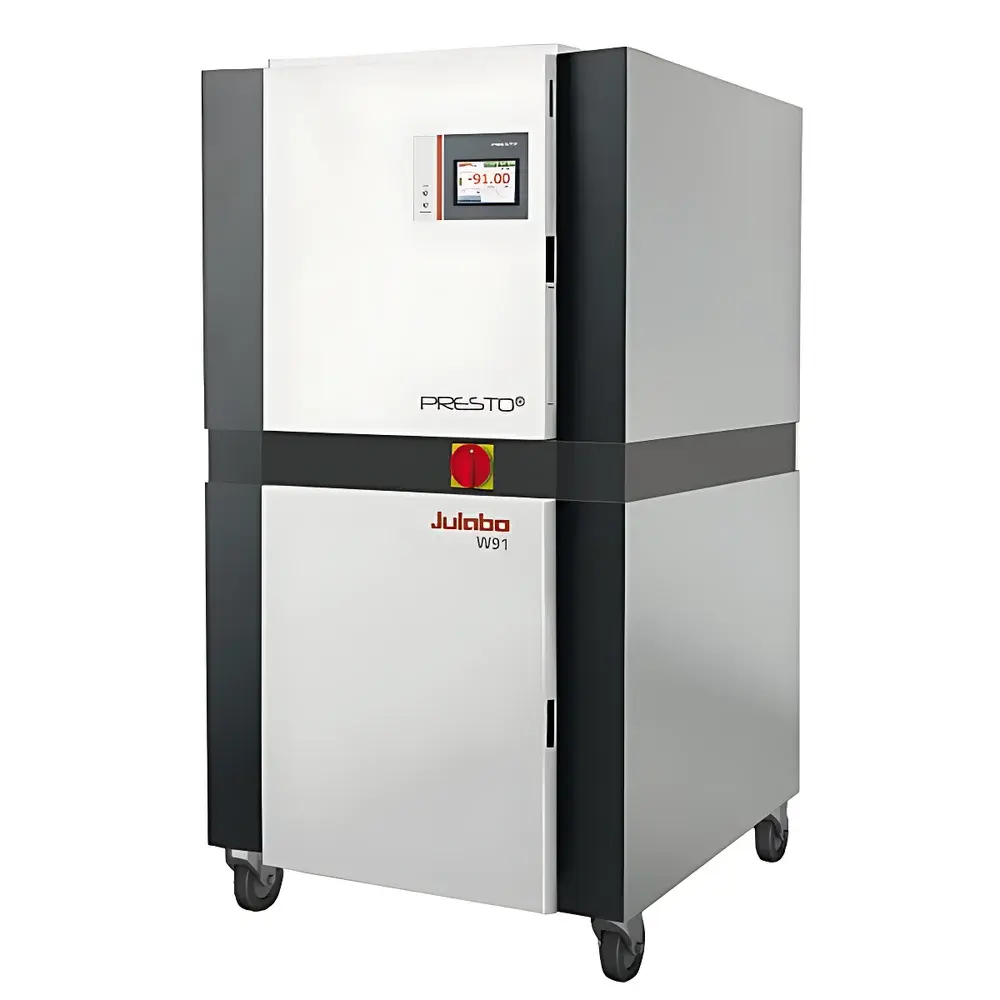
JULABO PRESTO W91x Series Closed-Loop High-Precision Dynamic Temperature Control System
| Brand | JULABO |
|---|---|
| Origin | Germany |
| Model | PRESTO W91x / W91ttx |
| Circulation | Internal & External |
| Temperature Control Mode | Refrigeration & Heating |
| Bath Volume | 40 L |
| Temperature Range | −91 °C to +250 °C |
| Temperature Stability | ±0.05 °C to ±0.2 °C |
| Heating Power | 18 kW (W91x) / 36 kW (W91ttx) |
| Refrigeration Power (kW) | 11.0 @ +20 °C, 11.0 @ 0 °C, 11.0 @ −20 °C, 10.5 @ −40 °C, 8.0 @ −60 °C, 2.0 @ −80 °C |
| Pump Flow Rate | 18–70 L/min |
| Pump Pressure | 0.8–5.5 bar |
| Fill Volume | 40 L |
Overview
The JULABO PRESTO W91x Series is a closed-loop, high-precision dynamic temperature control system engineered for demanding external process applications—particularly jacketed reactors, calorimeters, and pilot-scale synthesis units requiring rapid, bidirectional thermal response across an exceptionally wide operational range. Unlike conventional circulators limited by bath fluid compatibility or static thermal inertia, the PRESTO W91x implements JULABO’s proprietary dynamic temperature control architecture—first conceptualized in 1989 with the ATS prototype—where real-time power modulation, adaptive ICC (Intelligent Cascade Control) algorithms, and thermally optimized hydraulic design converge to deliver sub-second thermal responsiveness and stability down to ±0.05 °C. This system operates without bath fluid replacement across its full −91 °C to +250 °C span, enabled by a dual-circuit refrigeration architecture (low-temp cascade + high-temp vapor-compression), high-efficiency electric heating elements, and a sealed, pressurized circulation loop that eliminates volatile emissions and oxidation degradation of thermal fluids such as Thermal HL.
Key Features
- True wide-range operation: Single-fluid capability from −91 °C to +250 °C—no fluid swaps, no downtime, no cross-contamination risk.
- Intelligent Cascade Control (ICC): Adaptive PID-based algorithm with feedforward compensation for exothermic/endothermic load transients; achieves ±0.05 °C stability under dynamic process conditions.
- Closed-system hydraulics: Hermetically sealed reservoir and vapor-tight circulation path prevent oil mist, odor, and oxidative aging—extending thermal fluid service life by >3× versus open-bath systems.
- High-power dual-mode thermal actuation: 18 kW (W91x) or 36 kW (W91ttx) heating capacity paired with multi-stage refrigeration delivering up to 11.0 kW cooling at 0 °C and 2.0 kW at −80 °C.
- Variable-speed high-head circulation pump: Flow adjustable from 18–70 L/min with pressure output up to 5.5 bar—optimized for high-resistance reactor jackets and long external loops.
- No-frost/no-ice operation: Integrated defrost logic, condensate management, and cryogenic insulation ensure uninterrupted performance even during extended sub-zero cycling.
Sample Compatibility & Compliance
The PRESTO W91x supports external temperature control of glass, stainless steel, and Hastelloy-jacketed vessels (standard DIN/ISO 2852, ASME BPE compliant interfaces). Its sealed architecture meets IEC 61000-6-3 (EMC) and IEC 61010-1 (safety) requirements for laboratory and pilot-plant environments. When integrated into automated reaction platforms, the system supports audit-trail-enabled operation per FDA 21 CFR Part 11 when used with JULABO’s optional TRONIC software suite. It complies with ISO 17025 calibration traceability standards for temperature control verification and is routinely deployed in GLP/GMP-regulated R&D labs performing API synthesis, polymerization kinetics, and catalytic screening per ASTM E2847 and USP .
Software & Data Management
Control is executed via the embedded 7″ capacitive touchscreen interface running JULABO’s TRONIC OS v4.x—supporting multi-segment ramp/soak programming, real-time trend logging (≥10,000 data points), and alarm-triggered email/SNMP notifications. Optional Ethernet/Modbus TCP and Profibus DP interfaces enable seamless integration into DCS/SCADA systems (e.g., DeltaV, Siemens PCS7). Raw temperature, flow, pressure, and power consumption data are exportable in CSV or XML format. Firmware updates are performed via USB or secure HTTPS; all configuration changes and setpoint modifications are time-stamped and user-logged—meeting ALCOA+ data integrity principles for regulated workflows.
Applications
- Temperature-controlled synthesis in jacketed glass or metal reactors (e.g., Grignard, lithiation, hydrogenation).
- Reaction calorimetry (RC1, CPA) requiring precise enthalpy tracking during fast exotherms.
- Material testing: Thermomechanical analysis (TMA), dynamic mechanical analysis (DMA), and rheological profiling under programmable thermal ramps.
- Pharmaceutical development: Crystallization optimization, polymorph screening, and lyophilization cycle support.
- Electrochemical cell conditioning and battery electrolyte stability studies at extreme low temperatures.
- Calibration laboratories requiring NIST-traceable thermal source stability for sensor validation.
FAQ
What distinguishes “dynamic” temperature control from conventional circulators?
Dynamic control refers to active, real-time power balancing between heating and cooling actuators—enabled by dual independent thermal circuits and predictive load estimation—not just proportional setpoint regulation.
Can the W91x operate continuously at −90 °C?
Yes—its cascade refrigeration system and vacuum-insulated bath allow sustained operation at −91 °C with stability ≤±0.15 °C under nominal load conditions.
Is Thermal HL fluid mandatory, or can other heat transfer media be used?
Thermal HL is recommended and factory-validated for full-range performance; substitution requires revalidation of thermal conductivity, viscosity, and flash point compliance per IEC 60584.
Does the system support external PLC integration for batch sequence control?
Yes—via Modbus TCP, Profibus DP, or 4–20 mA analog I/O; full register mapping and command protocol documentation is provided upon request.
How is temperature uniformity maintained across large external loops?
By combining high-flow/low-pressure-drop pump hydraulics, insulated flexible tubing kits, and optional inline temperature feedback probes with cascaded secondary control loops.



