
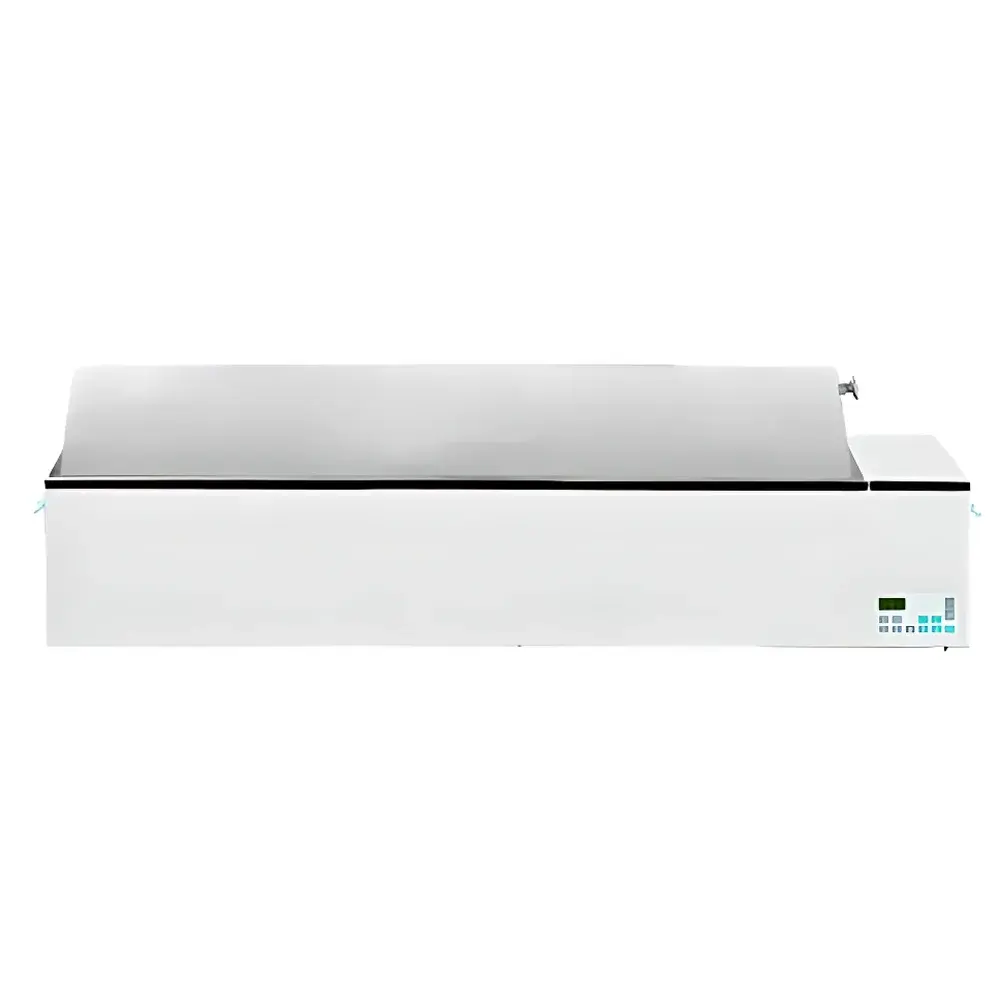
JULABO SW40 Large-Capacity Temperature-Controlled Orbital Shaking Water Bath
| Brand | JULABO |
|---|---|
| Origin | Germany |
| Model | SW40 |
| Instrument Type | Circulating Temperature-Controlled Shaking Bath |
| Capacity Range | 16–40 L |
| Temperature Range | Ambient +5 °C to 85 °C |
| Temperature Stability | ±0.2 °C |
| Temperature Resolution | 0.1 °C |
| Oscillation Frequency Resolution | 1 rpm |
| Oscillation Amplitude | 15 mm / 25 mm (selectable) |
| Heating Power | 2 kW |
| Bath Opening Dimensions (W × L × H) | 100 × 60 × 18 cm |
| External Dimensions (W × D × H) | 120 × 35 × 26 cm (base) / 43 cm (total height) |
| Interface | RS232 |
| Timer Range | 0–10 h |
| Safety Features | Dry-run protection with audible/visual alarm and automatic power cutoff |
| Optional Accessories | Makrolon bath cover, universal tube racks, Erlenmeyer flask clamps, custom platform inserts |
Overview
The JULABO SW40 Large-Capacity Temperature-Controlled Orbital Shaking Water Bath is an engineered solution for applications requiring simultaneous precise thermal regulation and uniform orbital agitation across large-volume liquid samples. Designed around a dual-function circulation system—supporting both internal bath homogenization and external temperature transfer—the SW40 operates on a robust Peltier-assisted heating architecture combined with high-efficiency resistive heating elements, enabling stable setpoint maintenance from ambient +5 °C to 85 °C. Its orbital shaking mechanism employs a brushless DC motor with microprocessor-controlled speed feedback, delivering consistent motion profiles at selectable amplitudes (15 mm or 25 mm) and frequencies across the full operational range. Unlike basic static baths, the SW40 integrates closed-loop temperature monitoring via multiple platinum RTD sensors positioned within the bath fluid and at critical thermal interfaces, ensuring spatial uniformity and minimizing gradient-induced experimental variability. This architecture supports reproducible incubation of cell cultures, enzymatic reactions, solubility studies, and dissolution testing where both thermal fidelity and mechanical mixing are non-negotiable.
Key Features
- Microprocessor-based control system with waterproof membrane keypad for reliable operation in humid laboratory environments
- High-contrast LED display showing real-time setpoint and actual bath temperature, oscillation frequency, amplitude selection, and configurable high/low temperature alarm thresholds
- Dual-mode circulation: internal recirculation for bath homogeneity and external pump outlet for connection to auxiliary jackets or external reactors
- Dry-run protection circuitry with redundant level sensing—triggers audible/visual alarm and cuts power if fluid volume falls below safe operational threshold
- Precision timer (0–10 hours) with auto-shutdown functionality, supporting unattended overnight protocols
- RS232 serial interface for remote parameter configuration, data logging, and integration into centralized lab management systems
- Modular accessory ecosystem including Makrolon insulated bath covers (reducing evaporation and heat loss), adjustable multi-position tube racks, conical flask holders, and custom-fit platform inserts for irregular vessels
Sample Compatibility & Compliance
The SW40 accommodates standard laboratory glassware—including 250 mL to 5 L Erlenmeyer flasks, cylindrical culture bottles, and multi-well plates—via configurable mounting hardware. Its open-bath geometry (100 × 60 × 18 cm) allows flexible positioning of heterogeneous sample arrays while maintaining thermal uniformity (±0.2 °C stability, verified per DIN 12879). The unit complies with IEC 61010-1 for electrical safety and meets EN 61326-1 requirements for electromagnetic compatibility. When operated under validated SOPs, the SW40 supports GLP and GMP-aligned workflows; its RS232 interface enables traceable parameter recording compatible with FDA 21 CFR Part 11–compliant data acquisition software when paired with appropriate audit-trail-enabled host systems.
Software & Data Management
While the SW40 operates autonomously via its onboard controller, its RS232 port permits bidirectional communication with third-party SCADA platforms or JULABO’s optional PC-based software suite (e.g., JULABO LabSoft). This enables remote setting of temperature ramps, oscillation profiles, and alarm thresholds; real-time streaming of sensor values; and timestamped export of session logs (.csv format). All logged parameters include instrument ID, operator code (if entered), and environmental timestamps—facilitating compliance with ISO/IEC 17025 documentation requirements for method validation and equipment qualification.
Applications
- Cell culture expansion and suspension bioreactor seeding under controlled thermal and mixing conditions
- Enzyme kinetics assays requiring constant temperature and homogeneous substrate dispersion
- Solubility and phase behavior studies of pharmaceutical excipients and active ingredients
- Dissolution testing per USP and Ph. Eur. 2.9.3 guidelines using jacketed vessel configurations
- Hybridization and washing steps in molecular biology workflows (e.g., Southern/Northern blotting)
- Accelerated stability testing of formulations under defined thermal stress profiles
FAQ
What is the maximum recommended fill volume for optimal thermal and mechanical performance?
For best uniformity and oscillation efficiency, maintain fluid level between 16 L (minimum operational volume) and 40 L (maximum rated capacity), ensuring immersion depth exceeds 5 cm above the heater element and oscillation drive shaft.
Can the SW40 be used with oil-based heat transfer fluids?
No—the SW40 is specifically designed and validated for aqueous solutions only; use of oils or organic solvents voids warranty and poses safety risks due to incompatible sealing materials and thermal expansion characteristics.
Is calibration certificate included with shipment?
A factory-issued calibration report (traceable to PTB standards) is available upon request at time of order; on-site IQ/OQ/PQ validation support can be arranged through JULABO’s certified service partners.
How does the dry-run protection system detect low fluid levels?
It utilizes dual capacitive level sensors embedded in the bath chamber wall, cross-verified against temperature drift anomalies and flow-rate discontinuities in the circulation loop.
What maintenance intervals are recommended for long-term reliability?
Annual inspection of pump seals, RTD sensor integrity, and electrical grounding continuity is advised; quarterly cleaning of the stainless-steel bath interior with deionized water and mild detergent prevents mineral buildup and preserves thermal response accuracy.



