
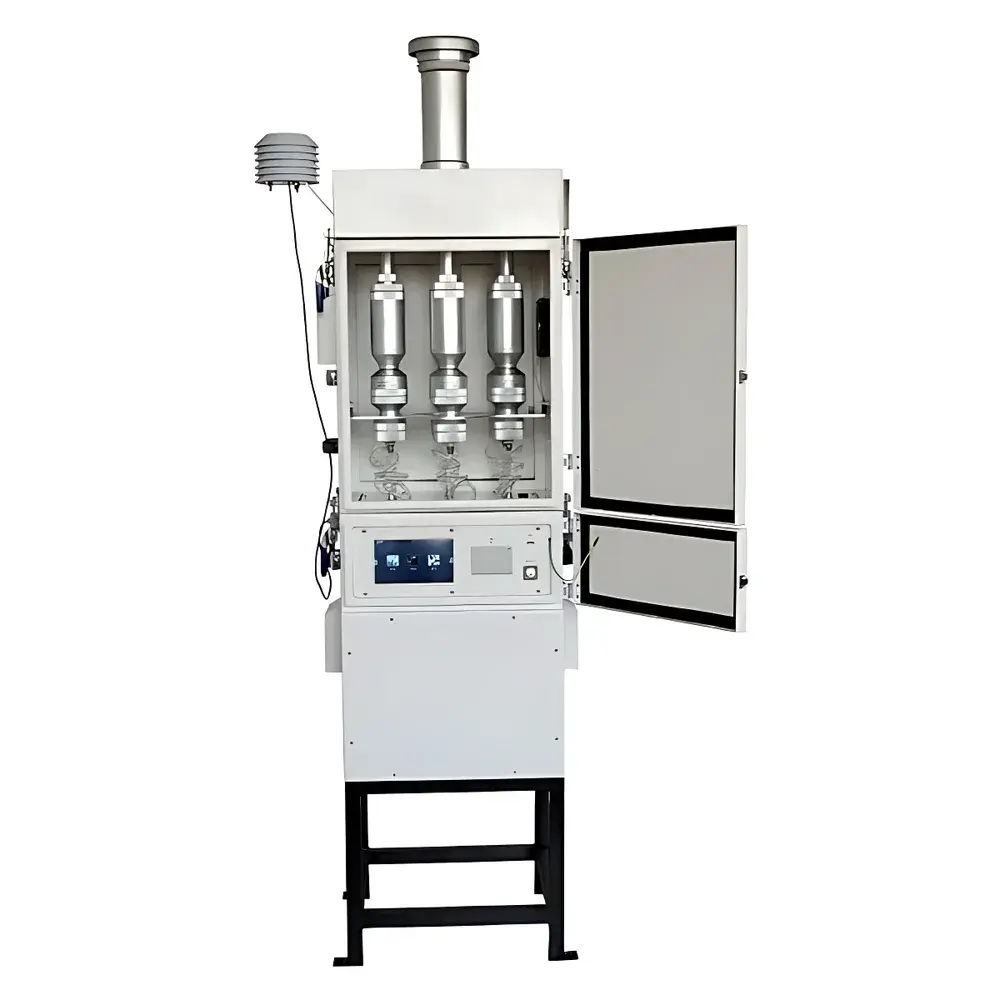
Junray ZR-3930D Multi-Channel Ambient Air Particulate Matter Sampler
| Brand | Junray |
|---|---|
| Origin | Shandong, China |
| Manufacturer Type | OEM Manufacturer |
| Model | ZR-3930D |
| Flow Rate Range | 16.7 L/min per channel |
| Maximum Pressure Drop Compensation | >35 kPa per channel |
| Flow Stability | ≤±5% over 1 h |
| Maximum Flow Error | ±2.5% (full-scale) |
| Operational Duration at Max Flow & Load | 2–8 h |
| Rated Service Life at Max Flow & Load | ≥5000 h |
Overview
The Junray ZR-3930D Multi-Channel Ambient Air Particulate Matter Sampler is a six-channel, isokinetic parallel sampling system engineered for regulatory-grade source apportionment and routine ambient air quality monitoring. It operates on the principle of inertial separation and gravitational settling, integrating certified PM10 and PM2.5 impactor cutting heads with a proprietary isotropic flow-splitting manifold. This design ensures that total suspended particulates (TSP) entering the inlet are uniformly distributed across all six independent sampling paths—preserving particle size distribution integrity and enabling true co-located, time-synchronized gravimetric analysis of TSP, PM10, and PM2.5 fractions. The instrument complies with core Chinese environmental standards HJ 93–2013 (Technical Requirements for PM10/PM2.5 Samplers) and HJ 656–2013 (Gravimetric Method Specifications for Manual Ambient PM Monitoring), and its physical architecture supports method validation under ISO 12103-1 (test dust calibration) and ASTM D1424 (air filtration efficiency testing) frameworks.
Key Features
- Six independent sampling channels with fully decoupled mass-flow control—each channel maintains stable 16.7 L/min operation even under dynamic filter loading conditions exceeding 35 kPa pressure drop.
- Brushless high-vacuum pump assembly with closed-loop PID flow regulation, delivering ≤±2.5% full-scale accuracy and ≤±5% short-term drift over one hour.
- Isotropic flow splitter with laminarized internal geometry—minimizes turbulent diffusion and particle bounce, ensuring representative partitioning of coarse, fine, and ultrafine fractions into designated impactor stages.
- Tool-free filter cassette exchange mechanism compatible with standard 47 mm quartz fiber or PTFE membrane filters; impactor heads designed for rapid disassembly, solvent rinsing, and trace-metal-free drying.
- Integrated environmental sensor suite: real-time measurement of ambient temperature (±0.3 °C), relative humidity (±2 %RH), and barometric pressure (±0.1 kPa), logged synchronously with flow and runtime data.
- Non-volatile memory stores ≥90 days of 5-minute interval records—including flow rate, pressure differential, temperature/humidity, cumulative operating hours, and power interruption timestamps.
Sample Compatibility & Compliance
The ZR-3930D supports gravimetric, elemental, and organic carbon analysis workflows using standard 47 mm filter media (e.g., Whatman QMA, Pallflex EFA-0600, or Sartorius SM17001). Its flow control architecture meets the stability and accuracy thresholds required for EPA Reference Method PS-1 and EU EN 12341 compliance when paired with certified PM10/PM2.5 cyclones or WINS impactors. All firmware logic adheres to GLP data integrity principles: audit trails record user logins, parameter changes, calibration events, and unexpected power-loss recovery sequences. Data export via USB adheres to ISO/IEC 17025-aligned metadata tagging (including UTC timestamps, instrument ID, operator code, and site-specific location coordinates).
Software & Data Management
The embedded Linux-based controller provides local data visualization through a 5.7-inch resistive touchscreen interface. Raw sampling logs (CSV format) include column headers compliant with AQMS-2021 metadata schema: “TIMESTAMP_UTC”, “CHANNEL_ID”, “FLOW_LPM”, “DP_KPA”, “TEMP_C”, “RH_PCT”, “PRESS_KPA”, “FILTER_ID”, “POWER_STATE”. USB mass-storage mode enables direct drag-and-drop transfer to laboratory LIMS systems. Optional RS-485 Modbus RTU output allows integration into centralized SCADA networks for multi-station ambient monitoring deployments. Firmware updates are performed via signed binary packages verified using SHA-256 checksums to prevent unauthorized modification.
Applications
- Ambient source apportionment studies requiring co-located, time-matched PM fractionation for receptor modeling (e.g., PMF, CMB).
- Long-term trend monitoring at national reference stations where inter-channel reproducibility (<2.1% RSD across six parallel filters, per HJ 656–2013 Annex B) is critical.
- Method validation laboratories verifying performance of new PM separation devices against HJ 93–2013 test protocols.
- Indoor-outdoor exposure assessment campaigns deploying synchronized samplers across microenvironments (traffic corridors, residential zones, industrial perimeters).
- Calibration facility use as a stable flow reference source for secondary calibrators and transfer standards.
FAQ
Does the ZR-3930D support remote configuration or networked data upload?
No—the device operates as a standalone field unit with local USB and optional RS-485 Modbus connectivity. Cloud-based telemetry requires external gateway hardware.
Can I replace the built-in PM10 and PM2.5 impactors with custom-designed cyclones?
Yes—mechanical mounting interfaces conform to ISO 9096 flange specifications; users must validate aerodynamic cutoff performance independently per ISO 29463-3.
What maintenance intervals are recommended for the brushless pump and flow sensors?
Pump bearings are rated for ≥5000 h at maximum load; annual verification of thermal mass flow sensor zero-point drift using dry nitrogen at 20 °C is advised.
Is the internal printer compatible with GLP-compliant audit trail printing?
Yes—the thermal printer outputs timestamped session summaries including calibration dates, filter IDs, and operator signatures; printed logs meet FDA 21 CFR Part 11 predicate rule requirements when used with controlled access procedures.
How does the instrument handle power interruptions during extended sampling campaigns?
It retains all operational parameters and cumulative runtime in non-volatile memory; upon restoration, it resumes sampling from the exact pre-interruption flow setpoint and logs the outage duration and recovery timestamp.







