
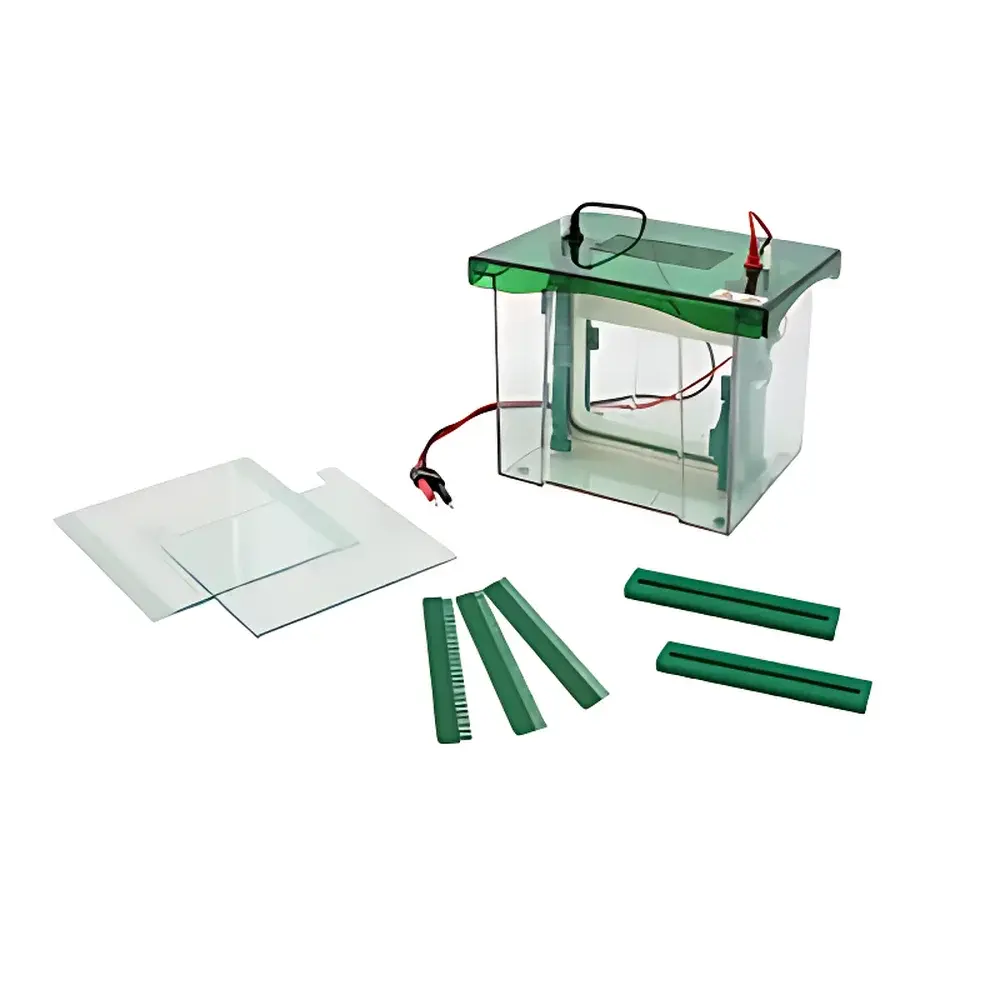
Junyi JY-JX5L Vertical Electrophoresis Tank
| Brand | Junyi |
|---|---|
| Origin | Beijing, China |
| Model | JY-JX5L |
| Gel Dimensions (W×L) | 186 × 205 mm |
| Gel Thickness | 1.0 mm |
| Number of Gels | 1–2 |
| Sample Capacity | 104 wells (with 1.0 mm thickness) |
| Buffer Volume | ~8000 mL |
| External Dimensions (L×W×H) | 320 × 240 × 230 mm |
| Net Weight | 5.6 kg |
| Construction | Vertically oriented, single-unit molded acrylic body |
| Gel Casting | In-situ casting during electrophoresis supported |
| Safety | Lid-activated power cutoff mechanism |
Overview
The Junyi JY-JX5L Vertical Electrophoresis Tank is an engineered platform for high-resolution polyacrylamide gel electrophoresis (PAGE), optimized for nucleic acid and protein separation in molecular biology laboratories. Designed on the principle of vertical slab electrophoresis—where electric current drives charged biomolecules through a porous polyacrylamide matrix under controlled buffer conditions—the JY-JX5L supports both standard denaturing (SDS-PAGE) and native PAGE applications. Its extended gel length (205 mm active separation distance) enhances resolution for closely migrating fragments, particularly critical in SSR (Simple Sequence Repeat) genotyping, microsatellite analysis, and post-PCR fragment profiling. The unit operates without integrated power supply—intended for use with external DC power sources compliant with laboratory safety standards (e.g., ≤600 V, current-limited output)—and is fully compatible with standard electrophoresis buffer systems including Tris-Glycine, Tris-Tricine, and Bis-Tris MES.
Key Features
- Molded monolithic acrylic construction ensures dimensional stability, chemical resistance to common electrophoresis buffers (e.g., SDS, TEMED, ammonium persulfate), and eliminates seam-related leakage—a persistent failure mode in older clamp-style systems.
- Integrated lid-actuated electrical interlock: Power is automatically disconnected upon lid opening, meeting IEC 61010-1 requirements for laboratory equipment safety.
- Precision-machined comb and frame alignment system guarantees consistent well geometry and gel thickness (1.0 mm), minimizing run-to-run variability in band migration and staining uniformity.
- In-situ gel casting capability allows polymerization to proceed concurrently with electrophoresis setup, reducing total assay turnaround time without compromising gel integrity.
- Optimized thermal management via 8 L buffer reservoir volume—providing sufficient thermal mass to stabilize pH and temperature during prolonged high-voltage runs (e.g., >200 V for 90+ minutes).
- Ergonomic wrench-based tightening mechanism simplifies gel sandwich assembly and reduces operator-induced stress on glass plates, improving reproducibility across users and shifts.
Sample Compatibility & Compliance
The JY-JX5L accommodates standard 1.0 mm thick polyacrylamide gels (186 × 205 mm), supporting up to 104 sample wells using multi-prong combs (25-, 40-, or 52-well configurations). It is routinely deployed in GLP-aligned SSR genotyping workflows, where traceability and repeatability are essential. While the tank itself does not carry CE/UKCA marking or FDA 510(k) clearance (as it is a passive electrophoretic chamber, not an active medical device), its design conforms to general laboratory equipment safety expectations referenced in ISO/IEC 17025:2017 (clause 6.4.2 — equipment suitability) and supports compliance with ASTM D5233-19 (standard practice for electrophoretic separation of nucleic acids). Buffer compatibility includes standard anionic and cationic systems; long-term exposure to strong oxidizers (e.g., >10% H₂O₂) or organic solvents is not recommended.
Software & Data Management
As a hardware-only electrophoresis chamber, the JY-JX5L does not incorporate embedded firmware, connectivity interfaces, or proprietary software. All data acquisition and analysis—including band quantification, molecular weight estimation, and lane normalization—is performed externally using industry-standard imaging platforms (e.g., Bio-Rad ChemiDoc, Azure Sapphire, or UVP Biospectrum) and open-format analysis tools (ImageJ/Fiji, Quantity One legacy import, or Python-based scikit-image pipelines). This architecture ensures full audit trail transparency and avoids vendor lock-in, facilitating integration into regulated environments requiring 21 CFR Part 11-compliant electronic records when paired with validated third-party imaging and analysis software.
Applications
- SSR and microsatellite allele sizing in plant and animal breeding programs
- Verification of PCR product integrity and specificity prior to sequencing
- High-resolution separation of small DNA fragments (20–500 bp) in denaturing PAGE
- Native PAGE analysis of protein complexes and oligomeric states
- Preparative PAGE for downstream extraction and mass spectrometry sample preparation
- Teaching laboratory implementation of fundamental electrophoretic theory and technique
FAQ
Is the JY-JX5L compatible with pre-cast gels?
No—it is designed exclusively for hand-cast polyacrylamide gels using standard glass plates and spacers.
What power supply specifications are recommended for optimal performance?
A programmable DC power supply capable of 10–600 V output, current limiting (0.01–500 mA), and constant voltage or constant current modes is required. Typical PAGE runs operate between 150–250 V.
Can two gels be run simultaneously in this unit?
Yes—the dual-gel configuration is mechanically supported, with independent buffer compartments maintained by central sealing gaskets.
Does the unit include glass plates, combs, or casting frames?
No—these are sold separately as consumables or accessories, allowing users to select plate thicknesses (0.75 mm, 1.0 mm, 1.5 mm) and well geometries based on application needs.
How is buffer recirculation handled?
The JY-JX5L relies on passive convection and large-volume buffer reservoirs; active recirculation requires external peristaltic pumps and custom tubing interfaces—not included or validated by the manufacturer.





