
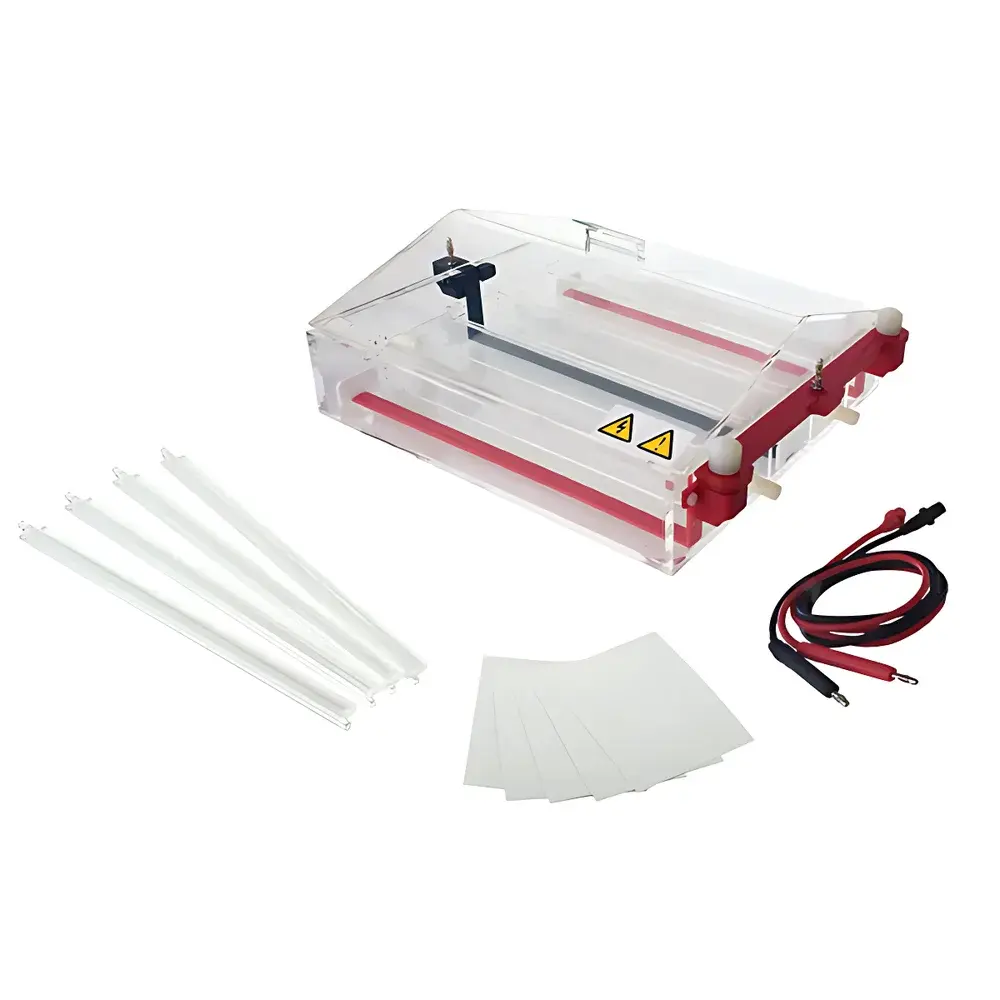
Junyi JY-SP7A Cellulose Acetate Membrane Electrophoresis Tank
| Brand | Junyi |
|---|---|
| Origin | Beijing, China |
| Manufacturer Type | Authorized Distributor |
| Product Category | Domestic |
| Model | JY-SP7A |
| Instrument Type | Transfer Electrophoresis Apparatus |
| Primary Component | Electrophoresis Tank |
| Gel Dimensions | 70 × 250 mm × 2 (dual bridge configuration) |
| Sample Capacity | 28 samples |
| Buffer Volume | ~1000 mL |
| External Dimensions | 350 × 260 × 65 mm |
| Net Weight | 1.6 kg |
| Cooling System | Integrated passive/convective thermal management |
| Electrode Assembly | Removable and serviceable |
| Safety Interlock | Lid-activated power cutoff |
Overview
The Junyi JY-SP7A Cellulose Acetate Membrane Electrophoresis Tank is a purpose-engineered apparatus designed for standardized, reproducible electrophoretic separation of biomolecules—including serum proteins, hemoglobin variants, lipoproteins, and isoenzymes—on cellulose acetate membranes. Unlike slab-gel systems relying on polyacrylamide or agarose matrices, this unit operates under constant-voltage or constant-current conditions (when paired with an external power supply) and leverages the high-resolution, rapid migration characteristics of cellulose acetate supports. Its dual-bridge architecture enables parallel electrophoresis across two independent 70 × 250 mm membrane lanes, supporting comparative analysis and experimental replication within a single run. The tank’s low-profile design (65 mm height) minimizes buffer volume requirements while maintaining sufficient electrode spacing for stable field uniformity. Constructed from impact-resistant, UV-stable acrylic, the chamber resists degradation from repeated exposure to ethanol, chloroform, and acetic acid—common solvents in membrane staining and destaining protocols.
Key Features
- Dual-bridge configuration accommodates two 70 × 250 mm cellulose acetate membranes simultaneously, doubling throughput without compromising resolution or run-to-run consistency.
- Integrated thermal management system mitigates Joule heating during extended runs; convective cooling via optimized buffer chamber geometry maintains temperature stability within ±2 °C under typical operating conditions (e.g., 150–250 V, 20–40 mA).
- Adjustable bridge rod positioning allows precise control over electrophoretic distance (migration length), enabling method adaptation for varying molecular weight ranges or protocol-specific separation requirements (e.g., hemoglobin A1c vs. transferrin isoforms).
- Fail-safe lid interlock mechanism interrupts electrical continuity upon opening, complying with IEC 61010-1 safety principles for laboratory electrical equipment.
- Modular electrode assembly—comprising platinum-coated stainless-steel wires mounted on detachable, chemically inert carriers—facilitates routine cleaning, calibration verification, and replacement without disassembling the main chamber.
- Ergonomic, one-touch lid release button ensures smooth, controlled access to membranes while minimizing mechanical stress on buffer seals and electrode contacts.
Sample Compatibility & Compliance
The JY-SP7A is validated for use with standard commercial cellulose acetate membranes (e.g., Whatman CA40, Helena Laboratories Seralizer®), as well as filter paper and microscope slide-based electrophoresis substrates. It supports common electrophoretic buffers including barbital, Veronal-acetate, and Tris-glycine systems at pH 8.2–8.6. The device conforms to fundamental safety requirements outlined in ISO 15195:2018 (clinical laboratory testing — requirements for reference measurement systems) and aligns with CLSI EP17-A2 guidelines for assessing analytical sensitivity in protein electrophoresis. While not certified for GLP or GMP environments per se, its mechanical repeatability, documented thermal behavior, and traceable component materials support audit-ready documentation in clinical pathology labs adhering to CAP or COLA accreditation standards.
Software & Data Management
As a benchtop electrophoresis tank, the JY-SP7A operates independently of proprietary software. However, it is fully compatible with third-party digital imaging systems (e.g., Bio-Rad ChemiDoc™, Azure Sapphire™) for post-run densitometric quantification. When used in conjunction with compliant power supplies featuring RS-232 or USB data logging (e.g., Bio-Rad PowerPac™ Basic), voltage, current, and run time parameters can be exported for inclusion in electronic lab notebooks (ELNs) satisfying 21 CFR Part 11 audit trail requirements. No embedded firmware or onboard storage is present—ensuring zero risk of data corruption or unauthorized remote access.
Applications
- Clinical serum protein profiling for detection of monoclonal gammopathies (e.g., M-protein bands in multiple myeloma screening).
- Hemoglobin variant analysis in sickle cell disease and thalassemia diagnostics, following standardized protocols per CLSI C37-A3.
- Lipoprotein subclass separation (HDL/LDL/VLDL) in cardiovascular risk assessment workflows.
- Quality control of purified immunoglobulins and recombinant therapeutic proteins during upstream bioprocessing.
- Undergraduate and graduate teaching laboratories—its dual-lane capability supports side-by-side comparison of controls vs. test samples, enhancing pedagogical clarity and statistical rigor.
FAQ
Does the JY-SP7A include a built-in power supply?
No. It is a passive electrophoresis tank requiring connection to an external DC power supply capable of delivering 100–300 V and 20–100 mA, depending on buffer conductivity and membrane hydration state.
Can the tank accommodate 90 mm wide membranes?
Yes—the bridge rods are positionally adjustable to support both 70 mm and 90 mm membrane widths, though maximum usable length remains 250 mm.
Is the acrylic chamber resistant to common organic solvents used in staining?
Yes. The material exhibits excellent resistance to ethanol, methanol, chloroform, and glacial acetic acid at room temperature for durations up to 30 minutes, consistent with standard Helenase® or Ponceau S protocols.
What maintenance is required for long-term reliability?
Rinse electrodes and chamber thoroughly with deionized water after each use; inspect platinum coating integrity annually using optical microscopy; replace electrode assemblies if visible pitting or uneven current distribution occurs across lanes.
Is technical documentation available in English with metric units?
Yes—full operation manual, dimensional drawings, and compliance summaries are supplied in English, with all specifications reported in SI units per ISO 80000-1.




