
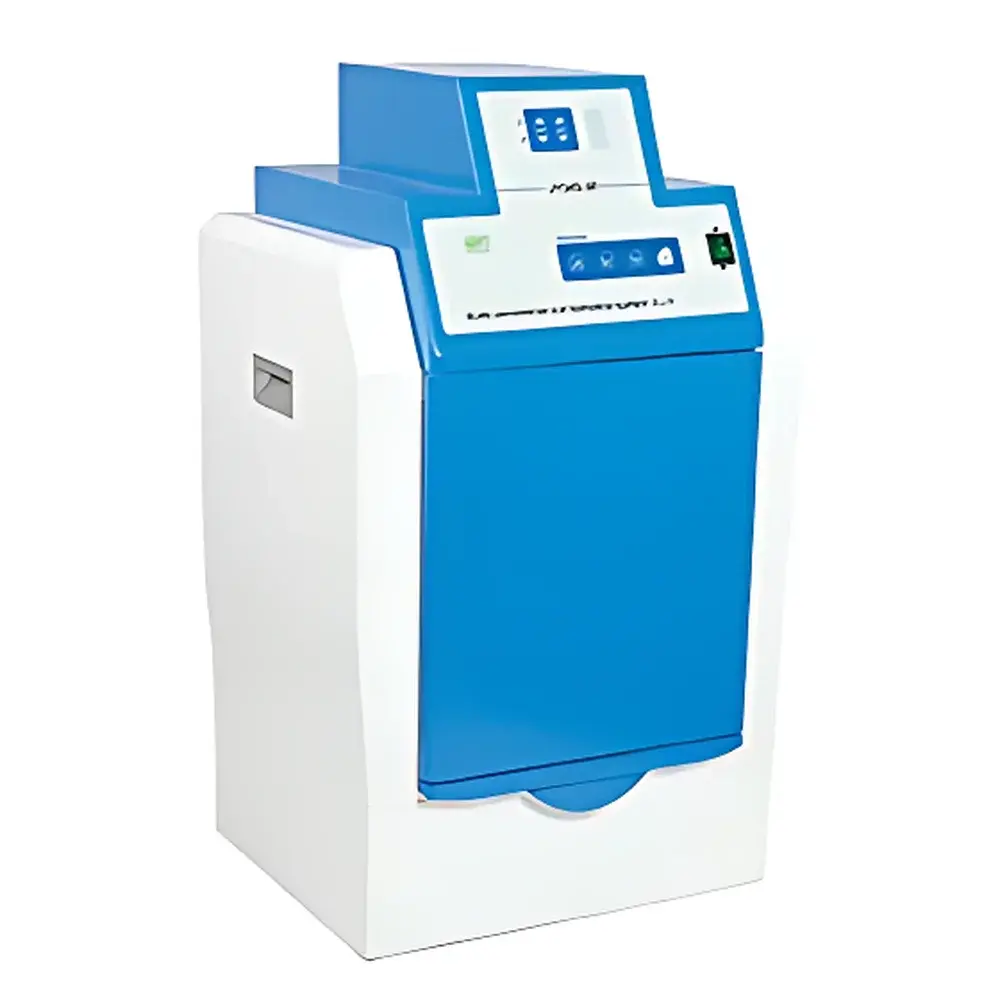
Junyi JY04S-3E Gel Imaging System
| Brand | Junyi |
|---|---|
| Origin | Beijing, China |
| Model | JY04S-3E |
| Instrument Type | Standard Gel Imaging System |
| CCD Resolution | 5 MP (2560 × 1920) |
| Bit Depth | 10-bit |
| CCD Sensor Size | 2/3" |
| Lens | F/1.2, 6× Motorized Zoom |
| UV Transillumination Wavelength | 302 nm |
| Reflective UV Wavelengths | 254 nm & 365 nm |
| Visible Light Transillumination Area | 250 × 210 mm |
| UV Transillumination Area | 250 × 200 mm |
| UV Lamp Power | 302 nm (8 W), 254/365 nm (11 W each) |
| Optical Filter | 590 nm Bandpass |
| Sensitivity | Detects <20 pg dsDNA stained with ethidium bromide |
| SNR | ≥56 dB |
| Dimensions (L×W×H) | 470 × 405 × 820 mm |
| Net Weight | 29.0 kg |
Overview
The Junyi JY04S-3E Gel Imaging System is a dedicated digital documentation and analysis platform engineered for post-electrophoresis visualization, capture, and quantitative assessment of nucleic acid and protein gels. It operates on the principle of fluorescence excitation and emission detection—specifically optimized for common nucleic acid stains (e.g., ethidium bromide, SYBR Safe) and protein dyes (e.g., Coomassie Blue, silver stain) under controlled UV and visible illumination. The system integrates a high-sensitivity, low-noise 5-megapixel monochrome CCD sensor with 10-bit analog-to-digital conversion, enabling reliable digitization of faint bands while preserving linear dynamic response across intensities. Its optical architecture features a precision 6× motorized zoom lens (F/1.2 aperture) mounted on a rigid, vibration-damped optical path, ensuring consistent focus and magnification repeatability across repeated acquisitions. All UV illumination modules—including transilluminators (302 nm) and dual-wavelength reflective sources (254 nm and 365 nm)—are housed within a fully shielded dark chamber compliant with IEC 61000-4 electromagnetic compatibility standards and designed to limit UV leakage to <1 µW/cm² at 25 cm (per IEC 62471 photobiological safety guidelines).
Key Features
- Imported high quantum efficiency CCD sensor (2/3″ format, 5.4 × 5.4 µm pixel pitch) delivering ≥56 dB signal-to-noise ratio for low-background imaging of weakly stained bands
- Fully motorized 6× zoom lens with F/1.2 aperture and integrated focus/iris control—enabling precise framing without manual repositioning
- Intelligent dark chamber with programmable UV lamp sequencing: automatic 30-second delay-off after door closure, emergency UV override switch for gel excision, and interlocked door-safety cutoff
- Dual-mode illumination: 302 nm UV transillumination (8 W) for standard DNA gels; selectable 254 nm / 365 nm reflective UV (11 W each) for TLC or native PAGE; white LED transillumination (via diffuser plate) for visible-stained gels
- Optimized optical train incorporating multi-layer hard-coated 590 nm bandpass filter to suppress stray light and maximize fluorescence signal isolation
- Modular mechanical design with drawer-style gel tray, center-alignment LED guide, and removable UV-cutting acrylic shield for safe in-chamber gel manipulation
- Full remote operation via USB 2.0 or RS-232 interface—supporting synchronized control of zoom, focus, iris, lamp selection, and exposure duration from host software
Sample Compatibility & Compliance
The JY04S-3E accommodates standard electrophoretic formats including agarose (0.5–4%), polyacrylamide (8–20%), SDS-PAGE, native PAGE, and two-dimensional gels up to 250 × 210 mm. It supports both ethidium bromide and alternative fluorescent dyes compatible with 302 nm excitation (e.g., GelRed, SYBR Gold). For regulatory environments, the system’s hardware-level UV safety interlocks and documented exposure limits align with ISO 15223-1 labeling requirements for medical device accessories. While not FDA-cleared as a standalone diagnostic instrument, its architecture satisfies foundational GLP/GMP infrastructure criteria for data integrity—particularly when paired with audit-trail-enabled acquisition software meeting 21 CFR Part 11 principles (electronic signatures, immutable logs, user access controls).
Software & Data Management
Acquisition and analysis are performed using Junyi’s proprietary GelStudio Pro software (Windows 10/11 compatible), which provides real-time preview, auto-exposure optimization, background subtraction, lane/band detection, molecular weight calibration, and relative quantification (integrated density, % volume, normalized intensity). Raw image files are saved in lossless TIFF format with embedded EXIF metadata (exposure time, lens position, lamp mode, filter ID). Export options include annotated PNG/JPEG for publication, CSV tables for statistical analysis, and PDF reports with embedded gel thumbnails and measurement summaries. Software update history, user login records, and parameter change logs are retained locally—facilitating internal validation protocols and laboratory quality audits.
Applications
- Verification and documentation of PCR amplification products, restriction digests, and cloning constructs
- Quantitative comparison of gene expression levels via RT-PCR or Northern blot densitometry
- Assessment of protein purification efficiency and subunit composition in SDS-PAGE
- Validation of CRISPR editing outcomes through T7E1 or Surveyor nuclease assays
- Quality control of synthetic oligonucleotides and plasmid preps prior to sequencing or transfection
- Educational use in undergraduate molecular biology laboratories requiring reproducible, classroom-safe UV handling
FAQ
What is the maximum gel size supported by the JY04S-3E?
The system accepts gels up to 250 mm wide × 210 mm tall for visible light imaging and 250 mm × 200 mm for 302 nm UV transillumination.
Does the system support fluorescence imaging with SYBR Safe or GelGreen?
Yes—the 302 nm transilluminator and 590 nm emission filter are spectrally matched to the excitation/emission profiles of these dyes.
Can exposure parameters be saved as presets for routine protocols?
Yes. GelStudio Pro allows creation and recall of named acquisition profiles—including lamp mode, exposure time, zoom level, and binning settings.
Is the CCD cooled to reduce thermal noise during long exposures?
No—the JY04S-3E employs ambient-cooled CCD architecture with optimized readout timing and correlated double sampling to achieve ≥56 dB SNR without active cooling.
What maintenance is required for long-term optical performance?
Annual verification of UV lamp output intensity (using NIST-traceable radiometer) and periodic cleaning of lens surfaces and filter assemblies with spectroscopic-grade methanol are recommended per manufacturer guidelines.




