
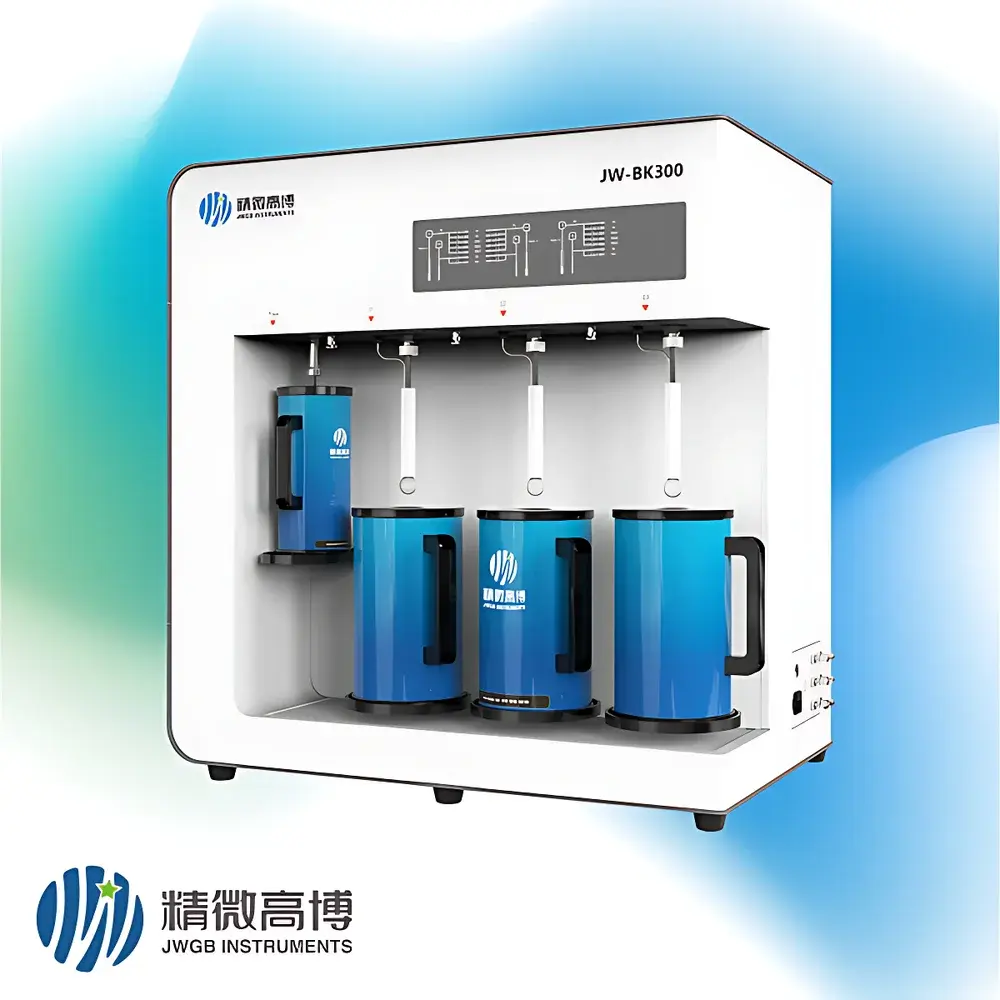
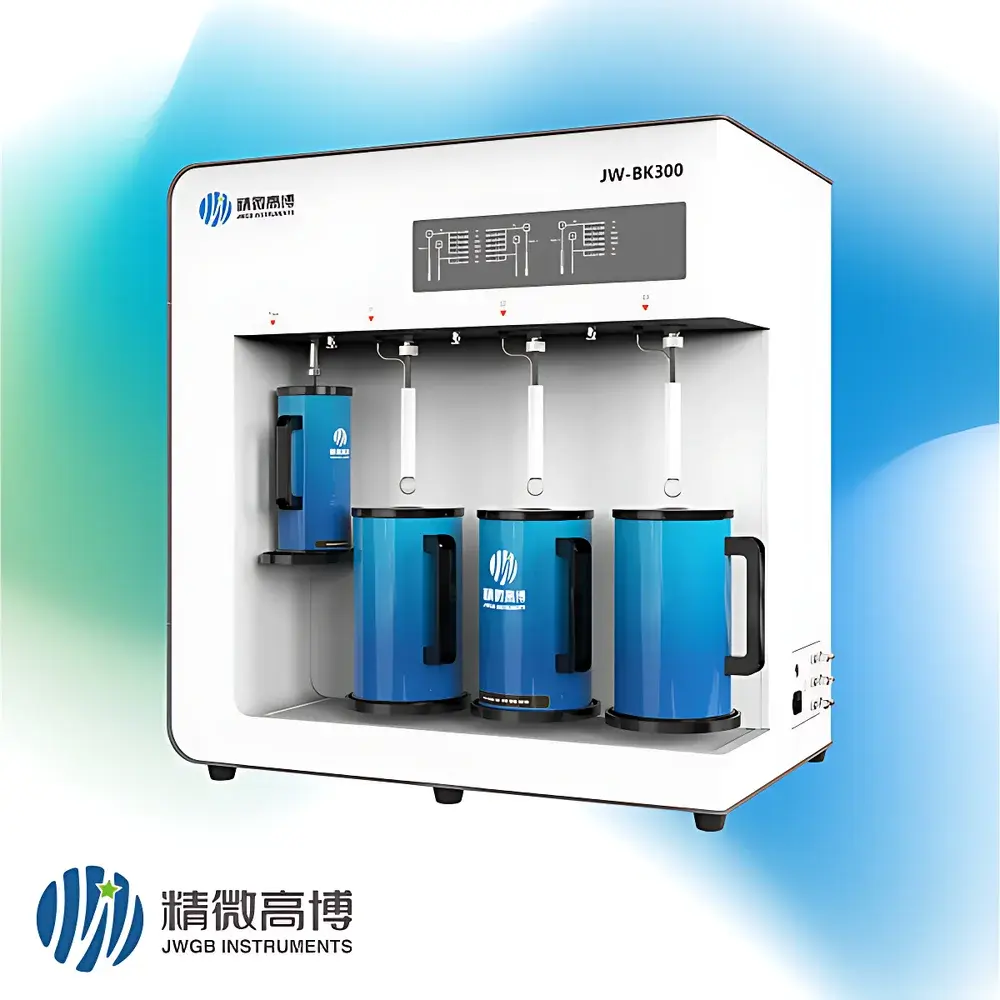
JWGB JW-BK300C Research-Grade Specific Surface Area and Pore Size Analyzer
| Brand | JWGB |
|---|---|
| Origin | Beijing, China |
| Manufacturer Type | Direct Manufacturer |
| Instrument Type | Specific Surface Area and Pore Size Analyzer |
| Model | JW-BK300C Research-Grade Specific Surface Area and Pore Size Analyzer |
| Measurement Principle | Static Volumetric Gas Adsorption |
| Number of Analysis Stations | 3 |
| Specific Surface Area Range | Down to 0.0001 m²/g |
| Relative Pressure Range | p/p₀ down to 10⁻⁸ (N₂ at 77 K) |
| Theoretical Models | BET Multilayer Adsorption, BJH Desorption for Mesopores, HK/SF for Micropores, NLDFT Non-Local Density Functional Theory |
Overview
The JWGB JW-BK300C Research-Grade Specific Surface Area and Pore Size Analyzer is a high-precision static volumetric gas adsorption instrument engineered for rigorous characterization of porous solids in academic research laboratories, national metrology institutes, and industrial R&D centers. It operates on the fundamental thermodynamic principle of physical adsorption—measuring equilibrium gas uptake under controlled temperature and pressure conditions to generate full adsorption–desorption isotherms. Using liquid nitrogen (77 K) or liquid argon (87 K) as cryogenic media, the system quantifies gas adsorption/desorption by detecting minute pressure differentials across calibrated dead volumes via ultra-high-resolution capacitance manometers. This enables derivation of specific surface area (via BET and Langmuir models), pore size distribution (via BJH, DH, HK, SF, and NLDFT methods), total pore volume, micropore volume, and adsorption energy distributions—all traceable to SI units and compliant with ISO 9277, ASTM D3663, and IUPAC recommendations.
Key Features
- Triple independent analysis stations with dedicated P₀ measurement capability—each station equipped with real-time temperature monitoring (Td) and minimized dead volume (Vd) for enhanced adsorption quantification accuracy.
- Ultra-low-pressure detection architecture: Standard 1 torr capacitance manometers (optional 0.1 torr) enable p/p₀ resolution down to 10⁻⁸ for N₂ at 77 K—critical for reliable micropore analysis in MOFs, activated carbons, and zeolites.
- Dual-mode vacuum system architecture: Configurable with separate high-vacuum molecular pumping (turbo-molecular pump, base pressure ≤1×10⁻⁸ Pa) for analysis stations and mechanical pumping for degassing stations—eliminating cross-contamination and enabling simultaneous degas/analysis workflows.
- Intelligent cryogenic control: 3 L vacuum-jacketed Dewar with optimized thermal geometry, software-based liquid level correction, and isothermal zone stabilization—ensuring consistent sample tube temperature profiles during long-duration isotherm acquisition.
- Anti-entrainment vacuum regulation: Multi-stage, programmable vacuum ramping with integrated internal anti-fly unit—prevents fine particulates (<100 nm) from migrating into valves and sensors during initial evacuation.
- Modular scalability: BK300 platform supports field-upgradable configurations—including up to 8 independent gas inlets (N₂, Ar, Kr, CO₂, H₂, O₂, CH₄, NH₃), He pycnometry channel, and dual-gas selective adsorption modules for competitive adsorption studies in environmental catalysis and gas separation applications.
Sample Compatibility & Compliance
The JW-BK300C accommodates powders, granules, monoliths, and extrudates across diverse material classes—including metal–organic frameworks (MOFs), hierarchical zeolites, mesoporous silica (SBA-15, MCM-41), activated carbons, catalyst supports (γ-Al₂O₃, TiO₂), battery electrode materials, and pharmaceutical excipients. All degassing protocols adhere to ASTM D4641 and ISO 15901 guidelines for thermal pretreatment: integrated 400 °C ±1 °C programmable furnace supports 10-segment heating ramps, with optional in-situ (on-analyzer) and off-line (dedicated degas station) modes. Vacuum integrity meets GLP/GMP documentation requirements; audit trails, user access levels, electronic signatures, and 21 CFR Part 11–compliant data archiving are supported through optional software modules. Certified reference materials (e.g., NIST SRM 1990a, 2000a) validate repeatability: RSD ≤1.0% for surface area (≥0.0001 m²/g), SD ≤0.02 nm for median micropore diameter (0.35–2 nm range).
Software & Data Management
Control and analysis are executed via JWGB’s proprietary “AdsorbMaster” software—a Windows-based, wizard-driven interface supporting remote operation over Ethernet (TCP/IP). Real-time visualization includes dynamic isotherm progression, manifold pressure/temperature telemetry, event logging with LED status indicators, and live P₀ tracking per analysis cycle. Raw data are saved in vendor-neutral .ads format with embedded metadata (instrument ID, operator, timestamp, calibration logs). Batch processing enables concurrent analysis of multiple isotherms using >15 standardized models: BET, Langmuir, t-plot, αs-plot, DR, DA, BJH (adsorption/desorption), Dollimore-Heal, HK, SF, and NLDFT kernel libraries (carbon, silica, alumina, zeolite variants). Export options include CSV, Excel, PDF reports, and ASCII-compatible files compatible with third-party modeling tools (e.g., MATLAB, OriginLab). Unattended operation allows overnight runs with automatic shutdown upon completion.
Applications
The JW-BK300C serves as a primary characterization tool in advanced materials development pipelines. In energy storage, it quantifies electrode-specific surface area and pore accessibility in Li-ion battery cathodes/anodes and supercapacitor carbons. In heterogeneous catalysis, it correlates support porosity with metal dispersion and diffusion limitations in Pt/Al₂O₃ or Ni/MOF systems. For environmental engineering, it evaluates CO₂ capture capacity in amine-grafted silicas and selectivity metrics in mixed-gas breakthrough simulations. In pharmaceutical sciences, it assesses excipient surface energetics affecting drug dissolution kinetics and tablet compaction behavior. Its micro-pore resolution supports QC/QA in carbon black production (ASTM D3849), pigment dispersion stability (ISO 5525), and catalyst regeneration monitoring per UOP test methods.
FAQ
What gases can be used for adsorption analysis on the JW-BK300C?
N₂, Ar, Kr, H₂, O₂, CO₂, CO, NH₃, and CH₄—provided they are non-corrosive and compatible with stainless-steel and Viton® wetted materials.
Does the system support automated P₀ measurement during each isotherm point?
Yes—each P₀ station employs a dedicated 133 kPa sensor and performs real-time, point-by-point P₀ determination synchronized with sample equilibration.
Can the instrument perform helium pycnometry for skeletal density?
Yes—the He purge channel enables automatic free-space calibration prior to adsorption, correcting for intraparticle void volume and yielding true adsorbed-phase quantities.
Is NLDFT pore size analysis included in the standard software package?
Yes—NLDFT kernels for carbon, silica, alumina, and zeolite frameworks are pre-installed and validated against NIST-traceable standards.
What vacuum level is achievable in the analysis manifold?
With the optional turbo-molecular pump configuration, ultimate pressure reaches ≤1×10⁻⁸ Pa—verified by cold-cathode gauge and documented in factory acceptance tests.
How is data integrity ensured for regulated environments?
Optional 21 CFR Part 11 compliance module provides role-based access control, electronic signatures, immutable audit trails, and encrypted database backups meeting FDA and EMA expectations for GxP laboratories.



