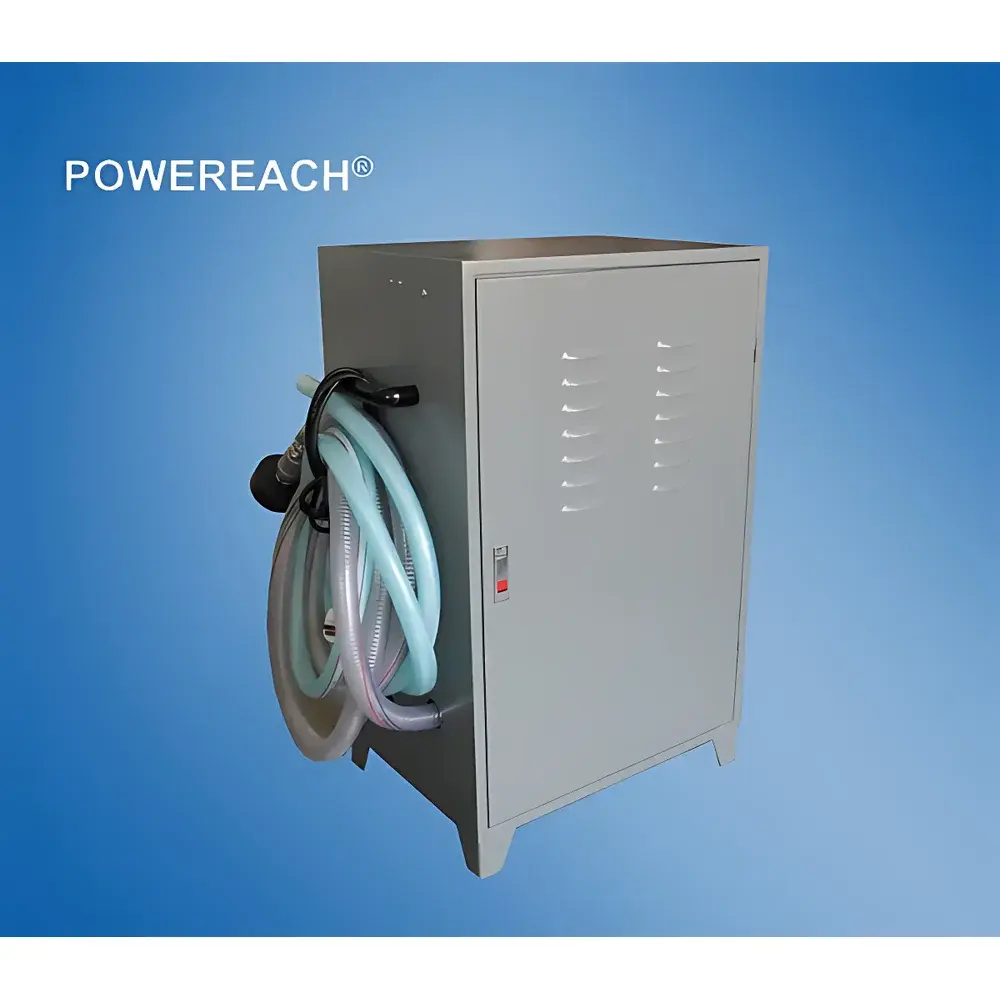
JWNP Universal Ultrafine Bubble Generator
| Origin | Beijing, China |
|---|---|
| Manufacturer Type | Distributor |
| Origin Category | Domestic |
| Model | JWNP |
| Pricing | Upon Request |
Overview
The JWNP Universal Ultrafine Bubble Generator is an engineered fluidic system designed to produce ultrafine bubbles (UFBs) with diameters predominantly in the 50–600 nm range—centered at 150 ± 30 nm—via a hybrid physical mechanism combining high-shear mechanical dispersion and pressurized gas dissolution. Unlike conventional microbubble generators relying on porous membranes, electrolysis, or hydrodynamic cavitation alone, the JWNP series implements Professor Banglin Chen’s nanoscale gas–liquid interfacial technology, enabling stable, high-density UFB generation without chemical additives, catalysts, or electrochemical byproducts. This principle leverages controlled energy input to induce rapid nucleation and stabilization of nanoscale gas domains within aqueous media, resulting in aqueous dispersions containing 10⁷–10⁹ UFBs per mL and zeta potentials consistently below −30 mV—critical for colloidal stability and prolonged residence time. The device operates strictly on physical principles; no hazardous emissions, residual ions, or secondary pollutants are generated during operation, aligning with ISO 20480-1:2019 definitions of ultrafine bubbles and supporting sustainable process integration across regulated and environmentally sensitive applications.
Key Features
- Physically driven UFB generation: No electrolytes, membranes, or consumables required—ensures long-term operational reliability and eliminates fouling-related downtime.
- Nanoscale bubble size control: Achieves median diameter of 150 ± 30 nm with narrow distribution profile, verified via dynamic light scattering (DLS) and nanoparticle tracking analysis (NTA).
- Enhanced dissolved oxygen delivery: Total dissolved oxygen (DO) increases by ≥30% compared to pre-treatment baseline, with coexistence of molecularly dissolved O₂ and stabilized dispersed-phase UFBs.
- Zeta potential stability: Surface charge of −30 to −40 mV supports electrostatic repulsion, inhibiting coalescence and extending bubble lifetime in water beyond several days under static conditions.
- Modular electrical configuration: Available in both 220 V single-phase (0.37–0.75 kW) and 380 V three-phase (0.75–2.2 kW) variants, supporting scalable deployment from lab-scale trials to field-based irrigation or aquaculture systems.
- Integrated safety protocol: Built-in dry-run protection requires priming prior to activation; motor rotation direction verification is mandatory for 380 V units to ensure correct pump hydraulics and avoid mechanical stress.
Sample Compatibility & Compliance
The JWNP generator is validated for use exclusively in aqueous systems—including freshwater, brackish water, and nutrient-rich agricultural or aquacultural effluents—with no compatibility limitations for common pH ranges (5.5–8.5) or moderate ionic strength (<100 mM NaCl equivalent). It complies with ISO 20480-1:2019 (Fine and ultrafine bubbles — Part 1: Vocabulary) and supports adherence to GLP-aligned documentation practices for environmental and agricultural research. While not certified to IEC 61000-6-2/4 or UL 61010-1 out-of-the-box, its design conforms to fundamental EMC and functional safety expectations for industrial-grade laboratory and field equipment. All models meet CE marking requirements for electromagnetic compatibility when installed with appropriate grounding and shielding per EN 61326-1.
Software & Data Management
The JWNP series operates as a hardware-only platform with no embedded firmware or proprietary software interface. Operational parameters—including flow rate (1.0–5.7 m³/h), power draw, and inlet pressure—are monitored externally using calibrated industrial sensors (e.g., Coriolis mass flow meters, dissolved oxygen probes, and digital multimeters). Users integrate data acquisition via standard 4–20 mA or 0–10 V analog outputs compatible with SCADA, LabVIEW, or PLC-based control architectures. Audit trails for maintenance, priming cycles, and directional verification are maintained manually per GLP-compliant logbooks—supporting traceability in regulatory submissions related to environmental remediation or agricultural efficacy studies.
Applications
- Soil bioremediation & agronomy: UFB-treated irrigation water enhances soil aeration, microbial activity, and root-zone oxygenation—documented improvements include +25% yield in paddy rice with 25% reduced fertilizer input, increased tillering, improved grain quality (amino acid profile), and structural reinforcement of stem morphology (38.8% greater diameter, 42.2% thicker walls).
- Aquaculture & hatchery management: In crab farming trials, UFB-treated ponds demonstrated 18% higher average harvest weight, elevated survival rates, and superior grading distribution—specifically +15% increase in market-premium specimens (>4 oz), alongside consistent DO > 5 mg/L and near-zero ammonia/nitrite accumulation over 12-month monitoring.
- Small-scale waterbody restoration: Effective in semi-closed urban waterways (e.g., campus canals, ornamental lakes, dead-end rivers), where UFB injection replaces chemical coagulants—eliminating secondary sludge formation and sustaining aerobic conditions without altering native microbiota.
- Nanomaterial synthesis support: Serves as a stable UFB carrier medium for template-assisted nanostructure fabrication, leveraging high interfacial area and negative surface charge for controlled particle nucleation and dispersion stabilization.
FAQ
What is the primary physical mechanism behind UFB generation in the JWNP system?
It combines controlled mechanical shear (via precision rotor–stator geometry) with supersaturated gas dissolution under elevated pressure—followed by rapid depressurization to trigger homogeneous nucleation of nanoscale bubbles.
Is the system compatible with seawater or high-salinity effluents?
Yes—validated for salinities up to 10 ppt; however, long-term exposure above this threshold requires periodic inspection of stainless-steel wetted components for pitting corrosion.
Does the device require calibration or routine certification?
No scheduled calibration is mandated; however, users should verify flow rate accuracy annually using a NIST-traceable flow meter and confirm zeta potential trends via third-party DLS/NTA analysis every 6 months for critical applications.
Can multiple JWNP units be synchronized for large-area deployment?
Yes—units may be manifolded into parallel configurations with shared inlet headers and individual flow control valves, provided total system backpressure remains within specified limits (≤0.8 MPa gauge).
What safety precautions are essential before first operation?
For 380 V models: verify motor rotation direction in dry-run mode using the observation port; for all models: perform full hydraulic priming before energizing—never operate the pump without liquid present.
Related Products