
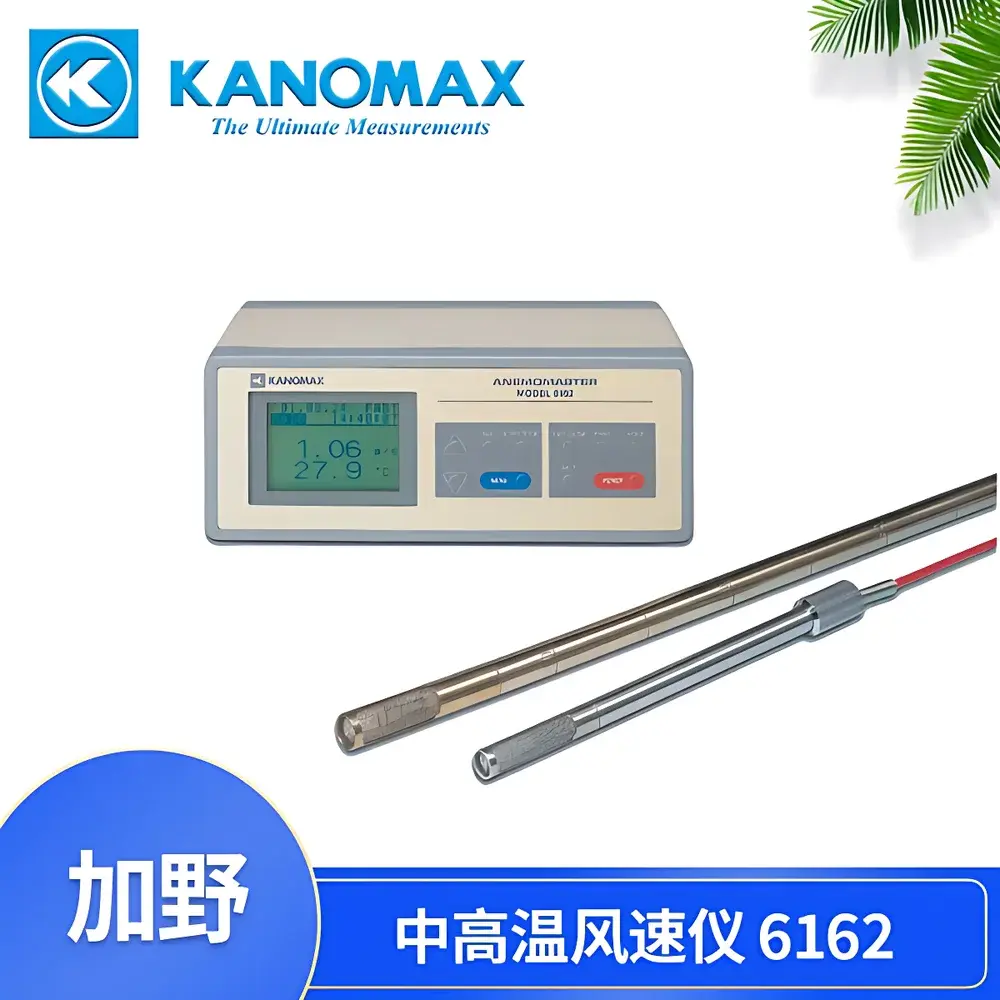
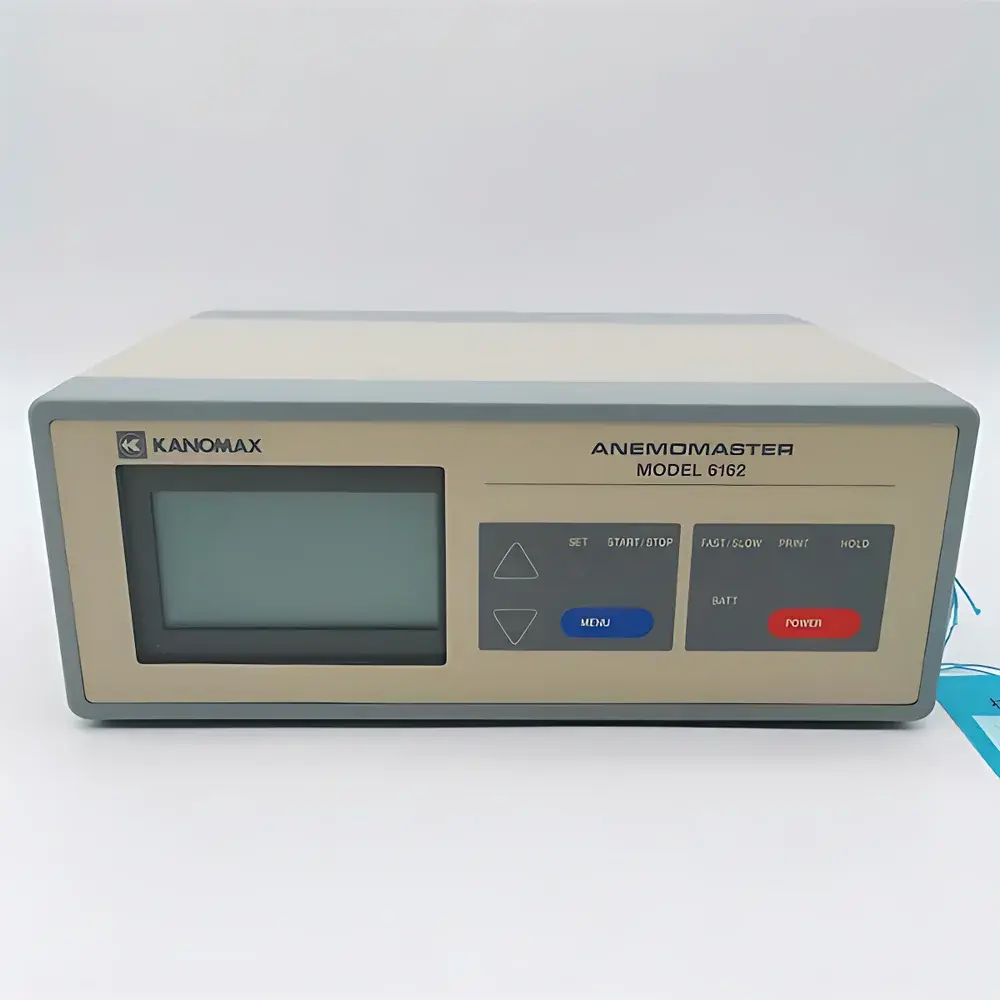
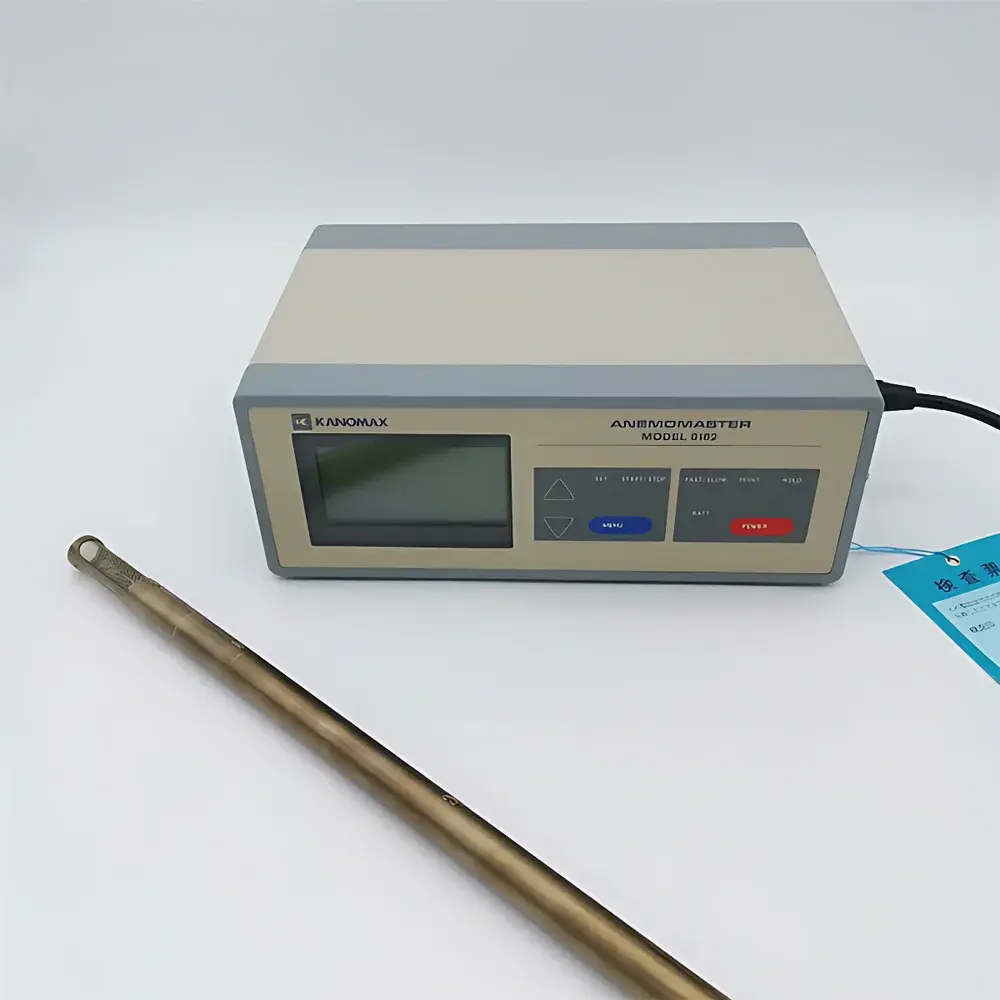
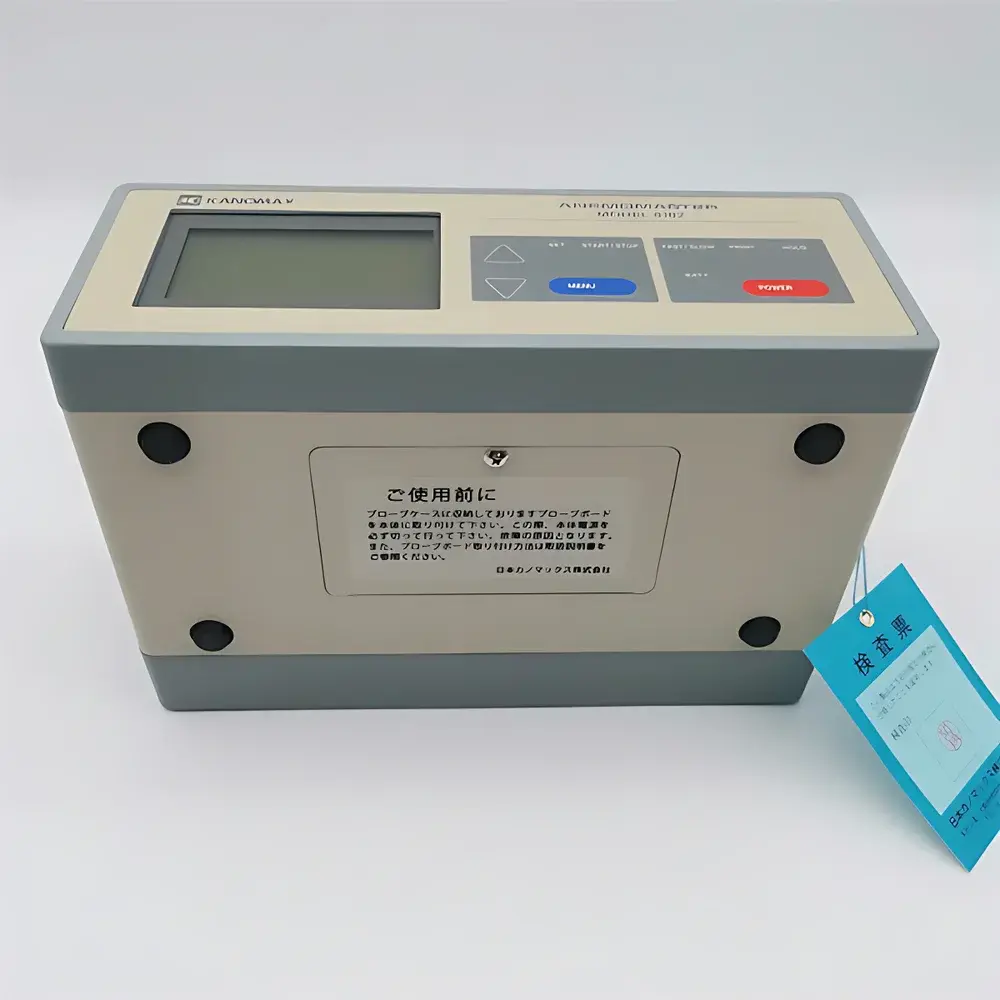
KANOMAX 6162+ High-Temperature Thermal Anemometer
| Brand | KANOMAX |
|---|---|
| Origin | Liaoning, China (Distributed by Authorized Domestic Distributor) |
| Model | 6162+ |
| Instrument Type | Thermal Anemometer |
| Resolution | 0.01 m/s |
| Velocity Range | 0.00–50.0 m/s (with temperature-dependent minimum detectable velocity) |
| Accuracy | ±(1% of reading + 1 °C) for temperature |
| Operating Temperature | 0–500 °C (probe-dependent) |
| Operating Humidity | 0–100% RH |
| Probe Compatibility | Interchangeable probes (0203, 0204, 0205) with PTFE-insulated cables rated to 200 °C |
| Data Storage | 999 measurement sets with min/max/avg statistics |
| Analog Output | 0–1 V DC proportional to velocity |
| Communication Interface | RS-232C |
| Power | 6 × 1.5 V AA alkaline batteries or 12.5 V / 450 mA AC adapter |
Overview
The KANOMAX 6162+ High-Temperature Thermal Anemometer is a precision-engineered instrument designed for reliable, real-time measurement of air velocity and temperature in demanding industrial environments—particularly combustion exhaust stacks, kiln ducts, boiler flues, and thermal process lines where ambient temperatures reach up to 500 °C. Unlike conventional vane or cup anemometers, the 6162+ employs constant-temperature anemometry (CTA), wherein a heated platinum wire sensor maintains a fixed temperature differential relative to the surrounding gas. As convective cooling increases with flow velocity, the instrument dynamically adjusts current to sustain thermal equilibrium—enabling highly responsive, low-inertia velocity quantification even under transient thermal conditions. Its modular architecture separates the rugged, heat-resistant probe from the portable main unit, allowing safe operation outside extreme thermal zones while maintaining metrological integrity across wide dynamic ranges.
Key Features
- Multi-range velocity detection (0.00–50.0 m/s) with adaptive low-velocity thresholds calibrated per temperature band: 0.2 m/s (0–99 °C), 0.4 m/s (100–199 °C), 0.7 m/s (200–299 °C), and 1.0 m/s (300–400 °C)
- Integrated dual-parameter sensing: simultaneous velocity and temperature acquisition with traceable calibration against NIST-traceable references
- Interchangeable probe system supporting three standard configurations: compact 208 mm probe (0203), extended 500 mm probe (0205), and ultra-long 1000 mm probe (0204)—all featuring PTFE-insulated leads rated to 200 °C
- Onboard statistical engine computing real-time min, max, and arithmetic mean across stored datasets (up to 999 records)
- 0–1 V analog output for integration with PLCs, SCADA systems, or continuous emission monitoring systems (CEMS)
- RS-232C serial interface compliant with EIA/TIA-232 standards for bidirectional data transfer and remote configuration
- Ruggedized main unit housing (220 × 150 × 85 mm, 1.8 kg) with IP54-rated enclosure for dust and splash resistance
Sample Compatibility & Compliance
The 6162+ is validated for use in non-corrosive, non-explosive gaseous media including air, flue gas, nitrogen, and inert process streams. It complies with IEC 61000-6-2 (immunity) and IEC 61000-6-3 (emissions) for industrial electromagnetic environments. While not intrinsically safe, its probe design meets mechanical safety requirements for insertion into ASME B31.1-compliant piping and ductwork. For regulatory reporting, velocity measurements support compliance with EPA Method 2 (stack gas velocity), ISO 16814 (thermal anemometer performance criteria), and EN 15259 (air velocity measurement in ventilation systems). The device supports GLP-aligned data handling through timestamped storage and exportable ASCII logs suitable for audit trails.
Software & Data Management
Data retrieval occurs via terminal-emulation software or custom scripts using standard ASCII command protocols over RS-232C. Each stored record includes timestamp, velocity (m/s), temperature (°C), and probe ID. Exported files are compatible with Excel, MATLAB, and LabVIEW for post-processing. The instrument does not require proprietary drivers; communication adheres to null-modem wiring conventions and default settings (9600 bps, 8N1). Audit-ready functionality includes sequential record numbering and non-volatile memory retention during battery replacement—ensuring continuity for QA/QC workflows requiring 21 CFR Part 11–compatible documentation (when paired with validated third-party logging software).
Applications
- Combustion efficiency assessment in industrial boilers and incinerators
- Velocity profiling across rectangular and circular duct cross-sections per ISO 10780 and EPA Performance Specification 11
- Thermal drying line optimization in ceramic, metallurgical, and food processing facilities
- Validation of HVAC airflow in high-temperature cleanrooms and semiconductor fab exhaust systems
- In-situ calibration verification of permanent stack-mounted ultrasonic or pitot-based CEMS
- Research-grade boundary layer studies in wind tunnels with heated test sections
FAQ
What is the maximum allowable exposure time for the probe at 500 °C?
The 0205 probe (Φ14 × 500 mm) is rated for continuous operation at 500 °C; however, prolonged exposure above 450 °C may reduce long-term sensor stability. Recommended duty cycle: ≤8 hours per day at peak temperature.
Can the 6162+ measure mass flow directly?
No—it measures volumetric velocity only. Mass flow calculation requires concurrent pressure and gas composition inputs, which must be supplied externally and applied via post-processing.
Is the analog output isolated?
The 0–1 V output is non-isolated and referenced to the instrument’s internal ground; galvanic isolation requires external signal conditioning for noisy industrial environments.
How is probe interchangeability ensured metrologically?
Each probe carries a unique calibration coefficient stored in its connector EEPROM; the main unit auto-detects and applies correction factors upon connection, maintaining traceability without manual recalibration.
Does the device support averaging over user-defined time intervals?
Yes—selectable averaging periods (1 s, 5 s, 10 s, 30 s, 60 s) are configurable via front-panel menu, with corresponding min/max/avg computed and stored per interval.







