
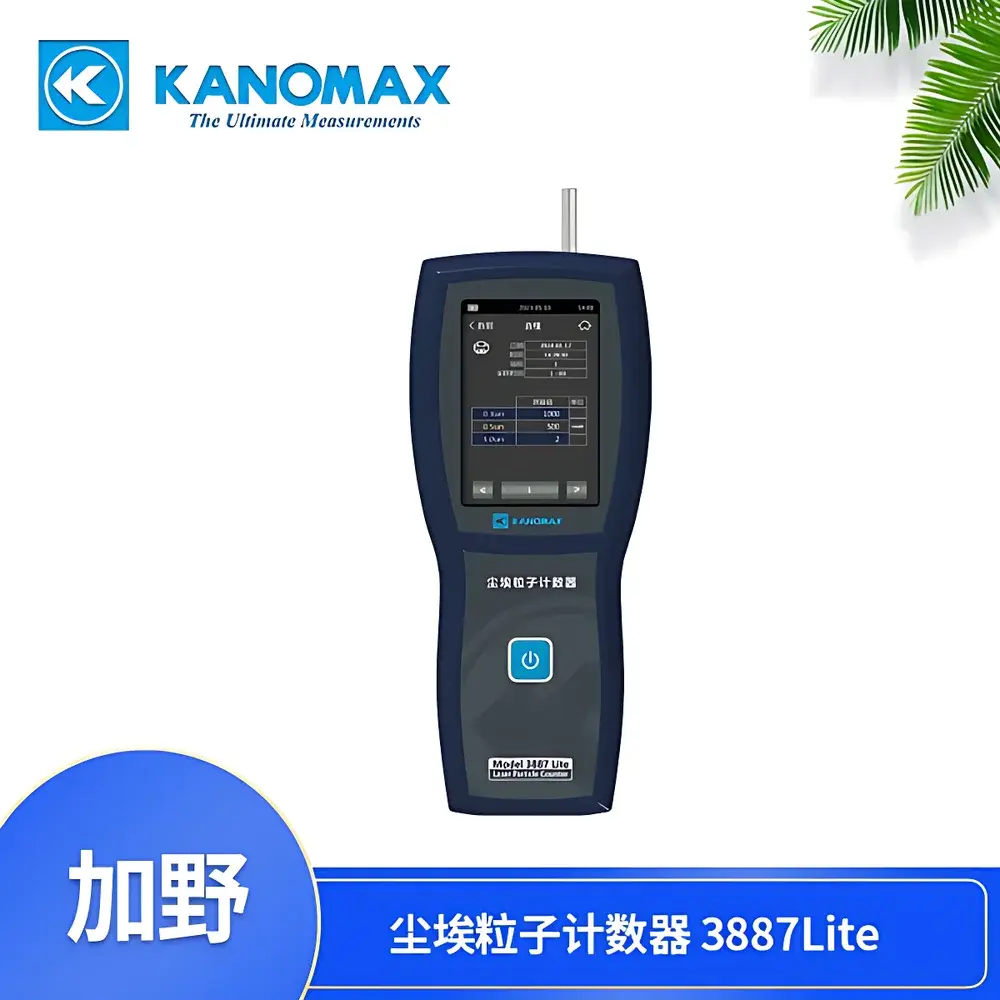
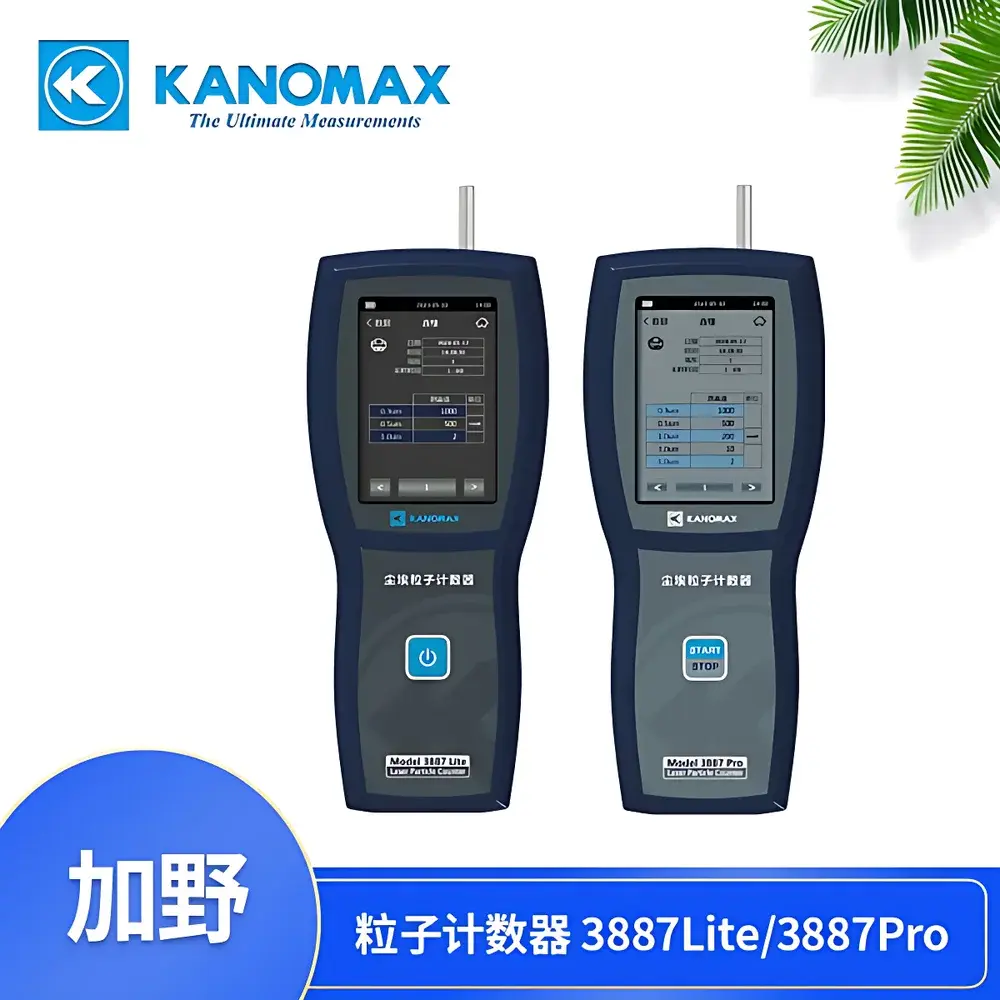
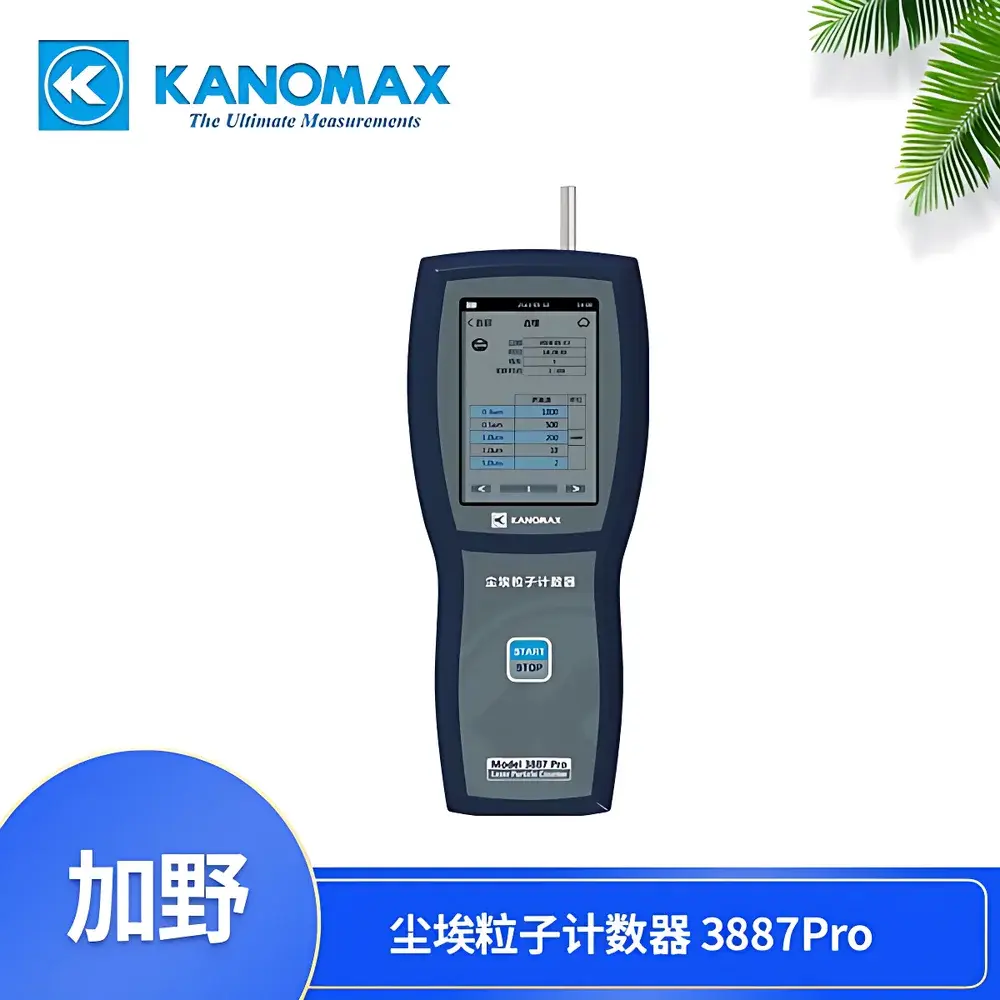
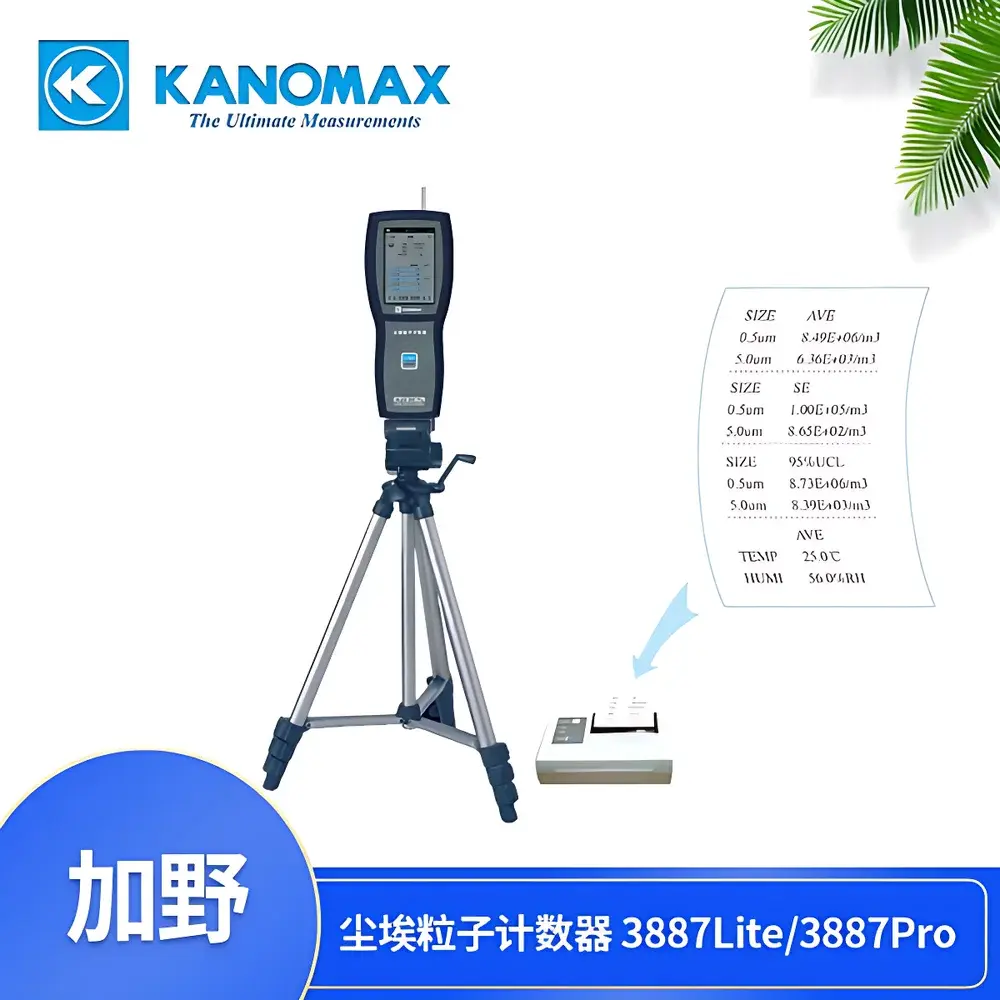
KANOMAX Handheld Airborne Particle Counter Model 3887Lite / 3887Pro
| Brand | KANOMAX |
|---|---|
| Origin | Japan |
| Instrument Type | Handheld Particle Counter |
| Flow Rate | 2.83 L/min ±5% |
| Detectable Particle Sizes | 0.3, 0.5, 1.0, 3.0, 5.0 µm (3887Pro) |
| Display | 3.5-inch resistive touchscreen |
| Light Source | Laser diode |
| Counting Efficiency Compliance | ISO 21501-4 & JIS B9921 |
| Max. Concentration | 2,000,000 particles/ft³ |
| Coincidence Loss | <5% at 2,000,000 particles/ft³ |
| Data Storage Capacity | 7,000 sample records |
| Power Supply | Rechargeable Li-ion battery (≈5 h operation) + USB-C AC adapter |
| Dimensions | 87 × 200 × 55 mm |
| Weight | ≈600 g |
| Operating Environment | 10–40 °C, 0–85% RH (non-condensing) |
| Communication Interfaces | USB & RS-485 |
Overview
The KANOMAX Handheld Airborne Particle Counter Model 3887Lite and 3887Pro are precision-engineered optical particle counters designed for real-time, on-site monitoring of airborne particulate contamination in controlled environments. Based on the principle of light scattering—where particles passing through a focused laser beam generate scattered photons detected by a high-sensitivity photodetector—the instruments provide quantitative concentration measurements across multiple discrete size channels. The 3887Pro model detects five standard calibration sizes (0.3, 0.5, 1.0, 3.0, and 5.0 µm), while the 3887Lite supports three (0.3, 0.5, and 5.0 µm), both operating at a certified volumetric flow rate of 2.83 L/min (0.1 CFM) with ±5% accuracy. This flow rate conforms to ISO 21501-4 and JIS B9921 requirements for calibration traceability and inter-laboratory comparability. The instruments are optimized for use in cleanrooms, isolators, laminar flow hoods, and other critical process environments where adherence to ISO 14644-1, GB/T 16292–2010, and China’s revised GMP Annex 1 is mandatory.
Key Features
- Compact handheld form factor (87 × 200 × 55 mm; ~600 g) enabling rapid point-of-use sampling without external power or fixed installation.
- 3.5-inch resistive touchscreen interface supporting intuitive navigation, real-time histogram visualization, and on-device parameter configuration.
- Integrated rechargeable lithium-ion battery providing up to five hours of continuous operation; USB-C charging compatible with universal power sources.
- Multi-mode sampling protocols—including single-shot, repeated, continuous, calculated (e.g., average over N cycles), remote-triggered, GB-compliant, and ISO-compliant sequences—ensuring alignment with site-specific SOPs.
- Robust data integrity architecture: automatic resumption after unexpected power loss preserves test state and prevents data gaps during long-duration monitoring campaigns.
- On-board statistical engine computes min/max/mean values per channel across stored datasets; all results exportable via USB or RS-485 to validated laboratory information systems.
Sample Compatibility & Compliance
The 3887 series is calibrated and verified for use with ambient air and filtered process gases under non-corrosive, non-explosive conditions (10–40 °C, 0–85% RH, non-condensing). It meets the counting efficiency specifications defined in ISO 21501-4 for 0.3 µm and larger particles, and complies with JIS B9921 for Japanese metrological equivalence. All generated reports satisfy the formatting, uncertainty reporting, and data retention requirements of ISO 14644-1:2015 (Cleanrooms and associated controlled environments), GB/T 16292–2010 (Testing methods for airborne particle concentrations in pharmaceutical cleanrooms), and China’s Good Manufacturing Practice (GMP) Annex 1 (Manufacture of Sterile Medicinal Products). Device firmware supports audit-ready timestamping and user-accessible event logs, facilitating GLP/GMP-aligned validation and routine qualification.
Software & Data Management
KANOMAX-supplied PC software enables comprehensive post-acquisition analysis, including time-series trending, spatial mapping (when used with GPS-enabled logging accessories), comparative overlay of multiple test locations, and automated report generation compliant with ISO 14644-2 surveillance requirements. Data files are stored in structured CSV and proprietary binary formats, both supporting metadata embedding (operator ID, location tag, sampling duration, environmental conditions). The software implements role-based access control and optional 21 CFR Part 11-compliant electronic signatures when deployed in regulated pharmaceutical or biotech settings. USB and RS-485 interfaces support integration into building management systems (BMS) or centralized environmental monitoring systems (EMS) via Modbus RTU or custom ASCII command sets.
Applications
These instruments serve as primary verification tools across industries requiring strict particulate control: semiconductor fabrication (wafer fab cleanroom certification), medical device manufacturing (ISO 13485 clean zones), aseptic pharmaceutical production (Grade A/B/C/D classification per EU GMP), hospital isolation rooms and OR ventilation validation, HVAC filter integrity testing, and R&D in nanomaterial handling facilities. They are routinely deployed for routine monitoring, periodic requalification, incident investigation (e.g., post-maintenance particle excursions), and supplier qualification audits. Their portability makes them ideal for mobile QA/QC teams performing cross-facility assessments or third-party certification bodies conducting ISO 17025-accredited cleanroom testing.
FAQ
What standards does the 3887 series comply with for calibration and performance verification?
It adheres to ISO 21501-4 for optical particle counter calibration, JIS B9921 for Japanese national equivalency, and supports reporting formats required by ISO 14644-1, GB/T 16292–2010, and China GMP Annex 1.
Can the instrument operate continuously for extended periods?
Yes—battery life supports ~5 hours of uninterrupted sampling; continuous operation is achievable using the included USB-C AC adapter.
Is remote triggering supported for synchronized multi-point monitoring?
Yes, the “Remote” test mode accepts TTL-level external triggers via the RS-485 interface, enabling coordinated sampling across distributed sensor networks.
How is data integrity ensured during power interruptions?
The firmware automatically saves the current test context (elapsed time, cycle count, active channel) and resumes from the exact point of interruption upon reboot—no data loss occurs.
Are firmware updates available, and how are they applied?
Firmware revisions are distributed by KANOMAX via secure download; updates are installed via USB connection using the provided PC software, with version rollback capability retained for validation continuity.
Related Products







