
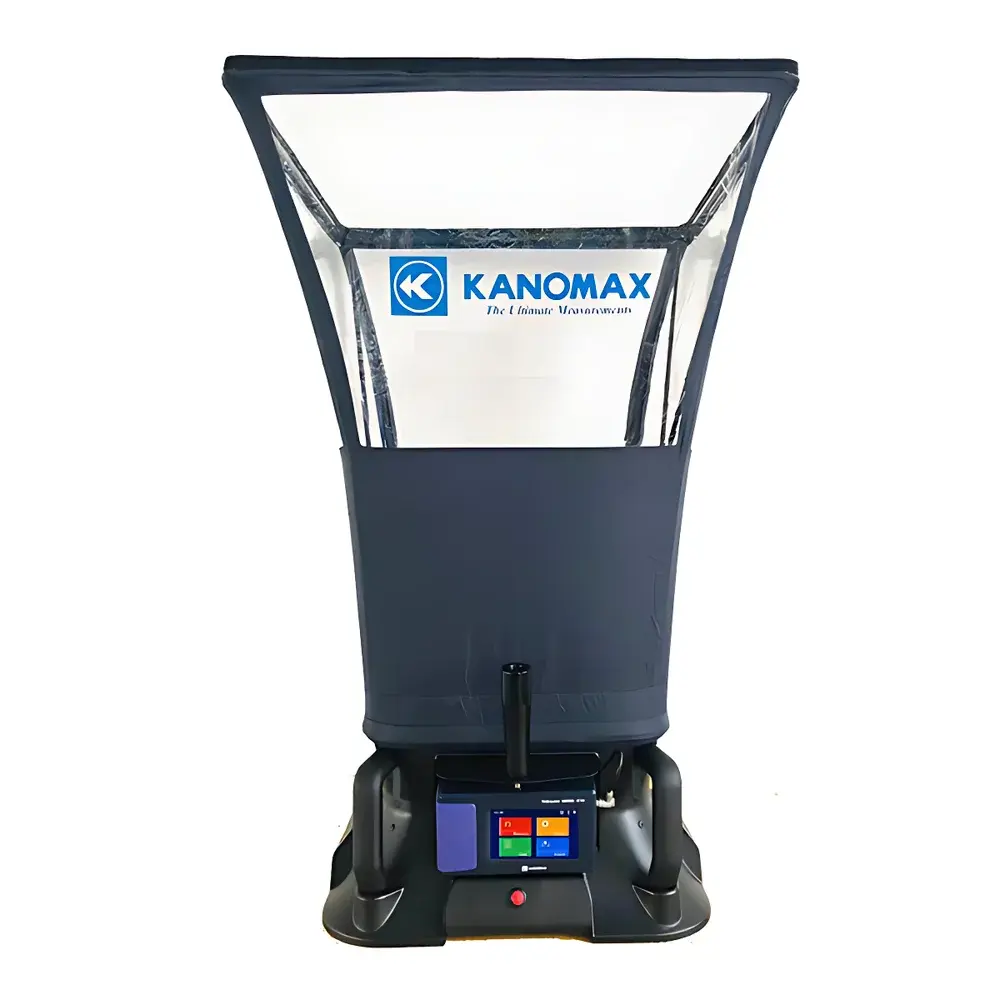
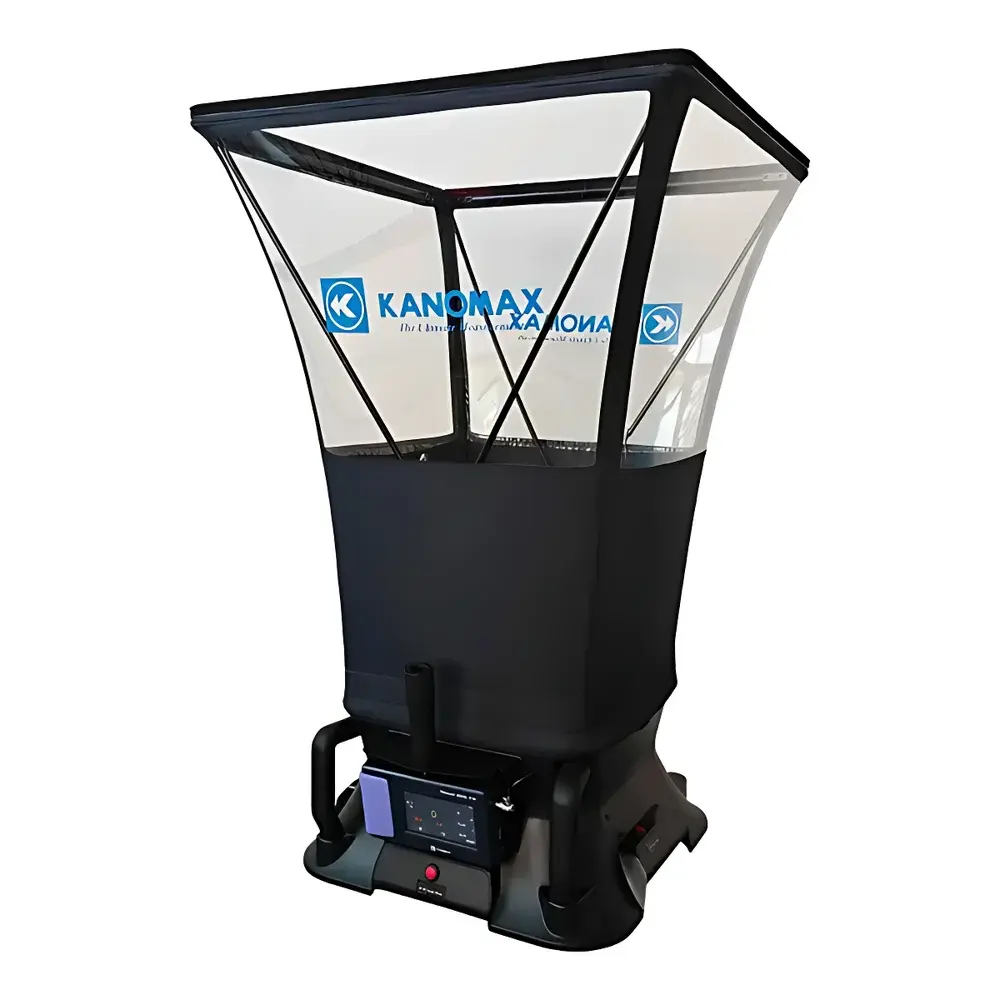
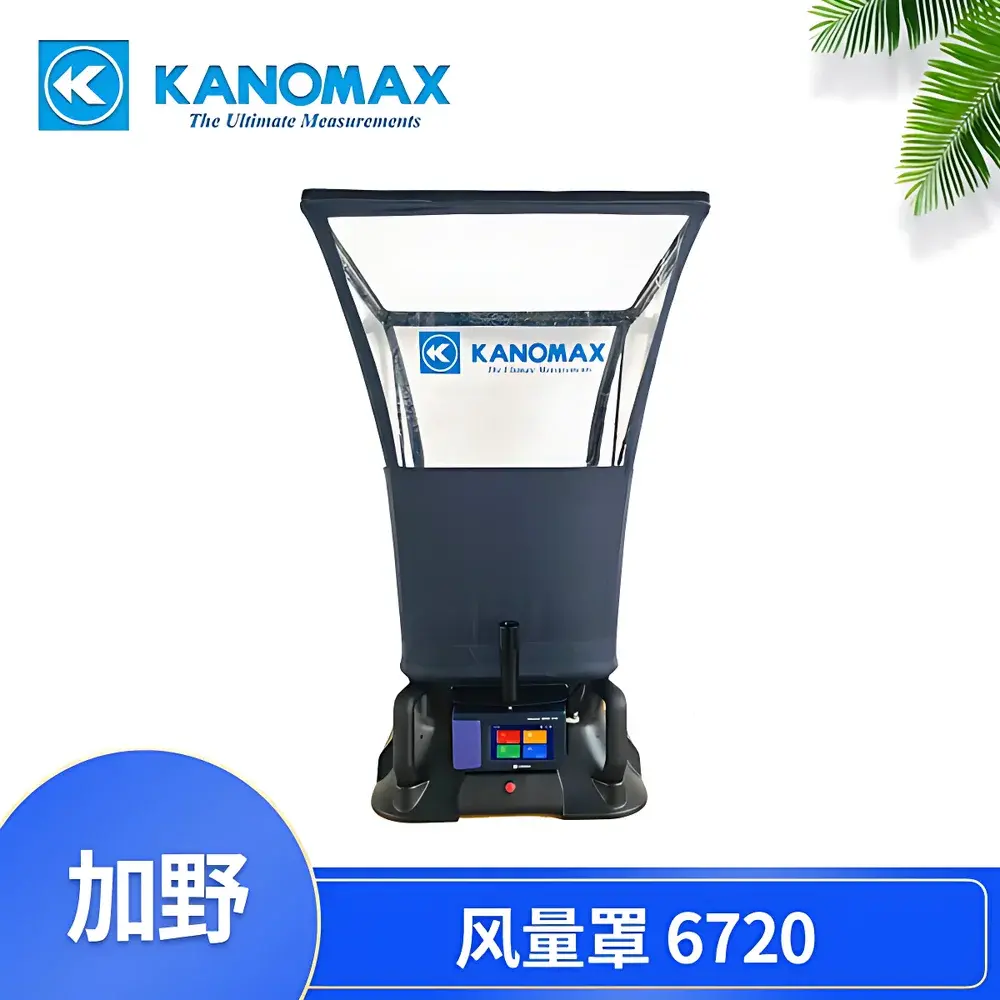
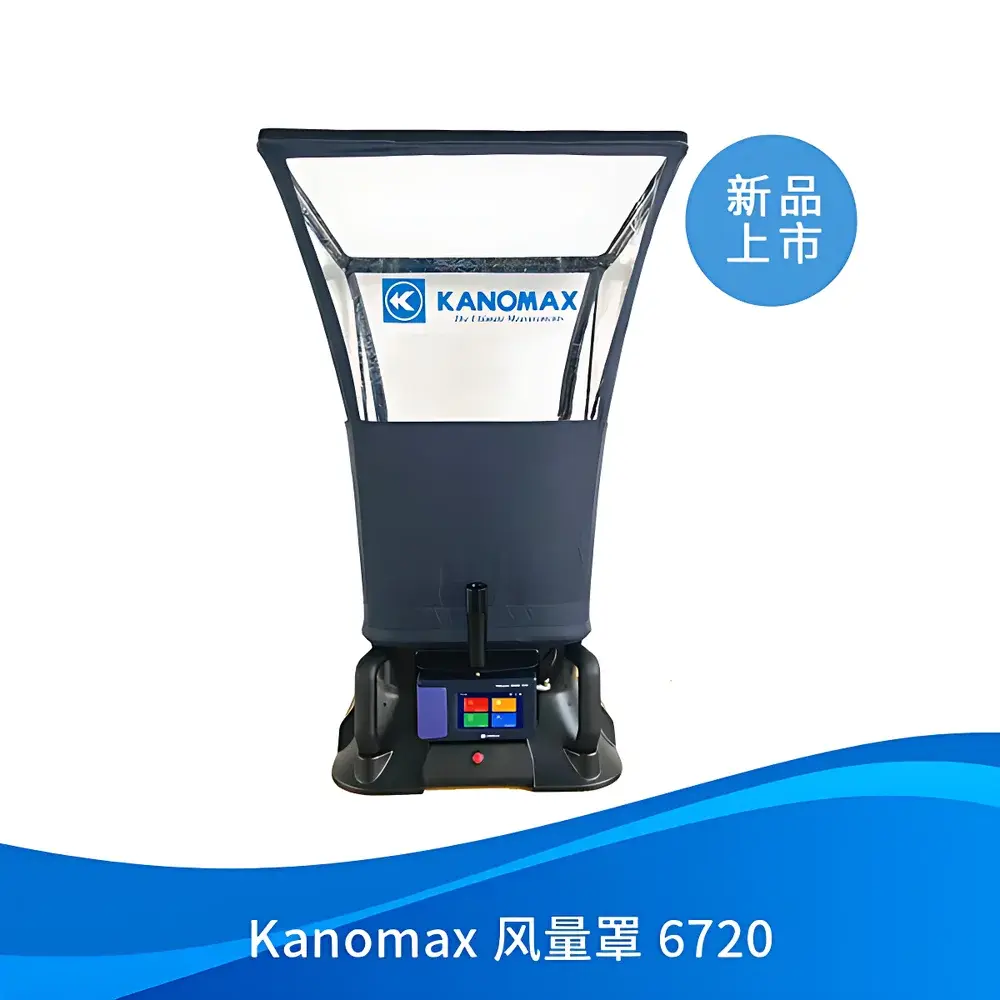
Kanomax 6720 Air Flow Hood for HVAC Commissioning in Pharmaceutical Cleanrooms
| Brand | Kanomax |
|---|---|
| Origin | Japan |
| Model | 6720 |
| Air Flow Range | 40–4300 m³/h |
| Accuracy | ±3% of reading ±8 m³/h |
| Operating Temperature | 0–60 °C |
| Operating Humidity | 0–100 %RH |
| Differential Pressure Range | –2500 to +2500 Pa |
| DP Accuracy | ±1.5% of reading ±0.25 Pa |
| Air Velocity Range (with matrix) | 0.15–15 m/s |
| Velocity Accuracy | ±3% of reading ±0.05 m/s |
| Temperature Accuracy | ±0.5 °C |
| Relative Humidity Accuracy | ±3 %RH (10–90 %RH) |
| Display | 4.3-inch full-color touchscreen |
| Data Storage | 8,000 measurements (host), 10,000 via companion app |
| Power | 4 × AA batteries (≈9 h), DC 5 V adapter |
| Weight | 3.6 kg |
| Standard Hood Size | 610 × 610 mm |
| Optional Hood Sizes | 610×1220, 305×1220, 500×500, 915×915, 915×610, 800×1400 mm |
| Key Functions | Backpressure compensation, atmospheric pressure & temperature correction, inflow/outflow mode detection, real-time Bluetooth data streaming, USB export, and thermal/hygrometric/differential pressure concurrent measurement |
Overview
The Kanomax 6720 Air Flow Hood is an integrated, handheld volumetric airflow measurement system engineered for precision commissioning, validation, and routine monitoring of HVAC systems in regulated pharmaceutical environments—including ISO Class 5–8 cleanrooms, aseptic processing suites, and biological safety cabinets. It operates on the principle of multi-point velocity integration across a calibrated capture hood aperture, applying real-time backpressure compensation and environmental corrections (ambient temperature, atmospheric pressure, and relative humidity) to deliver traceable, repeatable volumetric flow results in m³/h. Unlike single-point anemometers or pitot-static tubes, the 6720 employs a 16-point velocity matrix with thermistor-based sensors embedded in a removable, transparent acrylic hood—ensuring uniform spatial sampling while enabling visual confirmation of seal integrity at the diffuser or grille interface. Its design complies with core requirements of ISO 14644-3 (cleanroom testing), ISO 14644-4 (design and construction), and EU GMP Annex 1 (2022) for airflow characterization during qualification and periodic retesting.
Key Features
- Simultaneous measurement of volumetric airflow (40–4300 m³/h), face velocity (0.15–15 m/s), differential pressure (±2500 Pa), ambient temperature (0–60 °C), and relative humidity (0–100 %RH) — all displayed in real time on a 4.3-inch full-color capacitive touchscreen.
- Patented backpressure compensation algorithm corrects for static pressure build-up within the hood during low-flow or high-resistance outlet conditions, maintaining accuracy across variable duct configurations and filter loading states.
- Atmospheric pressure and temperature correction functions align measured airflow to standard reference conditions (e.g., 101.325 kPa, 20 °C), essential for comparative analysis across sites and over time per ASTM D5487 and ISO 5801.
- Modular architecture supports interchangeable hood sizes (standard 610 × 610 mm; optional up to 800 × 1400 mm), enabling adaptation to supply diffusers, return grilles, exhaust hoods, and BSC sash openings without recalibration.
- Bluetooth 5.0 connectivity enables secure wireless pairing with iOS/Android mobile devices running the official Kanomax AirFlow Connect app—supporting remote configuration, live data logging, statistical summary (min/max/avg/cumulative), unit conversion, K-factor adjustment, and multilingual UI (English, Japanese, Chinese, German, French).
- Robust mechanical construction includes a fiberglass-reinforced support frame, optically clear polycarbonate viewing window, and IP54-rated electronics housing suitable for controlled environment use under GxP conditions.
Sample Compatibility & Compliance
The 6720 is validated for use with all common HVAC terminal devices encountered in pharmaceutical facilities: unidirectional airflow hoods, HEPA-filtered supply diffusers (including perforated, louvered, and swirl types), ceiling-mounted returns, floor grilles, fume hoods, and Class II/III biological safety cabinets. Its measurement methodology satisfies data integrity expectations under FDA 21 CFR Part 11 when used with audit-trail-enabled software (via companion app with timestamped export). The instrument’s calibration traceability follows JIS Z 8015 and NIST-traceable standards; factory calibration certificates include uncertainty budgets per ISO/IEC 17025. It meets electromagnetic compatibility (EMC) requirements per IEC 61326-1 and safety compliance per IEC 61010-1 for laboratory and industrial use.
Software & Data Management
Data acquisition and reporting are supported through dual pathways: onboard storage (8,000 test records with date/time stamp, location tag, operator ID, and environmental metadata) and synchronized cloud-ready export via the Kanomax AirFlow Connect app (10,000-record capacity). All exported files (.csv or .pdf) include raw sensor values, compensated airflow results, confidence indicators (e.g., seal status, turbulence index), and user-defined project identifiers. USB-C interface allows direct transfer to LIMS or QA documentation systems. Bluetooth printing supports on-site hardcopy generation using certified thermal printers—ideal for FAT/SAT sign-offs and regulatory inspections. Audit trail functionality records all parameter changes, data deletions, and firmware updates in accordance with ALCOA+ principles.
Applications
- HVAC system balancing and air change rate verification per ISO 14644-3 and EU GMP Annex 1 §4.27–4.32.
- Cleanroom classification and requalification (ISO 14644-1 particle counting correlation studies).
- Biological safety cabinet (BSC) inflow velocity and downflow uniformity assessment per NSF/ANSI 49.
- Fume hood face velocity mapping and containment validation (ASHRAE 110).
- Filter leakage testing pre- and post-integrity scan (when used with upstream challenge aerosol generators).
- Energy efficiency audits and commissioning documentation for LEED and ISPE Baseline Guide compliance.
FAQ
Does the 6720 require annual recalibration?
Yes—Kanomax recommends annual factory recalibration against NIST-traceable standards to maintain measurement validity under ISO/IEC 17025 and internal quality system requirements.
Can the 6720 be used for negative-pressure room verification?
Yes—the differential pressure sensor supports bidirectional measurement (–2500 to +2500 Pa), and the inflow/outflow mode logic automatically identifies directionality based on pressure gradient and velocity vector orientation.
Is the Bluetooth connection secure for GxP environments?
Bluetooth communication uses encrypted pairing and does not transmit data externally; all sensitive operations (e.g., report generation, user authentication) occur locally on the device or paired mobile terminal—fully compliant with data sovereignty policies.
What hood sizes are supplied with the base unit?
The standard configuration includes one 610 × 610 mm hood, carrying case, four AA batteries, USB communication cable, printed manual, and desktop software license.
How is traceability ensured during cleanroom certification?
Each measurement captures ambient conditions, hood geometry, operator input, and environmental corrections—generating a fully attributable dataset that satisfies FDA, EMA, and PMDA expectations for inspection readiness and lifecycle documentation.
Related Products







