
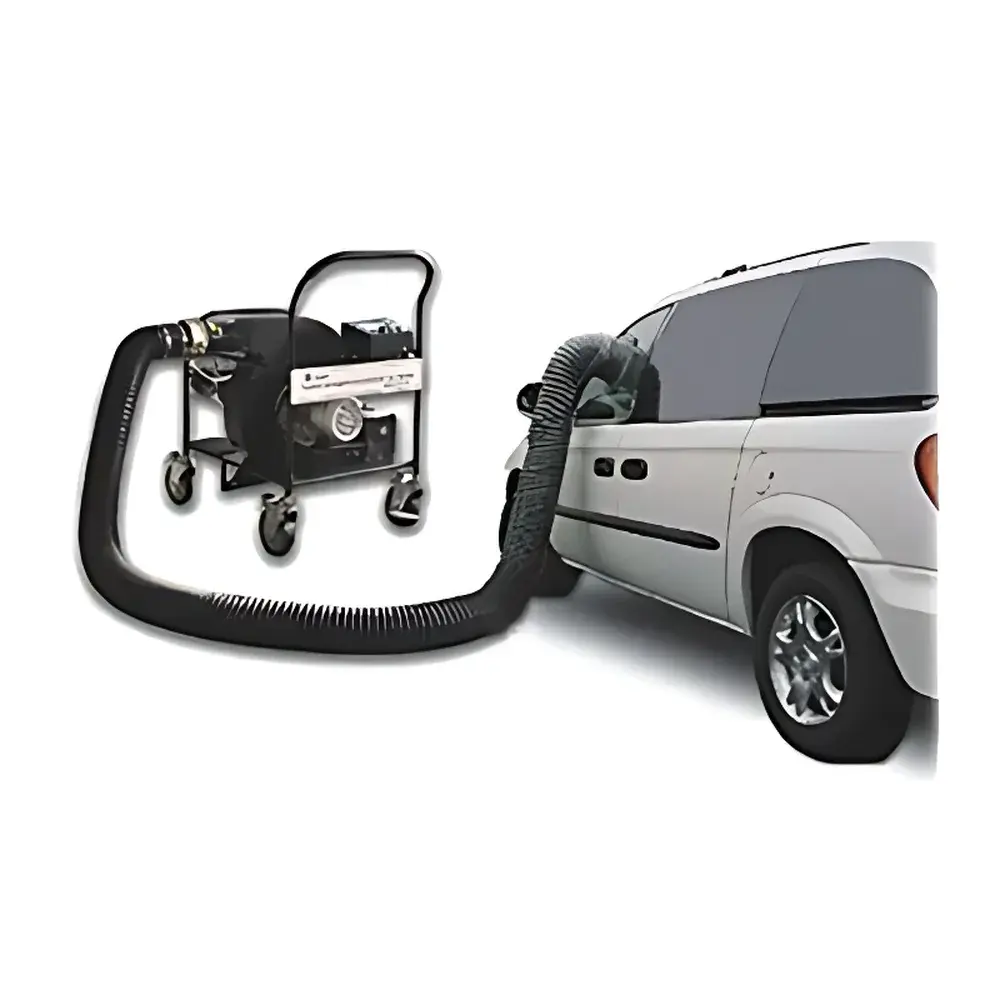
KANOMAX Cabin Air Tightness Test System
| Brand | KANOMAX |
|---|---|
| Origin | Japan |
| Model | Cabin Seal Tester |
| Pressure Range | ±2500 Pa |
| Leakage Flow Measurement Range | 1–200 L/s |
| Compliance | Designed for ISO 9001-aligned automotive HVAC & body-in-white validation workflows |
| Software Interface | PC-based control with real-time pressure/flow logging |
| Data Export | CSV, Excel-compatible format |
| Regulatory Context | Supports GLP-aligned test documentation per IATF 16949 and JIS D 0201-2018 (Automotive Interior Air Leakage) |
Overview
The KANOMAX Cabin Air Tightness Test System is an engineered solution for quantitative evaluation of air leakage pathways in automotive passenger compartments. It operates on the principle of controlled differential pressure testing—applying a regulated over- or under-pressure to the cabin interior while measuring volumetric airflow through calibrated nozzles. This method conforms to established physical principles described in ISO 5801 (fan performance) and aligns with functional requirements outlined in JIS D 0201:2018 (Automotive Interior Air Leakage Test Methods). The system delivers traceable, repeatable measurements of total cabin leakage as well as component-specific contributions—including doors, sunroofs, trunk lids, and firewall penetrations—enabling root-cause analysis during vehicle development, production line audit, or post-assembly quality verification.
Key Features
- Static pressure control across ±2500 Pa range via variable-speed centrifugal blower, enabling precise simulation of real-world aerodynamic loading conditions (e.g., high-speed driving, HVAC-induced pressure differentials)
- Modular nozzle array supporting flow measurement from 1 to 200 L/s with NIST-traceable calibration certificates available upon request
- Flexible ducting with flanged window interface—designed for rapid, non-invasive installation on production-intent vehicles without structural modification
- Dual-mode operation: user-selectable control of either target cabin static pressure or target leakage flow rate, with automatic fan speed adjustment to maintain setpoint stability
- Integrated static pressure tap on flange assembly for direct connection to high-accuracy digital manometers (e.g., KANOMAX Model 3887 or equivalent)
- Rugged aluminum frame with industrial-grade vibration isolation; designed for repeated use in factory-floor environments including paint shops and final assembly bays
Sample Compatibility & Compliance
The system accommodates passenger cars, light commercial vehicles, and EV platforms with standard side-window dimensions (up to 1200 mm × 800 mm aperture). It supports both left-hand and right-hand drive configurations via reversible mounting hardware. All mechanical interfaces comply with ISO 2768-mK general tolerances. Electrical components meet CE marking requirements (EMC Directive 2014/30/EU, Low Voltage Directive 2014/35/EU). While not certified to ISO/IEC 17025, the system is routinely deployed in laboratories operating under ISO 9001:2015 and IATF 16949:2016 quality management systems. Test reports generated using this equipment may be included in PPAP Level 3 submissions when paired with documented calibration records and operator training logs.
Software & Data Management
A Windows-based control application provides real-time visualization of cabin pressure, measured flow rate, and blower RPM. Data acquisition occurs at 10 Hz sampling frequency, with timestamps synchronized to system clock. All measurements are stored locally in timestamped CSV files, supporting post-processing in MATLAB, Python (pandas), or statistical process control (SPC) platforms. Audit trail functionality includes operator ID input, test parameter configuration history, and automatic detection of out-of-tolerance events (e.g., pressure deviation > ±15 Pa for >3 s). The software does not implement FDA 21 CFR Part 11 electronic signature controls but supports manual annotation and export for inclusion in GLP-compliant test records.
Applications
- Validation of door seal compression force and gasket geometry during prototype stage
- Production line leak screening for assembled bodies-in-white prior to paint shop entry
- Comparative assessment of HVAC system air-handling unit (AHU) bypass leakage versus cabin envelope integrity
- Correlation studies between computational fluid dynamics (CFD) models and empirical leakage distribution maps
- Root-cause investigation of wind noise complaints by isolating dominant leakage paths (e.g., A-pillar junction vs. rear quarter panel seam)
- Supporting certification compliance for ISO 16750-4 (Environmental conditions — Mechanical loads) and GB/T 18488.2–2015 (EV powertrain sealing requirements)
FAQ
Does the system include calibration certificates for the nozzles?
Yes—each nozzle set ships with individual calibration data referenced to NIST-traceable standards. Certificates specify flow coefficient (Cd) values across the full operating range and uncertainty budgets per ISO 5167-1:2003 Annex C.
Can it measure leakage at negative pressure only, or both positive and negative?
The system supports bidirectional pressure control from –2500 Pa to +2500 Pa, allowing evaluation of both ingress (negative pressure) and egress (positive pressure) behavior—critical for assessing HVAC recirculation mode integrity.
Is third-party integration possible (e.g., PLC or MES systems)?
Yes—the controller exposes Modbus TCP and ASCII serial protocols for external command initiation, status polling, and real-time data streaming. Integration documentation and register maps are provided with the system.
What maintenance is required for long-term accuracy?
Annual verification of blower motor response curve and nozzle orifice integrity is recommended. KANOMAX offers factory recalibration services with turnaround time of ≤10 business days.
Are replacement parts such as flexible ducting or flange gaskets available separately?
Yes—all consumables and wear components are stocked globally through KANOMAX’s authorized distribution network, with lead times typically under 5 working days for standard items.



