
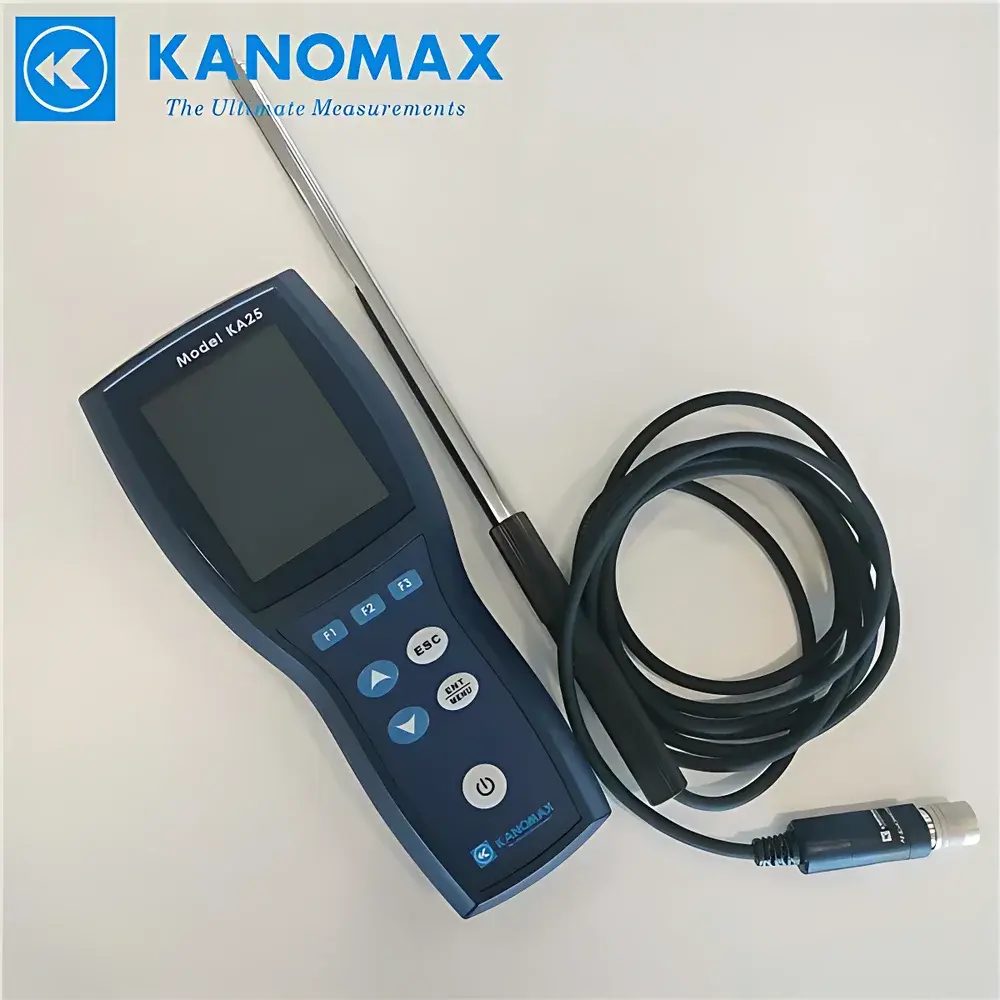
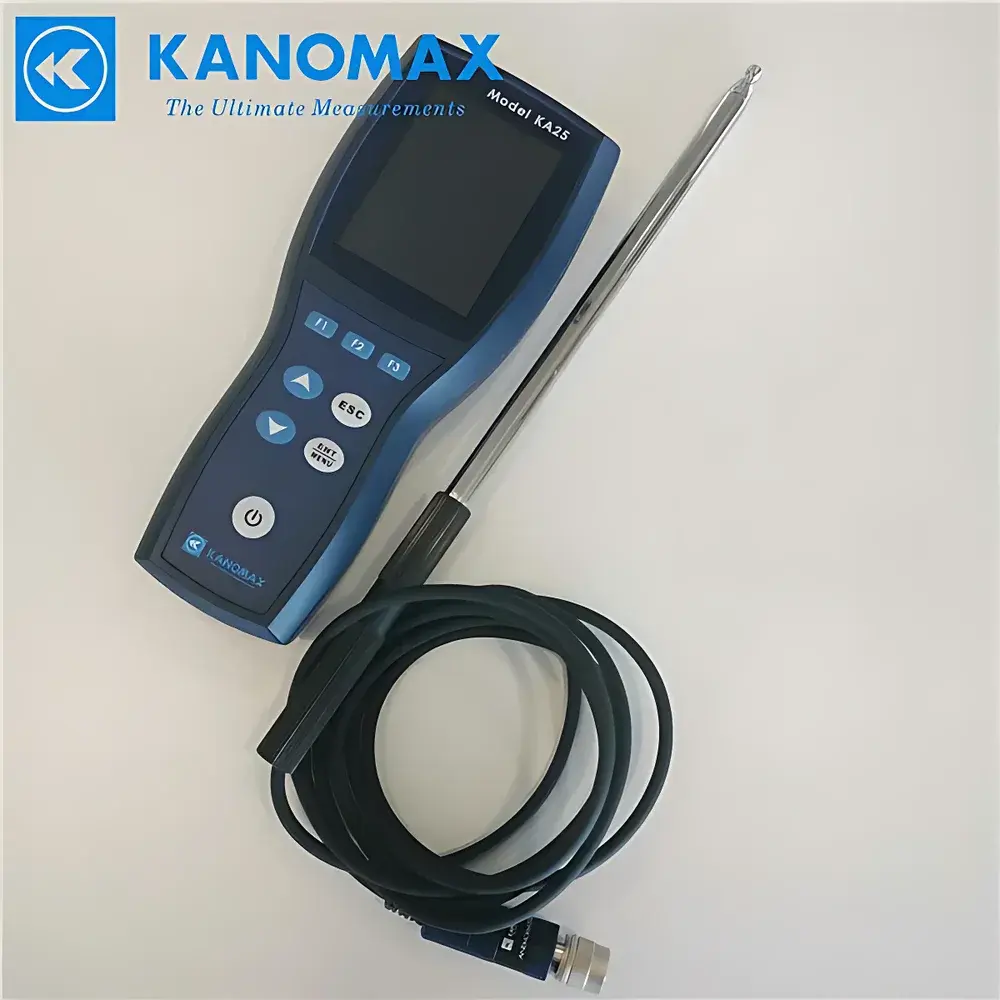
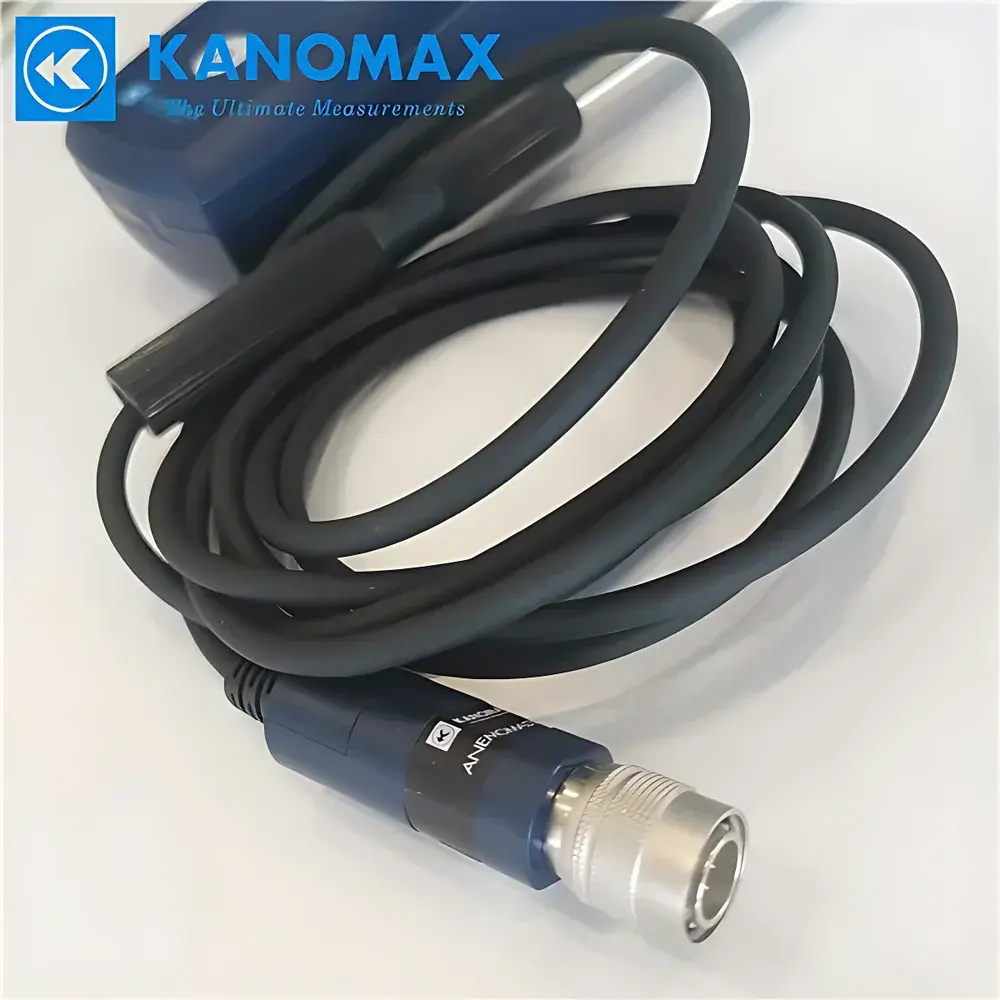
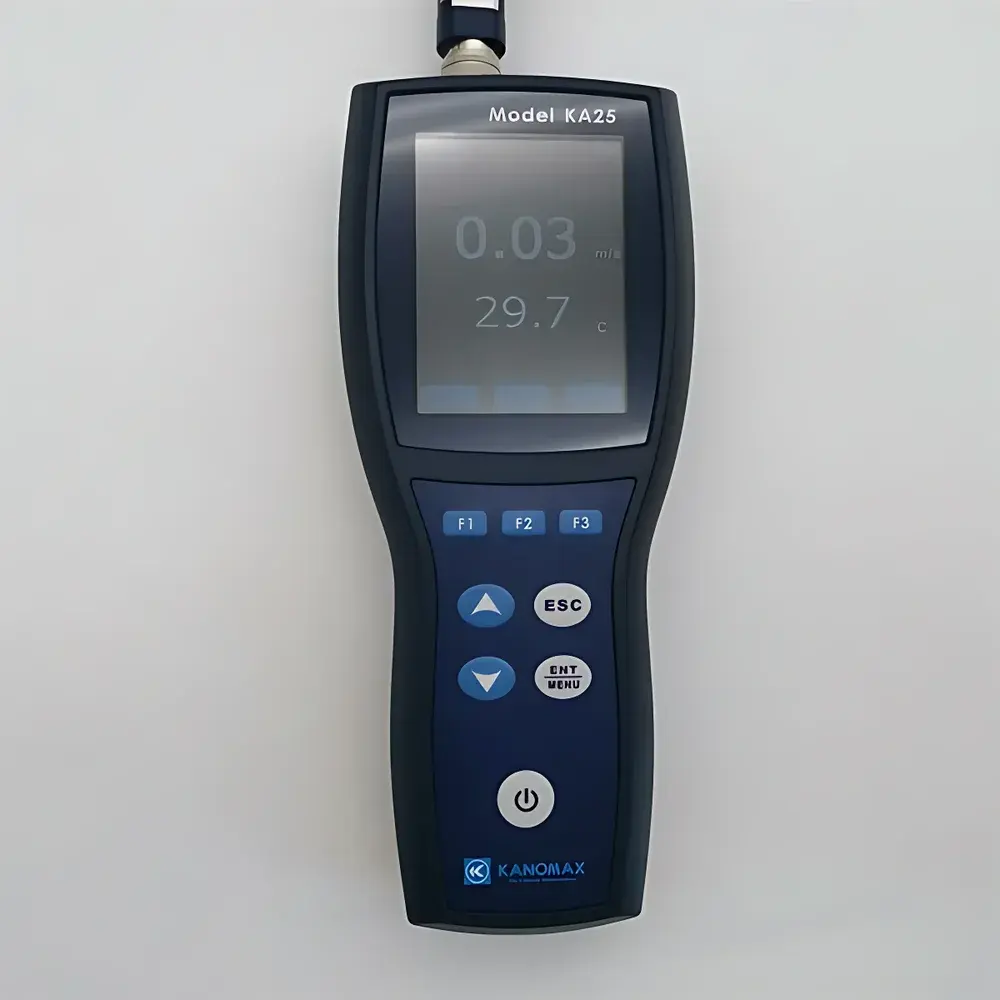
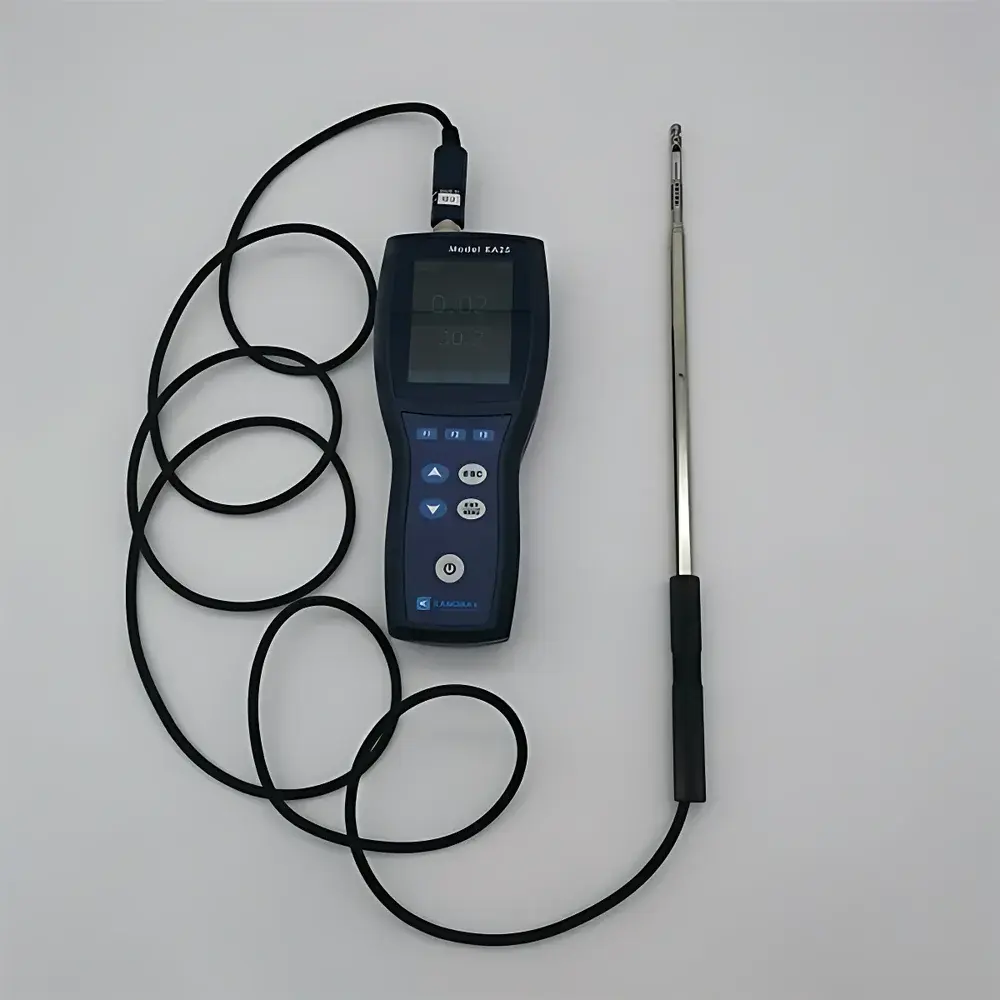
Kanomax KA25 Thermal Anemometer & Air Flow Meter
| Brand | Kanomax |
|---|---|
| Origin | Japan |
| Model | KA25 |
| Instrument Type | Thermal Anemometer |
| Resolution | 0.01 m/s |
| Measurement Range | 0.01–20.0 m/s |
| Accuracy | ±(3% of reading + 0.03 m/s) |
| Operating Temperature | −20–70 °C |
| Operating Humidity | 2–98% RH |
| Temperature Accuracy | ±0.5 °C (at v > 0.5 m/s) |
| Temperature Resolution | 0.1 °C |
| Response Time (Wind Speed) | ~1 s (90% response at 1 m/s) |
| Response Time (Temperature) | ~30 s (90% response at 1 m/s) |
| Air Volume Range | 1 m³/h (calculated) |
| Pipe Types Supported | Rectangular and Circular |
| Dimension Input Range | 0.1–255.0 cm |
| Data Hold, Min/Avg/Max Statistics, User-Adjustable Time Constant (1/5/10/20 s), Auto Power-Off (3/5/10 min), Backlit LCD (3-level), Battery Life | ~15 h (alkaline AA ×4) |
| Body Dimensions | 200 × 85 × 40 mm |
| Probe Dimensions | Ø6 mm (sensor) / Ø14 mm (handle) × 294–1060 mm (telescoping & bendable) |
| Cable Length | 2000 mm |
| Weight | ~220 g (body only, no batteries) |
| Storage Temperature | −20–60 °C |
Overview
The Kanomax KA25 Thermal Anemometer & Air Flow Meter is a portable, handheld environmental measurement instrument engineered for precision airflow characterization in HVAC commissioning, indoor air quality (IAQ) assessment, cleanroom validation, and laboratory ventilation system verification. It operates on constant-temperature anemometry (CTA) principles: a heated thermistor sensor dissipates heat proportional to local convective cooling, enabling direct correlation between thermal dissipation and fluid velocity. This method delivers high sensitivity at low velocities (down to 0.01 m/s) and stable performance across turbulent or laminar flow regimes typical in ductwork, fume hoods, and laminar flow cabinets. Unlike cup or vane anemometers, the KA25’s thermal sensing architecture eliminates mechanical inertia limitations, ensuring rapid dynamic response (~1 s at 90% step response for wind speed) and consistent repeatability under variable thermal gradients. Its integrated temperature sensor (±0.5 °C accuracy above 0.5 m/s) supports simultaneous ambient and flow temperature monitoring—critical for volumetric flow correction per ISO 5167 and ASHRAE Standard 111.
Key Features
- Telescoping and flexible probe design (Ø6 mm sensor tip, Ø14 mm handle, 294–1060 mm extension range) enables access to confined ducts, grilles, and irregular geometries without compromising sensor alignment.
- Real-time volumetric air flow calculation: user inputs duct cross-section dimensions (rectangular or circular, 0.1–255.0 cm), and the device computes instantaneous m³/h output using measured velocity and area—eliminating manual post-processing.
- Configurable time constant (1 s / 5 s / 10 s / 20 s) allows optimization for transient flow analysis or stabilized averaging in fluctuating environments.
- On-device statistical functions: continuous logging and display of minimum, maximum, and arithmetic mean values over user-defined intervals—essential for compliance with ISO 16813 and EN 13779 ventilation performance reporting.
- Three-level adjustable backlight LCD ensures legibility in low-light mechanical rooms or outdoor daylight conditions; data hold function freezes readings during documentation or remote probe positioning.
- Robust environmental tolerance: probe operational range spans −20 to 70 °C and 2–98% RH, supporting field use in unconditioned attics, industrial exhaust stacks, and humidified laboratories.
Sample Compatibility & Compliance
The KA25 is validated for use with clean, non-corrosive, particle-free air—consistent with ISO 14644-3 and IEST-RP-CC006.1 requirements for cleanroom airflow mapping. It is not rated for use with saturated steam, condensing moisture, abrasive particulates, or chemically aggressive gases (e.g., chlorine, ammonia). While not intrinsically safe or ATEX-certified, its battery-powered operation (4 × AA alkaline) avoids grounding risks in sensitive electrical environments. The instrument supports traceable calibration via NIST-traceable reference standards; users are advised to perform annual verification per ISO/IEC 17025-accredited procedures when employed in GLP or regulated QA/QC workflows.
Software & Data Management
The KA25 operates as a standalone field instrument with no proprietary PC software dependency. All measurement data—including timestamped min/avg/max sequences, duct geometry metadata, and environmental conditions—are retained in volatile memory until manually cleared. Export functionality is not embedded; however, values can be manually transcribed into compliant electronic lab notebooks (ELN) or LIMS platforms. The device meets foundational elements of FDA 21 CFR Part 11 for audit trail integrity when used with documented operator logs: auto-displayed units, clear parameter labeling, and immutable on-screen resolution (0.01 m/s, 0.1 °C). For GMP environments, it is recommended to pair KA25 measurements with contemporaneous handwritten records or digital capture via validated mobile applications.
Applications
- HVAC system balancing and TAB (Testing, Adjusting, Balancing) per ASHRAE Guideline 1 and NEBB Procedural Standards.
- Cleanroom air change rate verification in pharmaceutical manufacturing (ISO 14644-3 Class 5–8 spaces).
- Fume hood face velocity surveys for OSHA 1910.1450 and ANSI/AIHA Z9.5 compliance.
- Exhaust stack velocity profiling in environmental emissions monitoring (EPA Method 2, though not certified for stack certification without additional velocity traverse protocols).
- Academic and industrial research requiring repeatable low-velocity airflow quantification in wind tunnels, environmental chambers, or material testing enclosures.
FAQ
Is the KA25 suitable for outdoor wind speed measurement?
Yes, provided ambient conditions remain within −20–70 °C and relative humidity does not exceed 98% RH. However, its thermal sensor is susceptible to solar radiation heating and rain ingress; use with a radiation shield and protective cap is recommended for extended outdoor deployment.
Can the KA25 measure airflow in ducts containing high particulate loads?
No. The thermal sensor is vulnerable to contamination and drift from dust, oil mist, or fibrous debris. It is restricted to clean-air applications per Kanomax’s operational specifications.
Does the KA25 support data logging to external storage?
No. It lacks USB, Bluetooth, or SD card interfaces. All data must be recorded manually or captured externally via video/photo documentation.
What calibration interval is recommended for regulatory use?
Annual calibration against a NIST-traceable reference anemometer is standard practice. In GLP/GMP settings, calibration frequency should be justified by risk assessment and historical performance data.
How does the time constant setting affect measurement validity?
A shorter time constant (e.g., 1 s) captures rapid fluctuations but increases noise sensitivity; longer settings (e.g., 10–20 s) improve signal stability for steady-state reporting—select based on application-specific turbulence criteria defined in ISO 16813 Annex B.







