
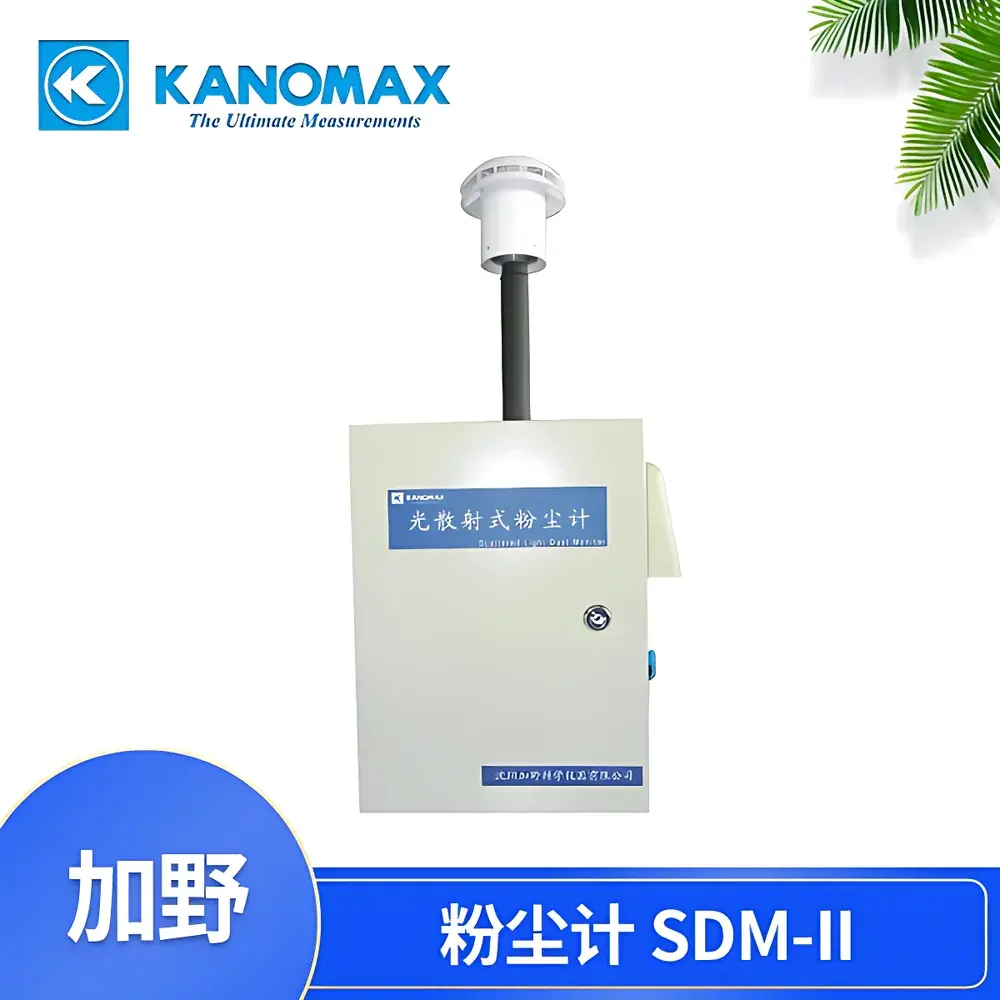
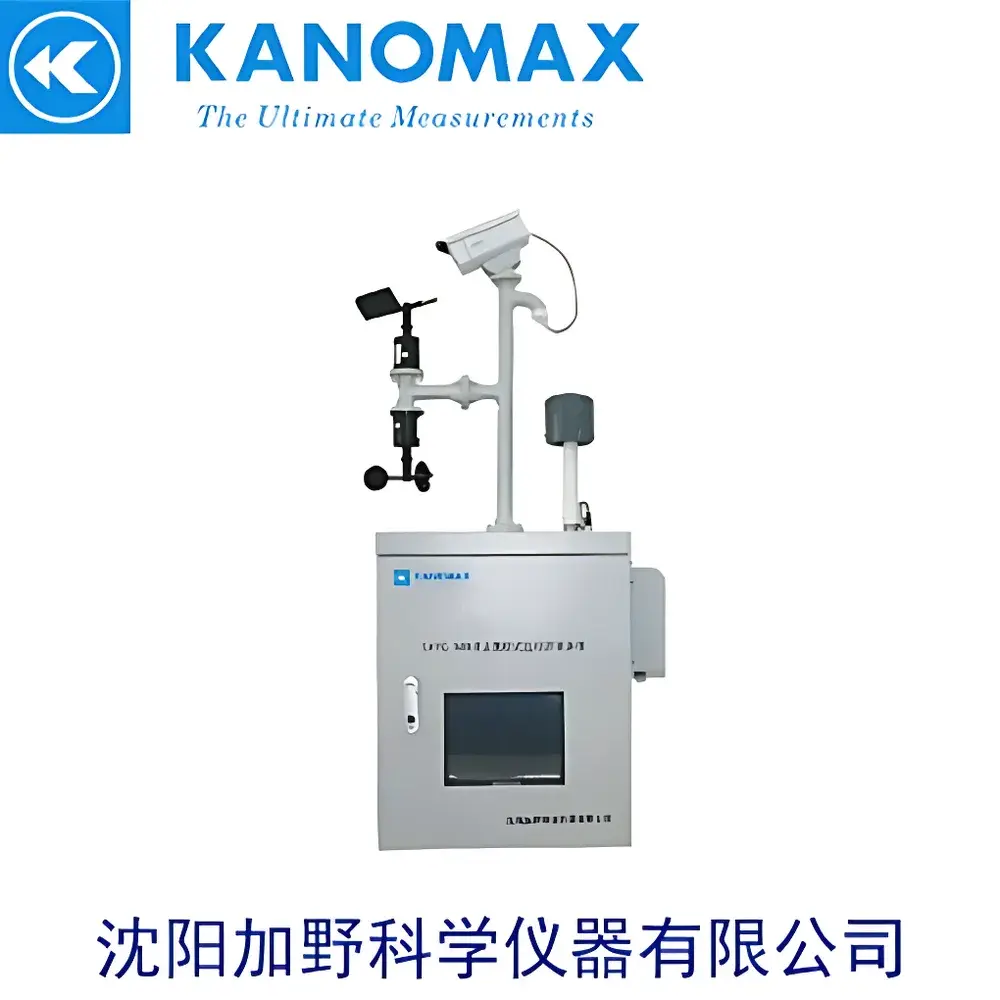
KANOMAX SDM-II+ Laser Dust Monitor
| Brand | KANOMAX |
|---|---|
| Origin | Japan |
| Model | SDM-II+ |
| Measurement Principle | Laser Light Scattering |
| Particle Size Range | PM2.5, PM10, TSP |
| Measurement Range | 0.01–10.00 mg/m³ |
| Resolution | 0.01 mg/m³ |
| Accuracy | ±10% |
| Relative Error | ≤±2% |
| Sampling Flow Rate | 1.7 L/min |
| Zero & Span Auto-Calibration | Yes |
| Humidity Compensation | Integrated Automatic Dehumidification |
| Alarm Threshold Setting | Configurable Concentration Limit |
| Communication Interface | RS485 |
| Power Supply | DC 10–15 V, 2 A |
| Dimensions (W×H×D) | 250 × 350 × 170 mm (unit only) |
| Weight | ~4.5 kg (unit only) |
Overview
The KANOMAX SDM-II+ Laser Dust Monitor is a precision-engineered environmental monitoring instrument designed for real-time, continuous measurement of airborne particulate mass concentration in ambient and occupational environments. Utilizing the well-established principle of laser light scattering (nephelometry), the SDM-II+ detects suspended particles—specifically within the PM2.5, PM10, and total suspended particulates (TSP) size fractions—by quantifying the intensity of light scattered at defined angular ranges when a collimated laser beam interacts with aerosol particles in the sampled airstream. This optical detection method enables rapid response (≤1 second sampling interval), high temporal resolution, and stable operation under variable humidity conditions—enhanced by its integrated automatic dehumidification system. Unlike gravimetric reference methods requiring post-sampling lab analysis, the SDM-II+ delivers immediate, field-deployable data while maintaining traceability to standardized aerosol calibration protocols. It is widely deployed for regulatory compliance support, construction site扬尘 (dust) management, roadside air quality surveillance, and indoor-outdoor air quality assessment in industrial and municipal settings.
Key Features
- Laser-based nephelometric sensing with dual-wavelength compensation for improved particle size sensitivity across PM2.5, PM10, and TSP fractions
- Real-time output with configurable averaging intervals (1–60 minutes) and built-in data logging capability
- Integrated automatic zero-point and span calibration function, reducing manual intervention and improving long-term measurement stability
- Active humidity control module that dynamically removes condensate from the optical path, minimizing signal drift during high-humidity exposure
- RS485 serial interface compliant with Modbus RTU protocol for seamless integration into SCADA systems, centralized environmental monitoring platforms, or PLC-based control networks
- Configurable alarm thresholds with relay output for local visual/audible alerts or remote notification via connected supervisory systems
- Front-panel membrane keypad and LCD display for on-device configuration, diagnostics, and live concentration readout
Sample Compatibility & Compliance
The SDM-II+ is optimized for ambient air, urban roadway emissions, construction zone fugitive dust, and general industrial workplace atmospheres. Its inlet design meets ISO 7708:1995 specifications for inhalable and thoracic fraction sampling geometry. While not intrinsically safe or explosion-proof, it is rated for use in non-hazardous locations per IEC 61000-6-2 (immunity) and IEC 61000-6-3 (emissions). The instrument supports quality assurance workflows aligned with EPA Method PS-11 (for continuous ambient PM monitors) and ISO 12103-1 A2 test dust calibration traceability. Data integrity complies with GLP documentation requirements, and optional firmware upgrades enable audit-trail logging suitable for ISO/IEC 17025-accredited laboratories.
Software & Data Management
The SDM-II+ operates as a standalone sensor node but is fully compatible with KANOMAX’s proprietary PC-based configuration and data acquisition software (Kanomax Data Manager v3.x). This application enables remote parameter setup, historical trend visualization, CSV export, and batch report generation—including daily mean, peak, and percentile statistics. For enterprise deployment, the RS485 interface allows direct integration with third-party environmental information systems (EIS) or cloud-based IoT platforms using standard Modbus register mapping. All logged data include timestamping with internal RTC (real-time clock), and memory retains up to 30 days of 1-minute averaged values (expandable via external SD card in custom configurations). Firmware updates are delivered via USB or serial port, supporting version-controlled maintenance and regulatory alignment.
Applications
- Regulatory-grade ambient air quality monitoring networks (AQN) for municipal environmental protection bureaus
- Construction site dust mitigation verification per local ordinances (e.g., China’s “Construction Site Air Pollution Prevention and Control Guidelines”)
- Industrial hygiene assessments in cement plants, quarries, foundries, and material handling facilities
- Indoor air quality (IAQ) benchmarking in schools, hospitals, and office buildings where PM infiltration is a concern
- Mobile monitoring deployments using vehicle-mounted or tripod-mounted configurations for spatial mapping of dust plumes
- Validation and co-location studies with federal equivalent (FRM/FEM) reference instruments during method equivalency testing
FAQ
Does the SDM-II+ require periodic recalibration with certified test dust?
Yes. While the instrument features automatic zero/span correction, annual calibration against NIST-traceable aerosol standards (e.g., Arizona Test Dust ISO 12103-1 A2) is recommended per ISO 29463-4 and manufacturer service guidelines.
Can the SDM-II+ be used indoors without external power?
It requires a stable DC 10–15 V, 2 A supply; battery operation is not supported natively, though external portable power stations meeting voltage/current specs may be used in temporary deployments.
Is the RS485 interface compatible with Modbus TCP gateways?
Yes—when paired with a standard RS485-to-Ethernet converter supporting Modbus RTU-to-TCP bridging, the SDM-II+ integrates into IP-based SCADA architectures.
How does the automatic dehumidification function affect measurement accuracy?
The integrated Peltier-based moisture removal maintains relative humidity inside the optical chamber below 60% RH, preventing Mie scattering artifacts caused by hygroscopic particle growth and ensuring consistent calibration transfer across humid climates.
What filter media are compatible with the optional gravimetric sampling module?
Standard 37-mm or 47-mm diameter quartz fiber or PTFE membrane filters (e.g., Pallflex Tissuquartz QAT-UP or SKC PVC filters) can be installed for concurrent mass-based validation per ISO 7708 and EN 481.
Related Products







