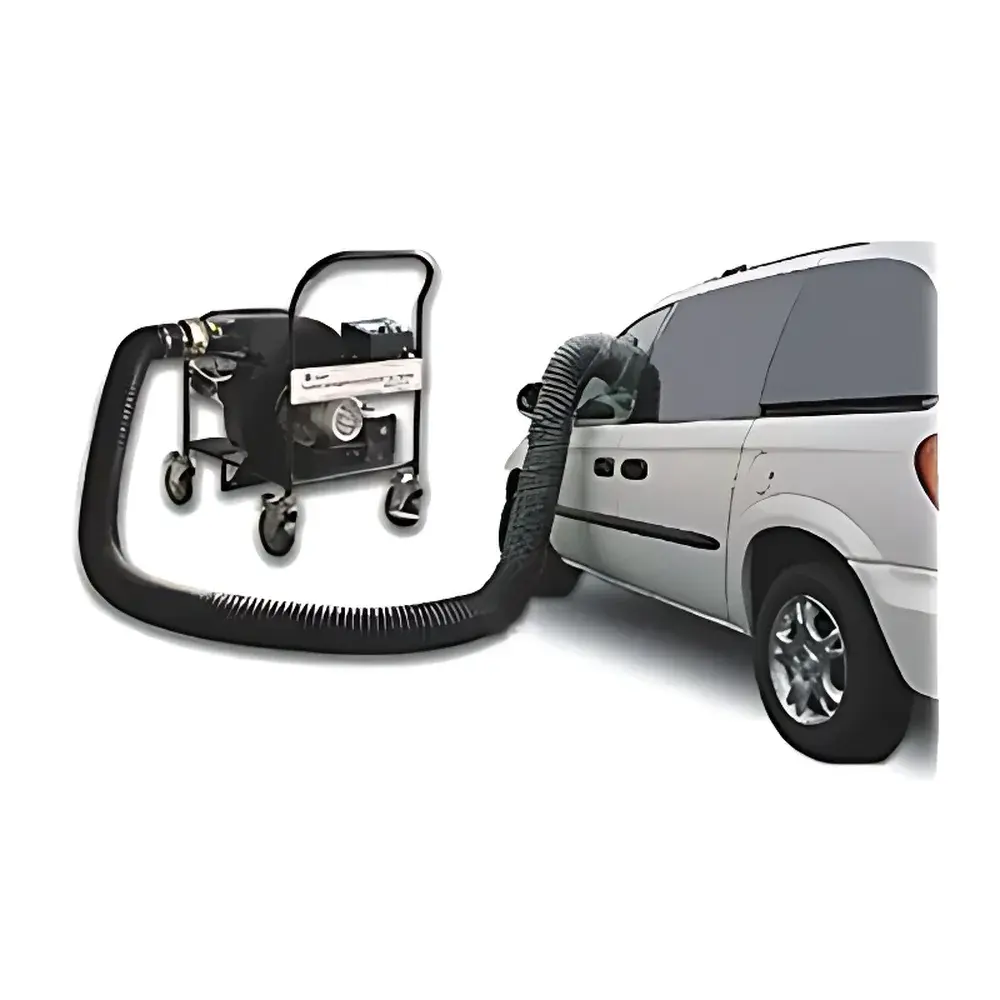
Kanomax KAN-VEH-SEAL Vehicle Cabin Air Leakage Test System
| Brand | Kanomax |
|---|---|
| Origin | Japan |
| Model | KAN-VEH-SEAL |
| Pressure Range | ±2500 Pa |
| Measurable Air Leakage Rate | 1–200 L/s |
| Mounting | Flanged Interface to Vehicle Window |
| Static Pressure Monitoring Port | Integrated on Flange |
| Control Mode | Static Pressure Setpoint or Volumetric Leakage Rate Setpoint |
| Actuation | Variable-Speed Fan with Real-Time Feedback Compensation |
| Compliance | Designed for ISO 9001-aligned automotive cabin integrity verification |
Overview
The Kanomax KAN-VEH-SEAL Vehicle Cabin Air Leakage Test System is a precision-engineered, benchtop-integrated pressure differential measurement platform designed for quantitative evaluation of air infiltration and exfiltration pathways in automotive passenger compartments. Operating on the principle of controlled pressurization/depressurization (blower door methodology), the system applies a regulated static pressure differential across the vehicle cabin envelope—ranging continuously from –2500 Pa to +2500 Pa—and measures the volumetric airflow required to maintain that differential. This enables direct quantification of total cabin leakage, as well as localized contributions from discrete components including doors, sunroofs, trunk lids, and firewall penetrations between the engine bay and occupant compartment. The system adheres to fundamental fluid mechanics principles governed by laminar and transitional flow regimes at low Reynolds numbers, ensuring high reproducibility under standardized ambient conditions (23 °C ± 2 °C, 50 % RH ± 10 %). Its architecture supports both steady-state and dynamic ramp testing protocols, making it suitable for R&D validation, production line QC screening, and post-assembly leak diagnostics.
Key Features
- High-fidelity variable-speed centrifugal fan with closed-loop PID control, enabling precise maintenance of user-defined static pressure setpoints or volumetric leakage rate targets
- Modular nozzle assembly kit (1–200 L/s range) with calibrated orifice plates and interchangeable diffusers for optimized flow coupling across diverse vehicle window geometries
- Integrated flanged mounting interface with dual-purpose design: structural sealing against the vehicle window frame and built-in static pressure tap port for real-time cabin pressure feedback
- Digital pressure transducer with ±0.5 % full-scale accuracy over the ±2500 Pa operating range, traceable to NIST-traceable calibration standards
- Real-time compensation algorithm that dynamically adjusts fan speed to counteract thermal drift, ambient barometric fluctuations, and minor seal degradation during extended test cycles
- Robust aluminum-alloy chassis with vibration-damped baseplate and IP54-rated electronics enclosure for workshop and climatic chamber deployment
Sample Compatibility & Compliance
The KAN-VEH-SEAL accommodates passenger vehicles (sedans, SUVs, light commercial vans) with standard side or rear window dimensions (minimum aperture: 400 × 300 mm). It is compatible with OEM-standard window glass thicknesses (4–6.5 mm) and curvature radii up to 1200 mm. The system supports compliance workflows aligned with JIS D 0207 (Automotive Interior Air Tightness), ISO/TS 16949 clause 8.2.4 (process monitoring of cabin sealing), and internal OEM specifications such as GM W0100002 and Ford CETP 00.00-L-467. While not certified to ISO/IEC 17025, its measurement uncertainty budget (k=2) is documented per ISO/IEC Guide 98-3 (GUM) and includes contributions from transducer linearity, temperature coefficient, and nozzle discharge coefficient variability.
Software & Data Management
The system operates via Kanomax’s proprietary VehSealControl v3.2 software (Windows 10/11, 64-bit), which provides synchronized acquisition of pressure, airflow, and time-stamped environmental parameters (ambient T/RH, barometric pressure). All data are stored in encrypted SQLite databases with configurable export to CSV, PDF test reports, or XML formats compatible with enterprise LIMS platforms. Audit trails record operator ID, test start/stop timestamps, calibration history, and parameter modification events—supporting GLP-compliant documentation requirements. The software enforces 21 CFR Part 11–compatible electronic signatures and role-based access control (Admin, Technician, Viewer).
Applications
- Quantitative benchmarking of door seal compression force vs. leakage performance across trim levels
- Validation of HVAC duct integrity and firewall gasket effectiveness under positive/negative cabin pressure bias
- Correlation studies between acoustic NVH performance and aerodynamic leakage paths
- Root-cause analysis of condensation ingress in instrument clusters or infotainment housings
- Pre-certification testing for EU Whole Vehicle Type Approval (WVTA) Annex XVI cabin air quality provisions
- Supplier qualification audits for Tier-1 door module and sunroof actuator assemblies
FAQ
What pressure ranges does the KAN-VEH-SEAL support, and how is stability maintained?
It delivers stable static pressure control from –2500 Pa to +2500 Pa using a servo-controlled fan with real-time feedback from the integrated pressure transducer. Stability is maintained within ±1.5 Pa over 10-minute intervals under constant ambient conditions.
Can the system isolate leakage from individual components (e.g., driver’s door only)?
Yes—by temporarily sealing all openings except the target component and repeating the test, users can derive relative contribution metrics. Optional add-on accessories include magnetic door-frame shutoff plates and inflatable sunroof perimeter seals.
Is calibration certification included with shipment?
Each unit ships with a factory calibration certificate referencing NIST-traceable standards for both pressure and volumetric flow channels, valid for 12 months from date of issue.
Does the system meet automotive industry cybersecurity requirements for shop-floor instrumentation?
The embedded controller uses a hardened RTOS without network stack; communication occurs exclusively via USB 2.0 or isolated RS-485. No internet connectivity or remote access capabilities are implemented, satisfying OEM cyber-resilience directives such as ISO/SAE 21434 Clause 8.3.2.