
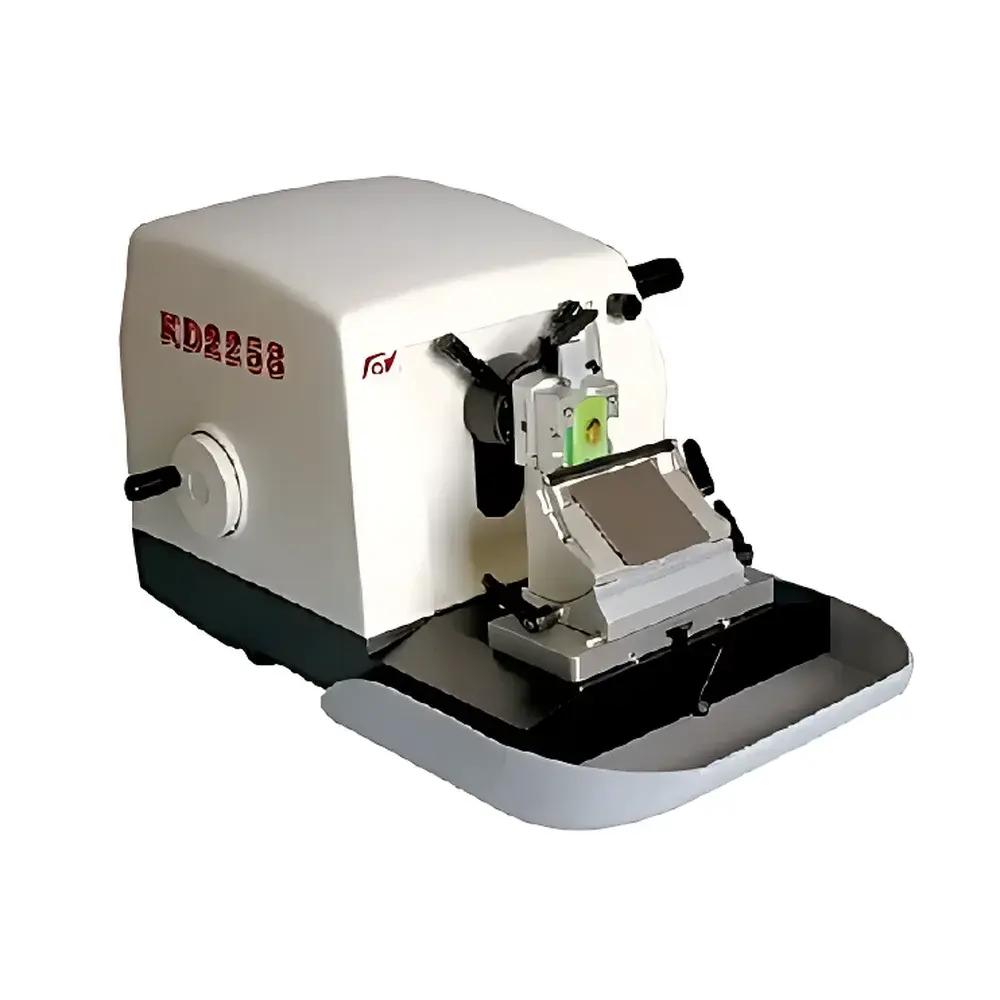
KD-2258 Rotary Microtome
| Origin | China |
|---|---|
| Manufacturer Type | Authorized Distributor |
| Model | KD-2258 |
| Cutting Thickness Range | 0.5–60 µm (with 0.5 µm minimum increment) |
| Sample Max Dimensions | 60 × 50 mm |
| Horizontal Specimen Travel | 28 mm |
| Vertical Specimen Travel | 60 mm |
| Retraction Range | 0–28 mm |
| Trimming Thickness Range | 1–60 µm |
| Overall Dimensions | 500 × 460 × 300 mm |
| Net Weight | 23.3 kg |
| Precision | ±5% |
| Minimum Graduation | 0.5 µm |
Overview
The KD-2258 Rotary Microtome is a precision-engineered, benchtop rotary microtome designed for high-reproducibility sectioning of paraffin-embedded and frozen biological specimens in histopathology, plant morphology, and preclinical research laboratories. It operates on the classical rotary principle—where the specimen advances linearly toward a stationary knife during each rotation of the handwheel—enabling consistent, planar sectioning across a broad thickness range. Engineered for ISO 13485-aligned manufacturing standards and compatible with GLP-compliant workflows, the KD-2258 integrates mechanical stability with ergonomic optimization to support extended daily use in diagnostic pathology labs and academic core facilities. Its rigid cast-aluminum base, imported roller-bearing guideways, and high-precision ground lead screw ensure minimal runout and long-term dimensional stability—critical for serial sectioning and immunohistochemistry (IHC) preparation.
Key Features
- Ergonomic three-axis specimen clamp with independent locking in X-, Y-, and Z-planes for precise orientation of tissue blocks prior to sectioning.
- Dual-mode knife holder system supporting both standard steel blades (N-type mount) and disposable blades (E-type mount), eliminating manual blade handling.
- Integrated red safety guard spanning full blade length, compliant with IEC 61000-4-2 ESD protection guidelines and reducing accidental contact risk during blade exchange or cleaning.
- Stepless handwheel with adjustable locking mechanism—enables secure positioning at any rotational angle for controlled manual advancement and enhanced operator safety.
- Automatic specimen retraction (0–28 mm) synchronized with each cutting cycle, minimizing compression artifacts and facilitating ribbon formation.
- Modular knife-base assembly allowing longitudinal and lateral fine adjustment without direct finger contact with the cutting edge.
- Sealed box-style dust cover requiring no disassembly for routine cleaning; large-capacity removable waste tray simplifies debris management between sessions.
Sample Compatibility & Compliance
The KD-2258 accommodates standard histological cassettes and embedding molds up to 60 × 50 mm, compatible with paraffin, low-melting-point wax, and OCT compound-embedded tissues. While primarily intended for room-temperature paraffin sectioning, it may be paired with optional cryo-accessories (e.g., KD-VI cold stage) for dual-mode operation per ASTM E2979-20 “Standard Guide for Cryosectioning of Biological Tissues.” The instrument conforms to CE marking requirements under Directive 2014/30/EU (EMC) and 2014/35/EU (LVD). All metallic components undergo passivation per ISO 8502-3, ensuring corrosion resistance in humid laboratory environments. Calibration traceability is supported via documented factory verification against NIST-traceable micrometer standards.
Software & Data Management
As a fully mechanical microtome, the KD-2258 does not incorporate embedded firmware or digital controls. However, its deterministic mechanical design ensures repeatable, operator-independent section thickness settings—essential for audit-ready documentation under FDA 21 CFR Part 11 when used within validated histology workflows. Thickness settings are recorded manually in lab notebooks or LIMS-integrated electronic records using standardized nomenclature (e.g., “KD-2258 / 4.0 µm / 2024-06-12 / Operator ID: HIST-087”). Optional integration with third-party digital slide scanners (e.g., Leica Aperio AT2, Hamamatsu NanoZoomer) enables metadata synchronization via DICOM-SR structured reporting templates.
Applications
- Routine diagnostic histopathology: Hematoxylin & eosin (H&E), special stains (e.g., Masson’s trichrome), and enzyme histochemistry on formalin-fixed paraffin-embedded (FFPE) human and veterinary tissue specimens.
- Plant anatomy studies: Sectioning of woody stems, root nodules, and leaf cross-sections for light microscopy and SEM sample preparation.
- Preclinical toxicology: Serial sectioning of rodent organ blocks for morphometric analysis and lesion mapping in GLP-regulated safety studies.
- Biobanking: High-fidelity ribbon collection from archival FFPE blocks for downstream nucleic acid extraction and spatial transcriptomics.
- Quality control in IVD manufacturing: Consistent sectioning of control tissue arrays for antibody validation and assay reproducibility testing.
FAQ
Is the KD-2258 compatible with cryomicrotomy?
The base KD-2258 model is optimized for paraffin sectioning at ambient temperature. For frozen sectioning, it must be coupled with the KD-VI rapid cooling system (sold separately), forming the KD-2258-VI configuration with programmable cold stage (-55 °C) and cold knife unit.
What blade types are supported?
The microtome accepts standard steel blades via an N-type holder and disposable blades via an E-type holder—both mounted without direct finger contact using the tool-free lever system.
Does it meet international calibration standards?
Yes. Each unit undergoes factory calibration verified against traceable micrometers; users may perform periodic verification using certified gauge blocks per ISO/IEC 17025-accredited procedures.
Can it be integrated into a digital pathology workflow?
While inherently analog, its mechanical repeatability supports robust correlation with digital imaging systems when paired with standardized SOPs for section thickness logging, staining protocols, and slide barcoding.
What maintenance is required?
Recommended biweekly lubrication of the lead screw with ISO VG 68 mineral oil and monthly inspection of guideway alignment; no firmware updates or software patches are applicable.



