
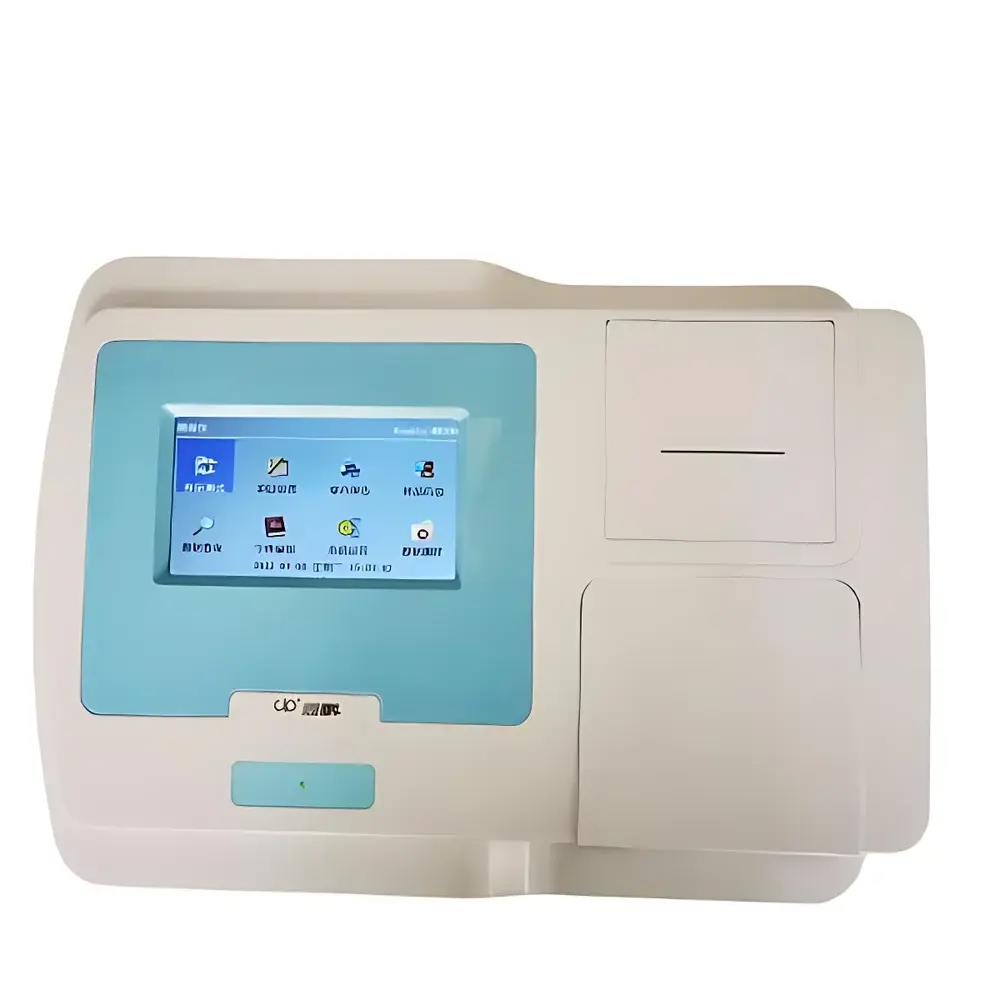
Keebio MR200 Automated Microplate Reader
| Brand | Keebio |
|---|---|
| Model | MR200 |
| Type | Automated Absorbance Microplate Reader |
| Wavelength Range | 340–800 nm |
| Absorbance Range | 0.000–4.000 A |
| Accuracy | ≤ ±0.005 A or ±0.2% T |
| Light Source | High-Stability LED (20,000 h lifetime) |
| Optical Path | 8-Channel Simultaneous Detection |
| Plate Format | Standard 96-well (flat/U/V-bottom compatible) |
| Read Speed | ≤3 sec/plate (single wavelength), ≤6 sec/plate (dual wavelength) |
| Filter Positions | 10 (standard: 405, 450, 492, 630 nm |
| Bandwidth | ≤8 nm (FWHM) |
| Resolution | 0.001 A (display), 0.0001 A (internal calculation) |
| Repeatability | ≤0.2% (A) or ≤0.2% T |
| Drift | ≤±0.002 A or ≤0.5% T / 10 min |
| Data Storage | 2,000 plates (96-well), ≥500 assay protocols |
| Interface | USB 2.0, RS232, parallel printer port, USB mouse/keyboard support |
| Display | 7-inch color TFT LCD touchscreen |
| Operating Environment | 5–40 °C, 15–80% RH |
| Dimensions | 475 × 350 × 210 mm |
| Net Weight | 10 kg |
Overview
The Keebio MR200 Automated Microplate Reader is a dedicated absorbance-based microplate detection system engineered for quantitative analysis in enzyme-linked immunosorbent assays (ELISA), colorimetric enzymatic assays, and other endpoint or kinetic biochemical measurements. It operates on the principle of monochromatic light absorption—measuring transmitted light intensity through sample wells after selective wavelength filtering—to determine analyte concentration via Beer-Lambert law correlation. Designed for high-throughput laboratory environments, the MR200 integrates an eight-channel optical path with precision LED illumination, eliminating warm-up delays and photometric drift associated with halogen or tungsten sources. Its fixed-wavelength architecture—configured with four standard filters (405, 450, 492, and 630 nm) and expandable to six user-defined wavelengths—ensures optimal spectral match for common ELISA substrates including TMB, OPD, pNPP, and ABTS. The instrument complies with fundamental photometric performance criteria outlined in CLSI EP10-A3 and ISO 15197:2013 for analytical accuracy and repeatability in clinical and research-grade applications.
Key Features
- High-stability LED light source with >20,000-hour operational lifetime and intelligent auto-shutdown to minimize thermal load and extend component longevity
- Simultaneous 8-channel detection across all wells of a standard 96-well plate, enabling rapid data acquisition (≤3 seconds per plate at single wavelength)
- Full-color 7-inch capacitive touchscreen interface with intuitive graphical layout, supporting direct plate mapping, protocol selection, and real-time result visualization
- Dual-mode input capability: native touch navigation supplemented by optional USB mouse and keyboard for advanced data entry and report customization
- Integrated thermal printer with configurable output formats—including QC summary sheets, raw OD tables, and curve-fitting reports—with support for external printers via parallel or USB interfaces
- Onboard diagnostics and self-calibration routines accessible via dedicated maintenance menu, generating traceable logs for GLP-compliant instrument verification
- Modular filter wheel accommodating up to 10 positions; factory-standard set covers major ELISA wavelengths, while additional slots allow field-installation of custom interference filters (e.g., 340 nm for NADH assays)
Sample Compatibility & Compliance
The MR200 supports standard 96-well microplates with flat, U-bottom, and V-bottom well geometries, ensuring compatibility with commercially available ELISA kits, cell viability reagents (e.g., MTT, CCK-8), and environmental toxin screening assays. It meets essential metrological requirements for absorbance instrumentation as defined under ISO/IEC 17025:2017 for testing laboratories, with documented linearity (R² ≥ 0.999 over 0.000–4.000 A), inter-channel uniformity (≤0.01 A deviation), and wavelength accuracy (±2 nm). While not FDA 510(k)-cleared, its design aligns with general principles referenced in USP and CLSI EP17-A2 for assay validation readiness. All firmware and software modules retain audit-trail functionality for user actions, time stamps, and parameter changes—supporting basic 21 CFR Part 11 readiness when deployed with networked PC-based data archiving.
Software & Data Management
The MR200 ships with Keebio Microplate Analysis Suite (KMAS) v3.x—a Windows-compatible desktop application supporting method creation, multi-plate batch processing, standard curve fitting (linear, 4PL, 5PL), and statistical outlier detection. KMAS enables export of raw OD values, calculated concentrations, and QC metrics in CSV, Excel (.xlsx), and PDF formats. Network connectivity via Ethernet or Wi-Fi (when paired with optional USB-to-Ethernet adapter) allows centralized deployment in shared lab environments. Data storage capacity accommodates ≥2,000 full 96-well plates and ≥500 saved assay templates, with automatic timestamping and user authentication fields. Software updates are delivered via encrypted USB drive or secure HTTPS portal, maintaining version control and change documentation per internal quality procedures.
Applications
- Quantitative ELISA for infectious disease serology (e.g., anti-HIV, HBsAg, SARS-CoV-2 IgG/IgM)
- Cell proliferation and cytotoxicity assays using tetrazolium salts (MTT, XTT) or resazurin-based reagents
- Enzyme activity profiling (e.g., ALP, LDH, HRP kinetics) in drug discovery and toxicology screening
- Food safety testing—including mycotoxin (aflatoxin B1) and pesticide residue quantification via competitive immunoassay
- Environmental monitoring of heavy metals (e.g., Cd²⁺, Pb²⁺) using colorimetric chelation assays
- Plant physiology studies involving chlorophyll content estimation and antioxidant capacity (FRAP, DPPH)
FAQ
What is the maximum absorbance range supported by the MR200?
The instrument measures absorbance from 0.000 to 4.000 A with internal resolution of 0.0001 A and display resolution of 0.001 A.
Can the MR200 perform dual-wavelength measurements automatically?
Yes—it supports simultaneous or sequential dual-wavelength reading (e.g., 450 nm/630 nm) with total read time ≤6 seconds per 96-well plate.
Is the onboard thermal printer replaceable or upgradeable?
The integrated thermal printer uses standard 58-mm thermal paper rolls; external printing is fully supported via parallel or USB interfaces with generic PCL or ESC/POS drivers.
How does the MR200 ensure long-term photometric stability?
Through temperature-compensated LED drive circuitry, real-time reference channel monitoring, and periodic dark-current correction during idle cycles.
Does the system support regulatory-compliant data integrity practices?
Yes—KMAS software provides electronic signatures, audit trails, and immutable result archives; full 21 CFR Part 11 compliance requires supplemental IT infrastructure controls (e.g., domain authentication, encrypted backups).



