
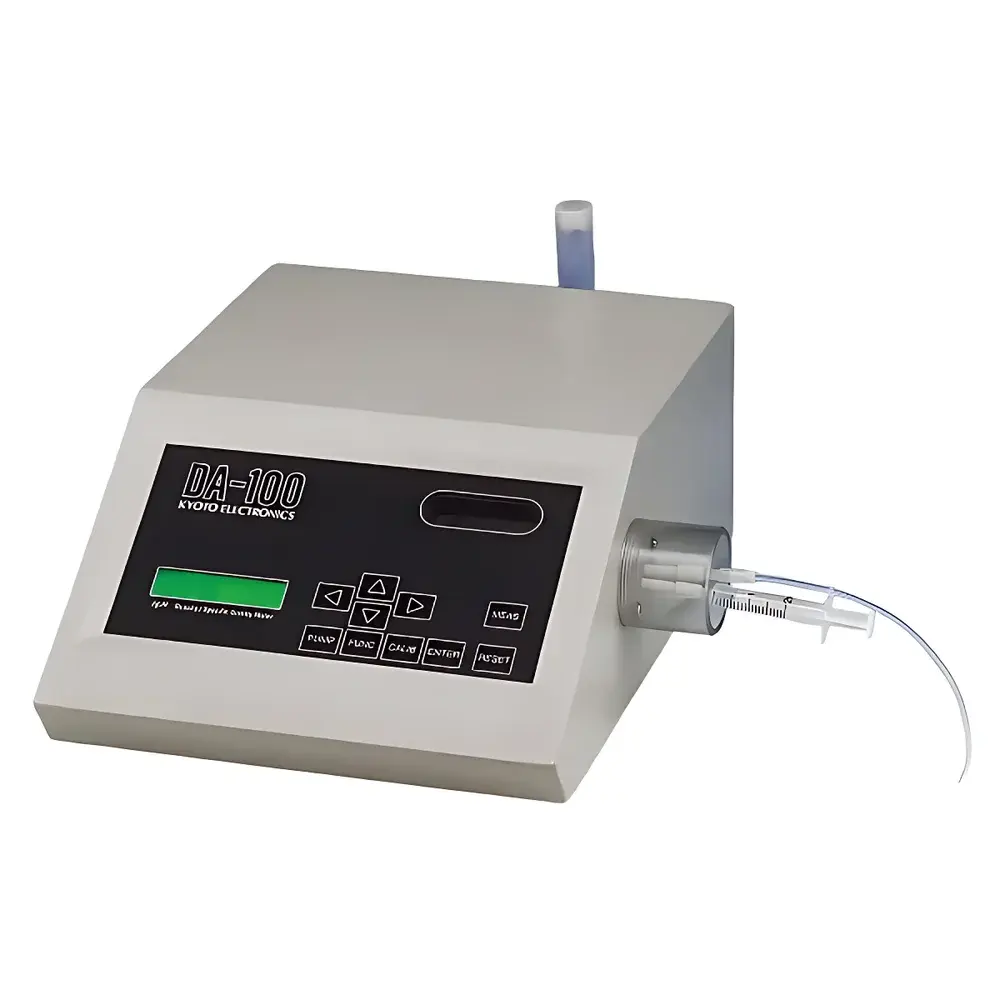
KEM DA-100 Benchtop Oscillating U-Tube Density and Specific Gravity Meter
| Brand | KEM (Kyoto Electronics Manufacturing) |
|---|---|
| Origin | Japan |
| Manufacturer | Yes |
| Import Status | Imported |
| Model | DA-100 |
| Instrument Type | Oscillating U-Tube Densimeter |
| Form Factor | Benchtop Laboratory Instrument |
| Sample Type | Liquids Only |
| Density Range | 0–3 g/cm³ |
| Density Accuracy | ±0.001 g/cm³ |
| Temperature Control Range | 15–40 °C (±0.1 °C stability, ±0.5 °C accuracy) |
| Repeatability | 0.001 g/cm³ |
| Resolution | 0.001 g/cm³ |
| Minimum Sample Volume | ~1 mL |
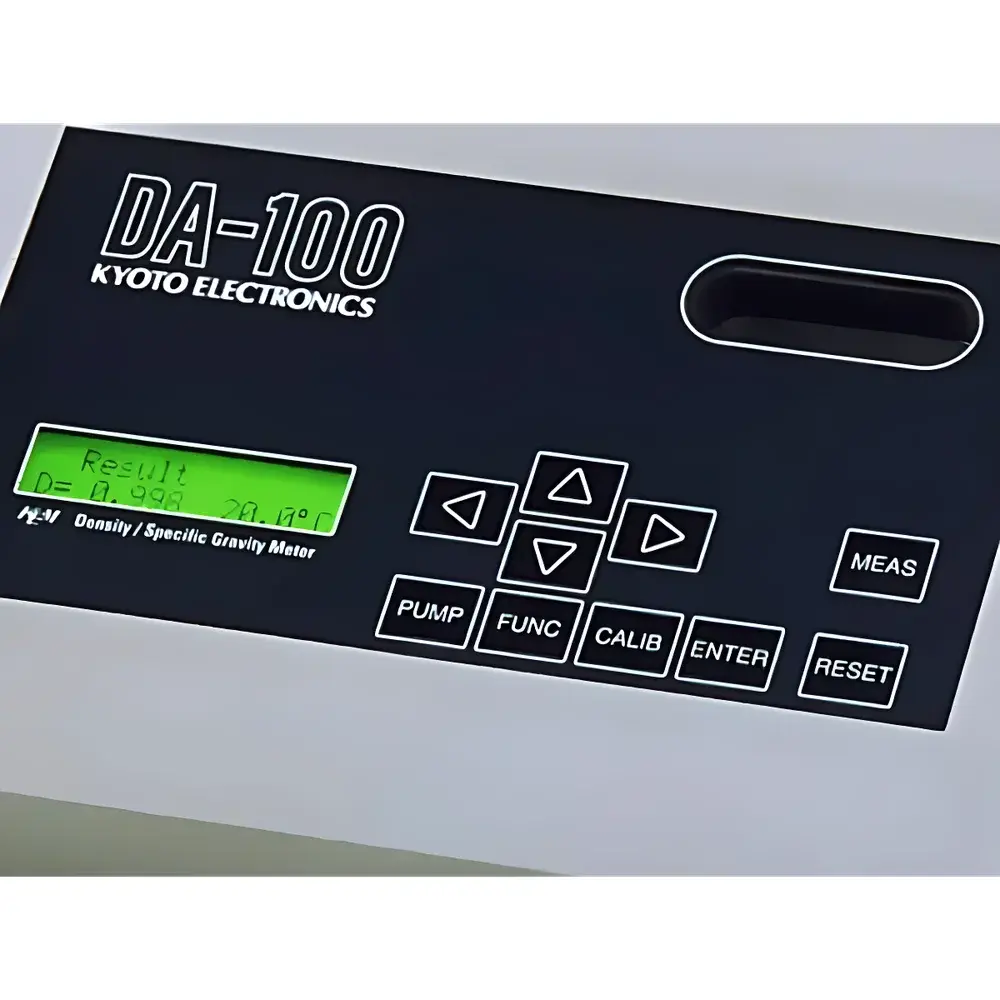
| Display | LCD |
| Measurement Time | 20–90 s |
| Calibration Standards | Dry air and double-distilled water |
| Data Interface | RS-232C |
| Power Supply | AC 100–240 V, 50/60 Hz, 30 W |
| Dimensions | 275 × 350 × 165 mm (W×D×H) |
| Weight | ~6 kg |
Overview
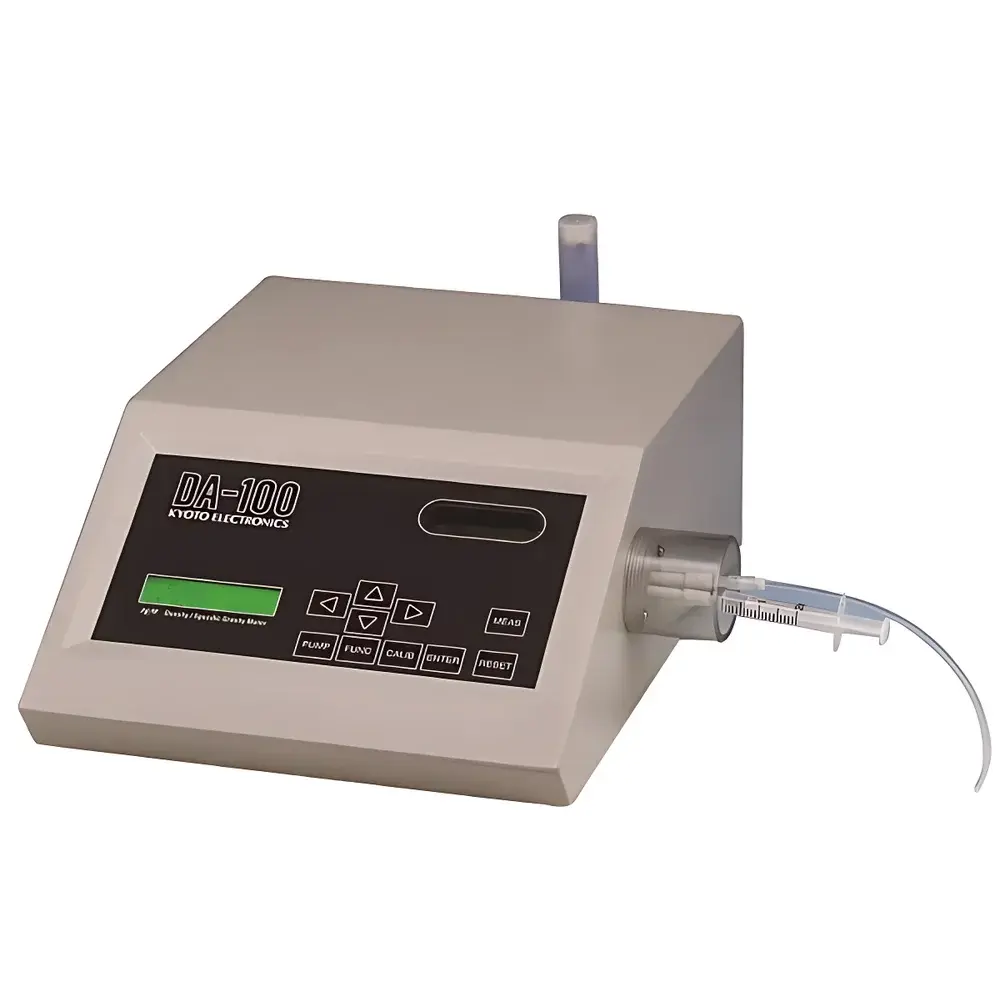
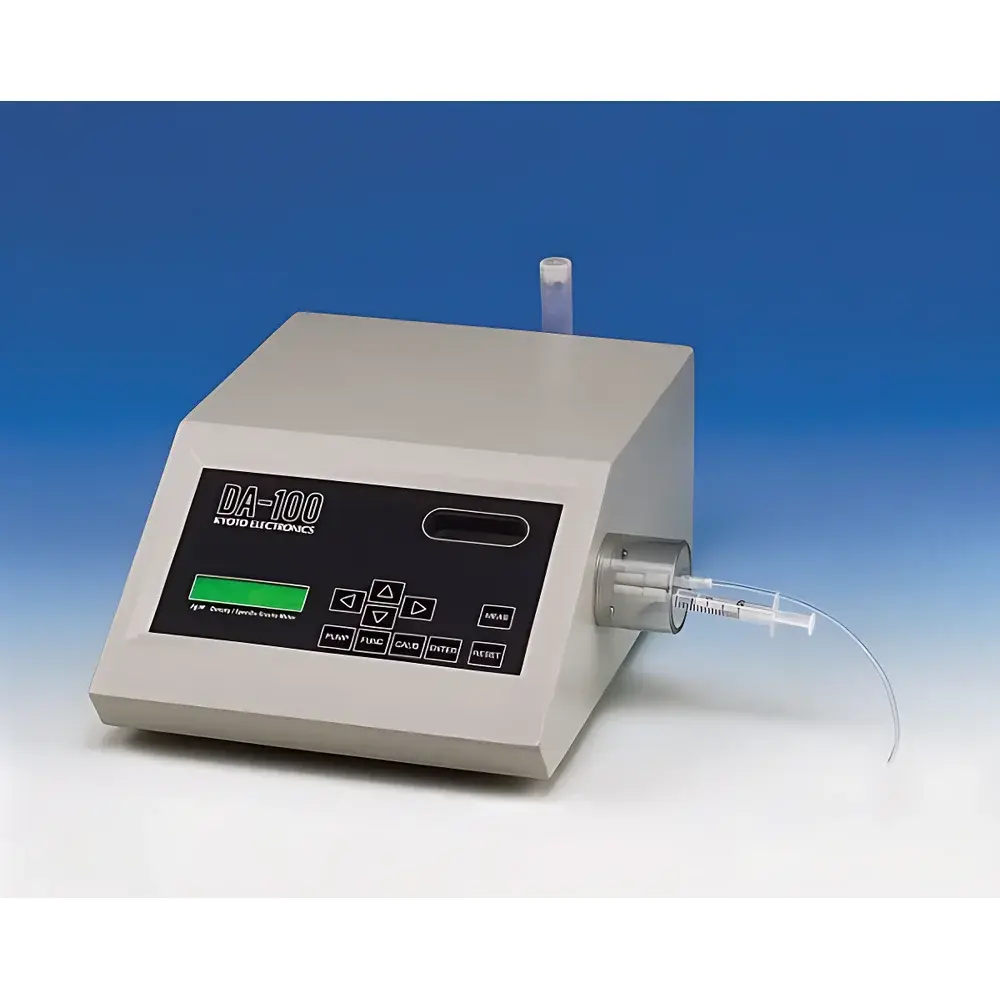
The KEM DA-100 Benchtop Oscillating U-Tube Density and Specific Gravity Meter is a precision laboratory instrument engineered for accurate, rapid, and operator-independent density and specific gravity determination of homogeneous liquid samples. It operates on the fundamental physical principle of oscillating U-tube densimetry: a precisely fabricated borosilicate glass U-tube is filled with the sample and electromagnetically excited into resonant vibration. The natural oscillation frequency of the tube is inversely proportional to the square root of the mass of the contained sample — a relationship governed by the equation f ∝ 1/√ρ, where f is the resonant frequency and ρ is the sample density. This method eliminates reliance on gravitational force or volumetric displacement, delivering high reproducibility across diverse liquid matrices including viscous, opaque, or low-volatility formulations. Designed in strict compliance with DIN EN ISO 15212-1:1998 (Oscillation-type density meters — Part 1: Laboratory instruments), JIS K0061, and JIS Z8804, the DA-100 meets international metrological requirements for routine quality control, raw material verification, and formulation consistency testing in regulated environments.
Key Features
- High-precision U-tube oscillator with temperature-stabilized borosilicate glass cell, ensuring mechanical integrity and long-term calibration stability.
- Integrated Peltier-based thermostatic system maintains sample temperature within ±0.1 °C over the full operational range (15–40 °C), critical for viscosity-sensitive measurements and inter-laboratory comparability.
- Density accuracy of ±0.001 g/cm³ and repeatability of 0.001 g/cm³ support compliance with ASTM D4052 and ISO 12185 for petroleum and chemical product testing.
- Direct conversion of density values to industry-standard concentration units—including API gravity, Baumé scale, alcohol % v/v, and sugar Brix—via built-in calculation algorithms traceable to NIST-certified reference materials.
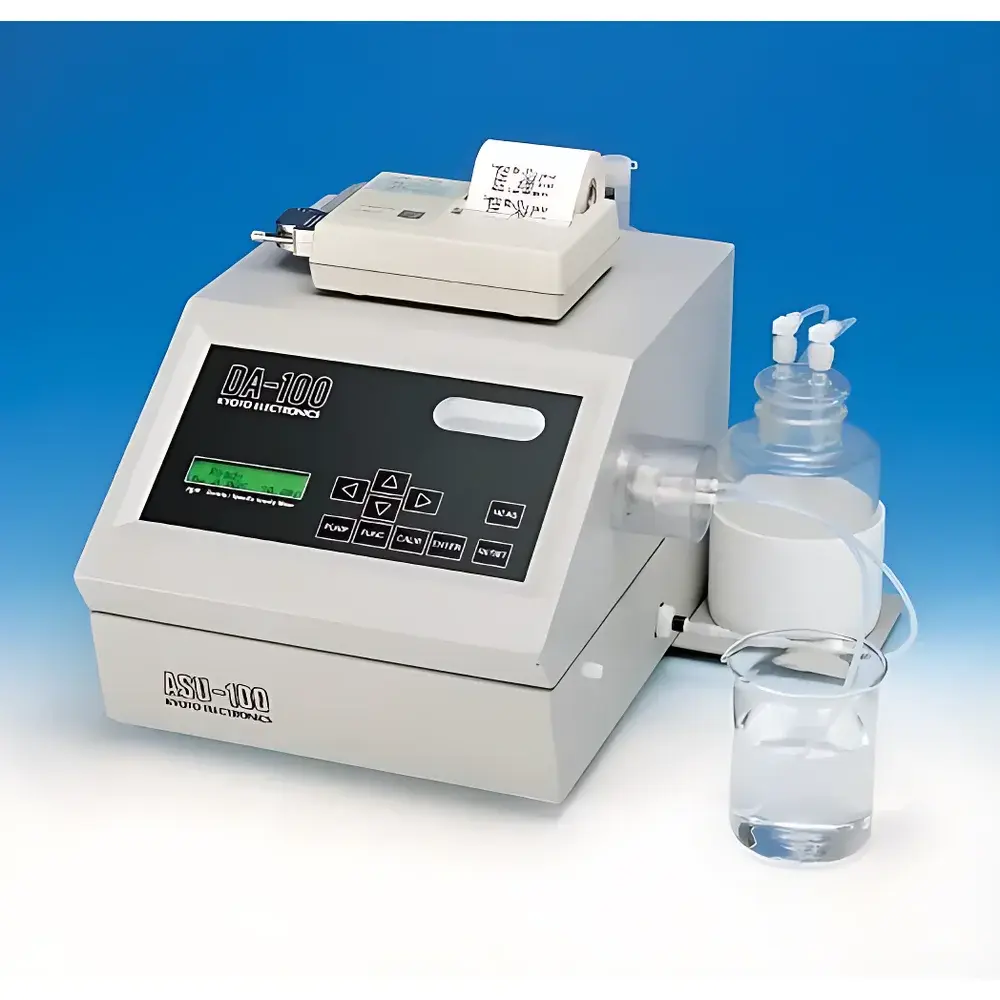
- Automated drying cycle using internal air pump minimizes carryover between samples; optional ASU-100 automatic sampler enables unattended sequential analysis of up to 10 samples per run.
- Calibration performed with only two certified standards: dry air (ρ = 0.0012 g/cm³ at 20 °C) and double-distilled water (ρ = 0.9982 g/cm³ at 20 °C), eliminating complex multi-point curve fitting or empirical corrections.
Sample Compatibility & Compliance
The DA-100 is validated for use with a broad spectrum of Newtonian and mildly non-Newtonian liquids, including milk, edible oils, beverages, surfactant solutions, glycols, organic solvents, and pharmaceutical excipients. Its robust U-tube geometry accommodates samples with kinematic viscosities up to 100 mPa·s without significant damping effects. The instrument conforms to JJG 1058–2010 (Chinese national verification regulation for laboratory oscillating-type liquid densimeters) and supports GLP/GMP documentation workflows through time-stamped measurement logs and RS-232C output compatible with LIMS integration. While not intrinsically explosion-proof, it complies with IEC 61010-1 safety standards for electrical equipment used in laboratory settings.
Software & Data Management
Data acquisition and reporting are managed via ASCII protocol over RS-232C interface, enabling seamless integration with third-party laboratory software (e.g., LabWare LIMS, Thermo Fisher SampleManager). Each measurement record includes timestamp, sample ID, temperature, density, specific gravity, calculated concentration, and instrument status flags (e.g., “Stable”, “Drying Complete”, “Calibration Due”). Audit trail functionality is supported when paired with compliant host systems adhering to FDA 21 CFR Part 11 requirements for electronic records and signatures. No proprietary software installation is required—raw data streams can be captured directly using terminal emulators or custom Python/Excel automation scripts.
Applications
- Quality assurance of incoming raw materials (e.g., ethanol purity, glycerin concentration, acid titration proxies).
- Batch release testing for food & beverage products (milk fat standardization, juice adulteration screening, vinegar acidity estimation).
- Pharmaceutical intermediate verification (solvent identity, propylene glycol/water ratio in injectables).
- Petroleum product grading (diesel fuel density specification per EN 590, jet fuel thermal stability monitoring).
- Academic research in colloid science, polymer solution rheology, and electrolyte thermodynamics where precise density serves as a proxy for composition or molecular interaction strength.
FAQ
What calibration standards are required for daily operation?
Dry air and double-distilled water are the only two required standards. No secondary reference fluids or certified density standards are necessary for routine use.
Can the DA-100 measure slurries or suspensions?
No. The instrument is strictly intended for homogeneous, particle-free liquids. Suspended solids will dampen oscillation and compromise accuracy and tube longevity.
Is temperature compensation applied automatically during measurement?
Yes. The Peltier-controlled chamber actively regulates sample temperature to the user-selected setpoint prior to oscillation initiation; all density results are reported at the specified measurement temperature.
How is sample residue removed between analyses?
The integrated air pump performs an automated purge-and-dry sequence after each measurement. For high-residue samples (e.g., syrups), manual rinsing with compatible solvent followed by forced-air drying is recommended before initiating the next cycle.
Does the DA-100 support network connectivity or USB output?
No. Communication is exclusively via RS-232C serial interface. Ethernet or USB adapters may be used externally, but are not natively supported or validated by KEM.



