
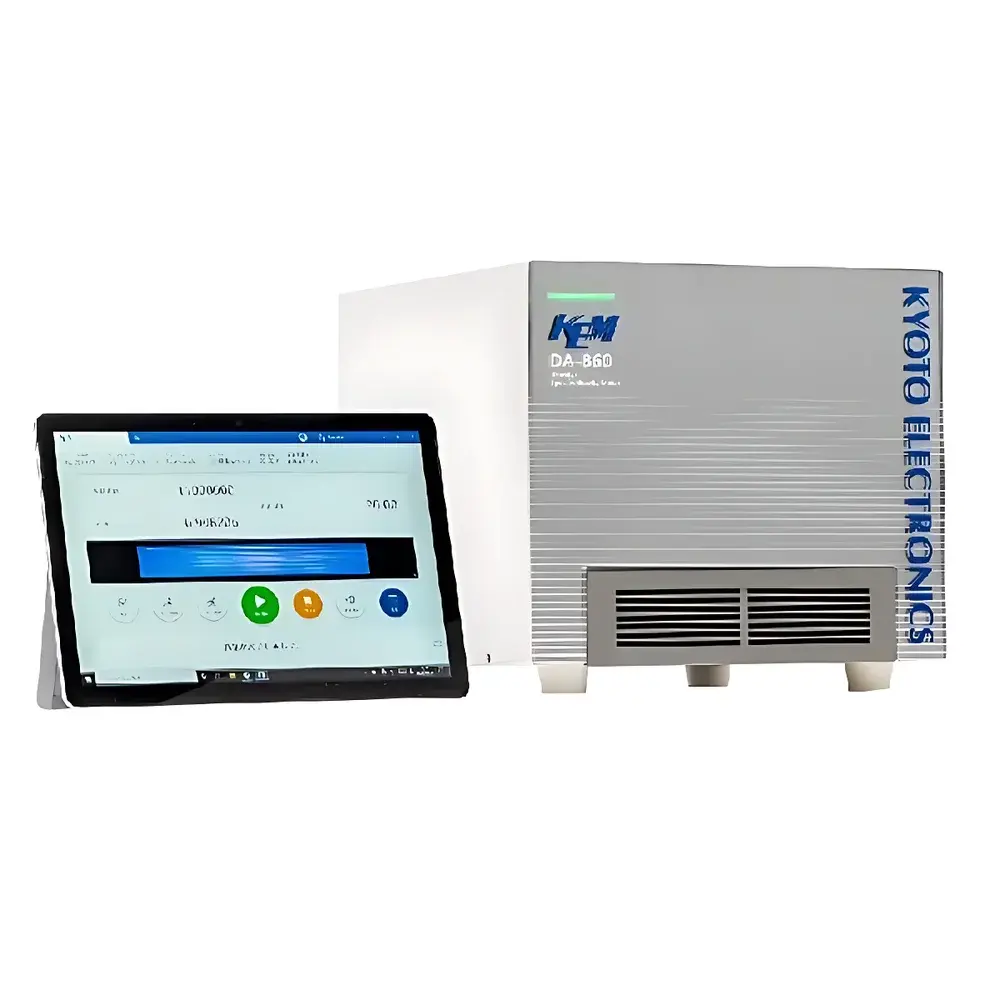
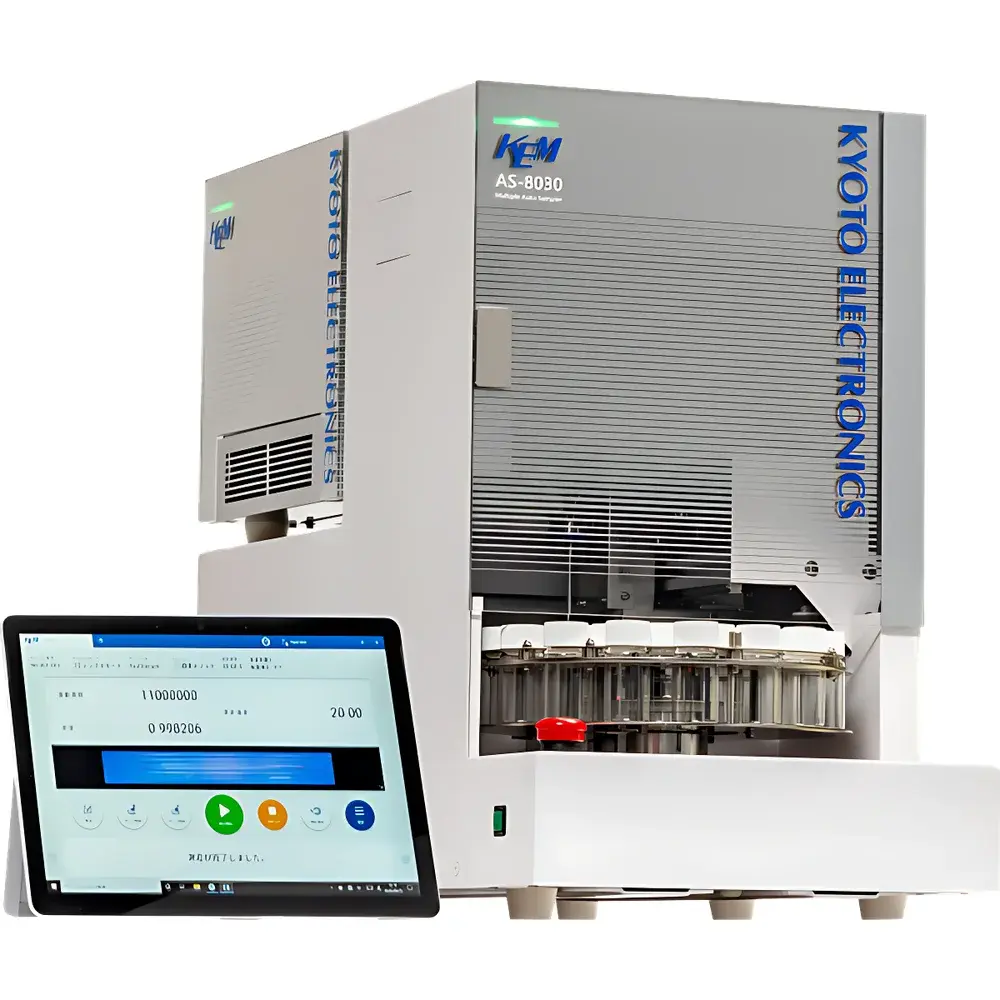
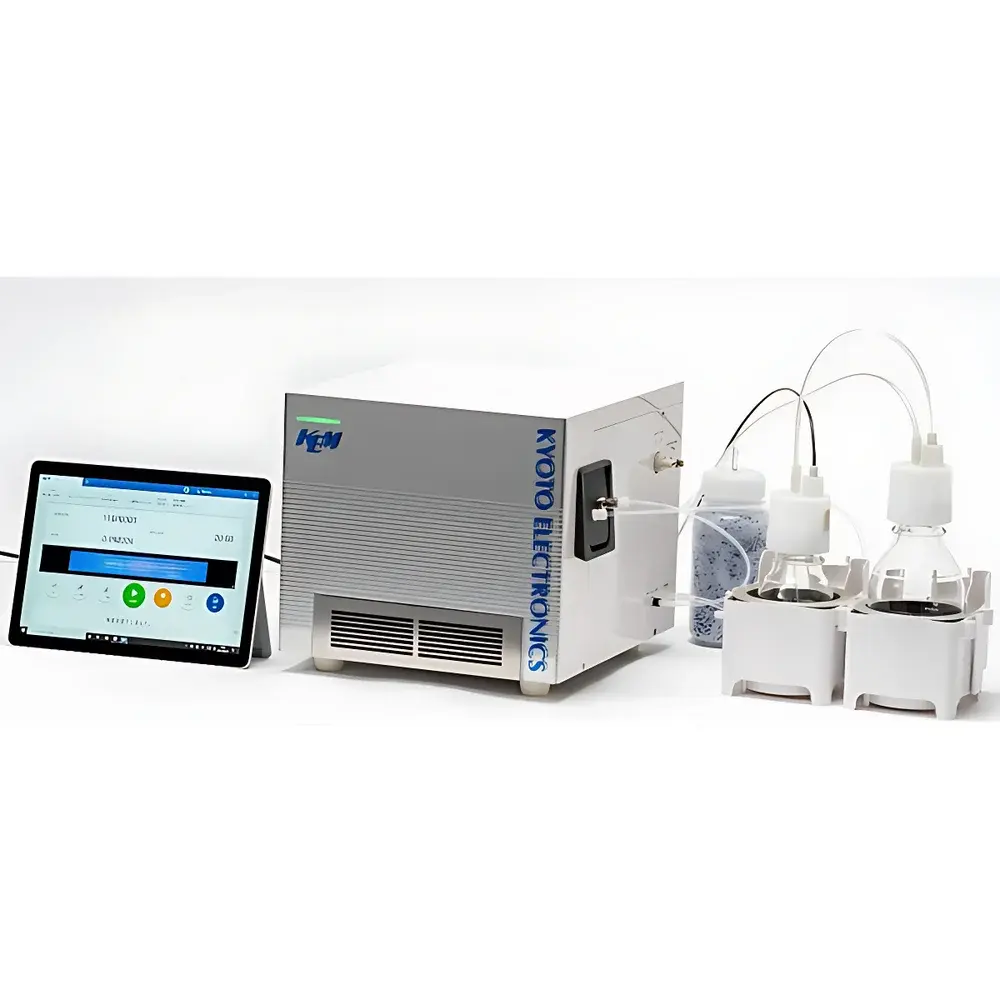
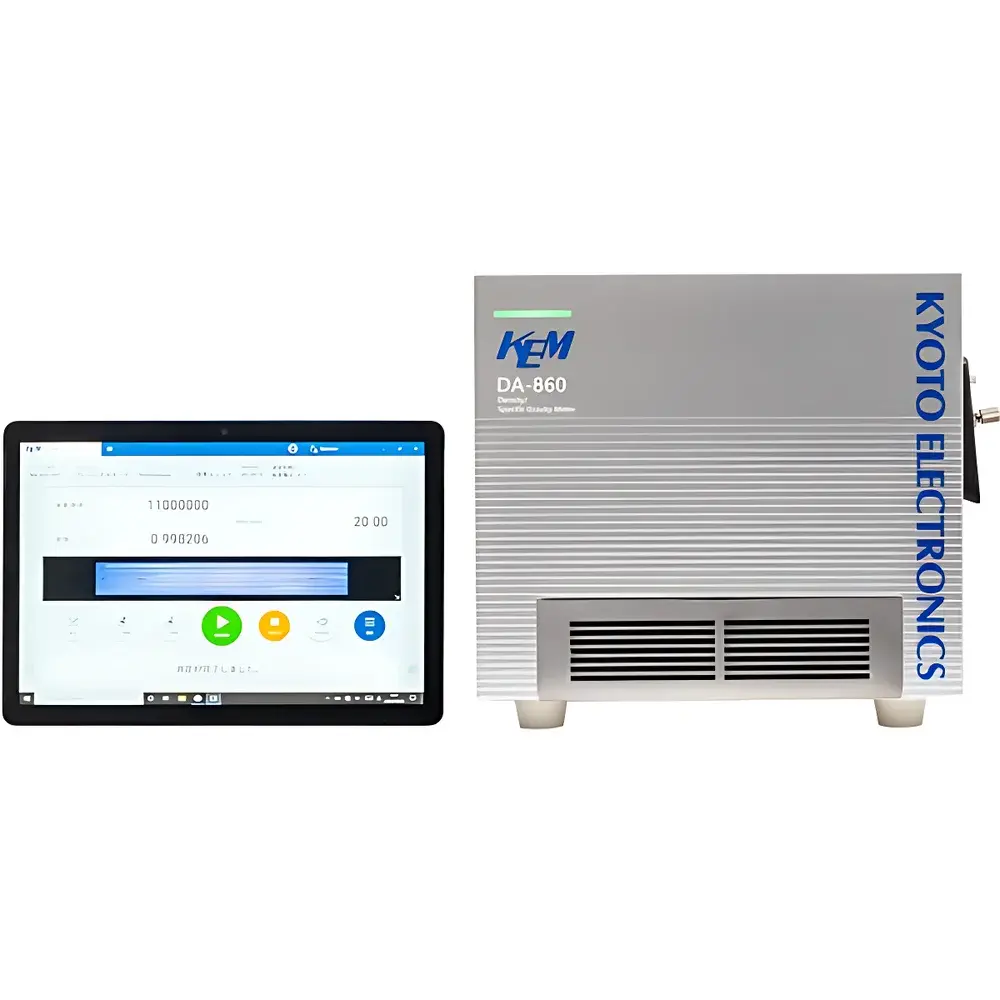
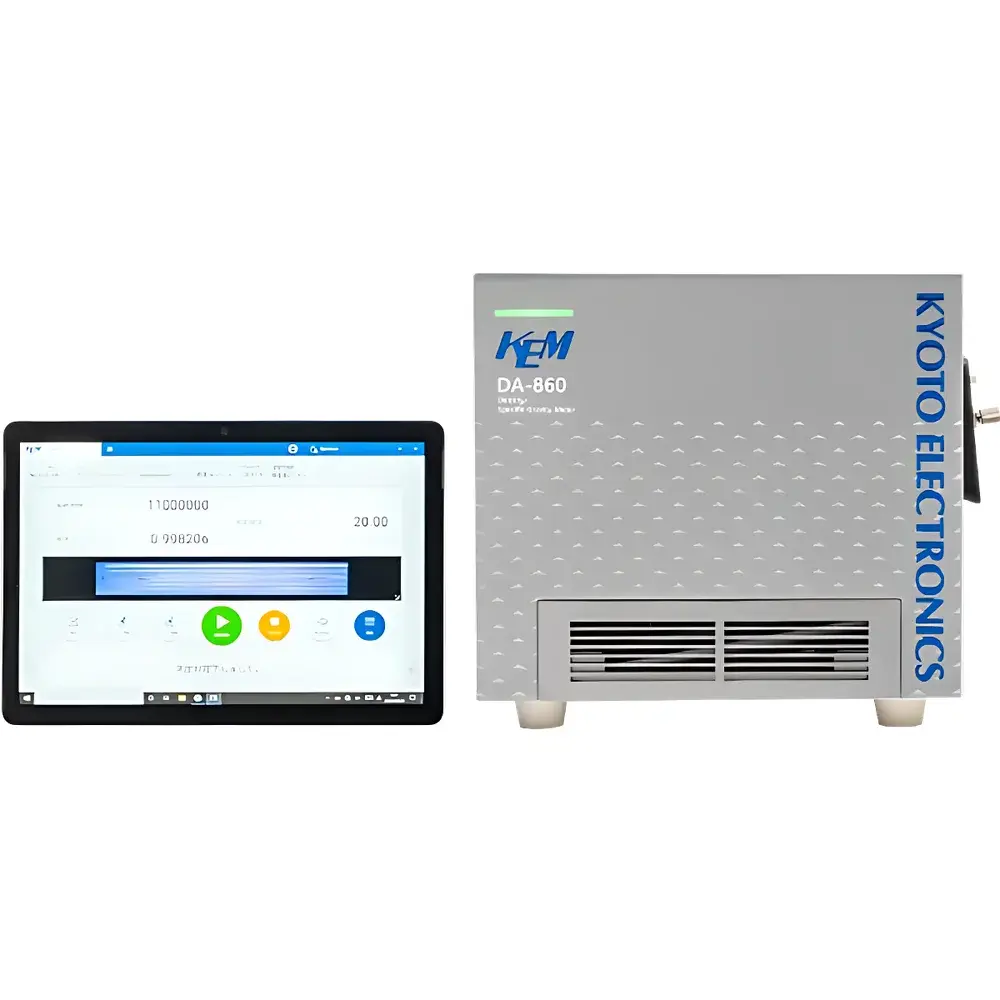
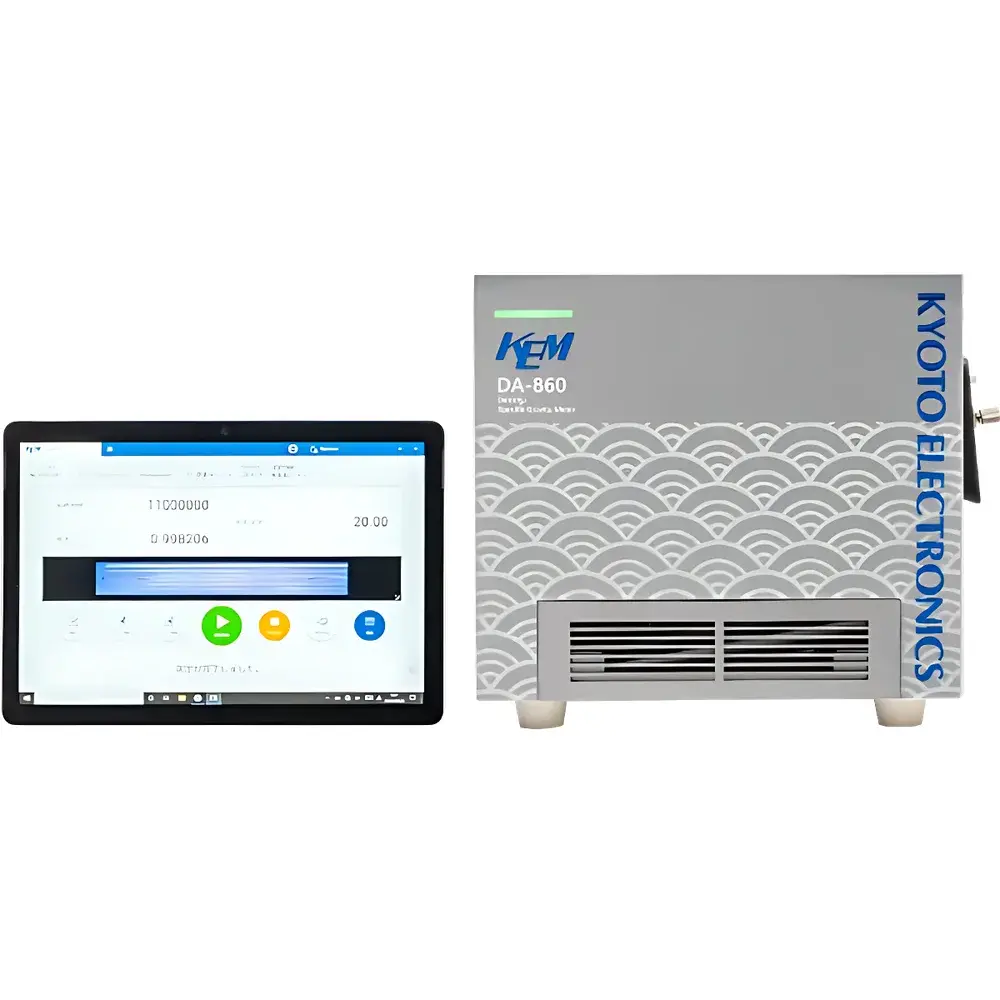
KEM DA-860 Advanced Digital Oscillating U-Tube Density Meter
| Brand | KEM (Kyoto Electronics Manufacturing) |
|---|---|
| Origin | Japan |
| Manufacturer | Yes |
| Instrument Type | Laboratory Benchtop Oscillating U-Tube Densimeter |
| Sample Type | Liquid |
| Density Range | 0–3 g/cm³ |
| Density Accuracy | ±3×10⁻⁶ g/cm³ |
| Density Repeatability | ±1×10⁻⁶ g/cm³ |
| Density Reproducibility | ±2×10⁻⁶ g/cm³ |
| Temperature Control Range | 0–100 °C (Peltier-regulated) |
| Temperature Stability | ±0.001 °C |
| Resolution | 1×10⁻⁶ g/cm³ |
| Minimum Sample Volume | 1 mL (manual), ~2 mL (auto-pump) |
| Measurement Time | ~10 s to 4-digit precision |
| Viscosity Correction | Automatic real-time correction |
| Bubble Detection | Integrated optical detection |
| Cleaning Mode | Fully automated rinse-dry cycle (vacuum, dual/triple solvent wash, drying air) |
| Data Interface | LAN, USB, RS-232C |
| Power | AC 100–240 V, 50/60 Hz, 40 W |
| Dimensions | 295 × 330 × 255 mm (W×D×H) |
| Weight | ~19 kg |
Overview
The KEM DA-860 Advanced Digital Oscillating U-Tube Density Meter is a high-precision laboratory instrument engineered for trace-level density and specific gravity determination of liquid samples across research, quality control, and regulatory environments. It operates on the fundamental physical principle of oscillating U-tube densimetry: a precisely machined borosilicate glass U-shaped tube is filled with sample and excited into resonant vibration; the natural oscillation period (τ) is measured with sub-microsecond timing resolution and converted to density (ρ) using the calibrated tube constant (A, B) derived from reference standards per ISO 12058-1 and ASTM D4052. This method eliminates buoyancy errors inherent in hydrostatic or pycnometric techniques and delivers metrological traceability to SI units via certified density standards. The DA-860 integrates Peltier-based temperature regulation with active thermal stabilization—ensuring <±0.001 °C setpoint deviation over time—critical for thermally sensitive formulations such as pharmaceutical solvents, battery electrolytes, and high-purity organic intermediates.
Key Features
- Ultra-high metrological performance: Density accuracy ±3×10⁻⁶ g/cm³, repeatability ±1×10⁻⁶ g/cm³, and reproducibility ±2×10⁻⁶ g/cm³—validated against NIST-traceable standard fluids.
- Integrated HD camera module: Real-time visualization of sample injection, bubble formation, and cell filling state; images timestamped and stored with measurement records for audit trail compliance.
- Flexible operator interface: Compatible with Windows-based PCs or Android/iOS tablets via LAN or USB; UI supports multi-language localization and customizable report templates.
- Adaptive measurement algorithm: Proprietary convergence logic achieves stable 4-decimal-place density output in ≤10 seconds without user intervention—optimized for high-throughput QC labs.
- Multi-unit network architecture: A single control unit can orchestrate up to four DA-860 measurement modules, enabling synchronized calibration, parallel batch analysis, and centralized data aggregation.
- Comprehensive fluid handling automation: Vacuum-assisted aspiration, programmable multi-solvent washing (SA2/SA3), compressed-air drying, and automatic dryness verification via conductivity sensing.
- Intelligent error mitigation: Real-time optical bubble detection, full-range dynamic viscosity correction (based on measured damping ratio), and barometric pressure compensation using integrated sensor input.
- Thermal equilibrium assurance: Active thermal mass balancing ensures no drift during measurement—even during rapid temperature transitions between 0 °C and 100 °C.
Sample Compatibility & Compliance
The DA-860 accommodates a broad spectrum of liquid matrices—including volatile solvents (e.g., acetone, ethanol), viscous oils (e.g., lubricants, biodiesel), corrosive reagents (e.g., concentrated acids/bases with compatible wetted materials), and temperature-sensitive biologics—provided they remain single-phase and non-particulate within the operating range. All wetted parts (U-tube, valves, tubing) are constructed from chemically inert borosilicate glass and PTFE. The system complies with ISO/IEC 17025 requirements for testing laboratories and supports 21 CFR Part 11-compliant electronic records when paired with KEM’s validated software suite (Density Manager Pro). It meets ASTM D4052-22 (Standard Test Method for Density of Petroleum Products by Digital Density Meter), ISO 12058-1 (Liquid petroleum products — Determination of density — Part 1: Oscillating U-tube method), and USP for pharmaceutical density verification.
Software & Data Management
Density Manager Pro (v3.2+) provides full instrument control, method development, and GLP/GMP-aligned data governance. Features include: user-defined concentration conversion tables (density ↔ w/w%, w/v%, molarity), temperature compensation curves (input ρ vs. T lookup tables or polynomial coefficients), statistical evaluation (mean, SD, RSD, confidence intervals), audit trail with immutable timestamps and operator ID logging, PDF/CSV export with digital signature support, and seamless integration with LIMS via HL7 or direct SQL database push. All raw oscillation data (frequency, damping, temperature, pressure) are retained alongside processed results to satisfy ALCOA+ principles (Attributable, Legible, Contemporaneous, Original, Accurate, Complete, Consistent, Enduring, Available).
Applications
- Pharmaceutical: Excipient purity verification, API solution density profiling, formulation density consistency checks per ICH Q5C stability protocols.
- Petrochemical: Hydrocarbon blend certification, biodiesel (B100) density grading per EN 14214, crude oil API gravity derivation.
- Food & Beverage: Sugar content estimation (Brix) from sucrose density tables, alcohol-by-volume (ABV) calculation in spirits, dairy product standardization.
- Electrolyte R&D: Li-ion battery electrolyte density monitoring during aging studies, ionic liquid characterization.
- Academic Research: Thermophysical property databases (ρ, αₚ, βₜ), solvent mixture modeling, polymer solution behavior studies.
FAQ
What is the minimum sample volume required for accurate measurement?
For manual injection, 1.0 mL is sufficient; with the optional auto-sampling pump, ~2.0 mL is drawn to ensure complete cell filling and purge residual air.
Does the DA-860 require periodic recalibration with certified standards?
Yes—daily verification using at least two certified reference materials (e.g., water and air at 20 °C) is recommended per ISO/IEC 17025; full recalibration every 6 months or after maintenance.
Can the instrument correct for sample viscosity effects in real time?
Yes—damping coefficient derived from the decay envelope of the oscillation signal is used to apply ISO 12058-2–compliant viscosity correction without user input.
Is the U-tube replaceable by the end user?
No—the U-tube is a factory-calibrated, hermetically sealed assembly; replacement requires return-to-factory service and full recalibration.
How is data integrity ensured during power interruption?
All measurements in progress are buffered in non-volatile memory; upon recovery, the system resumes operation and logs the event with timestamp and status code.



