
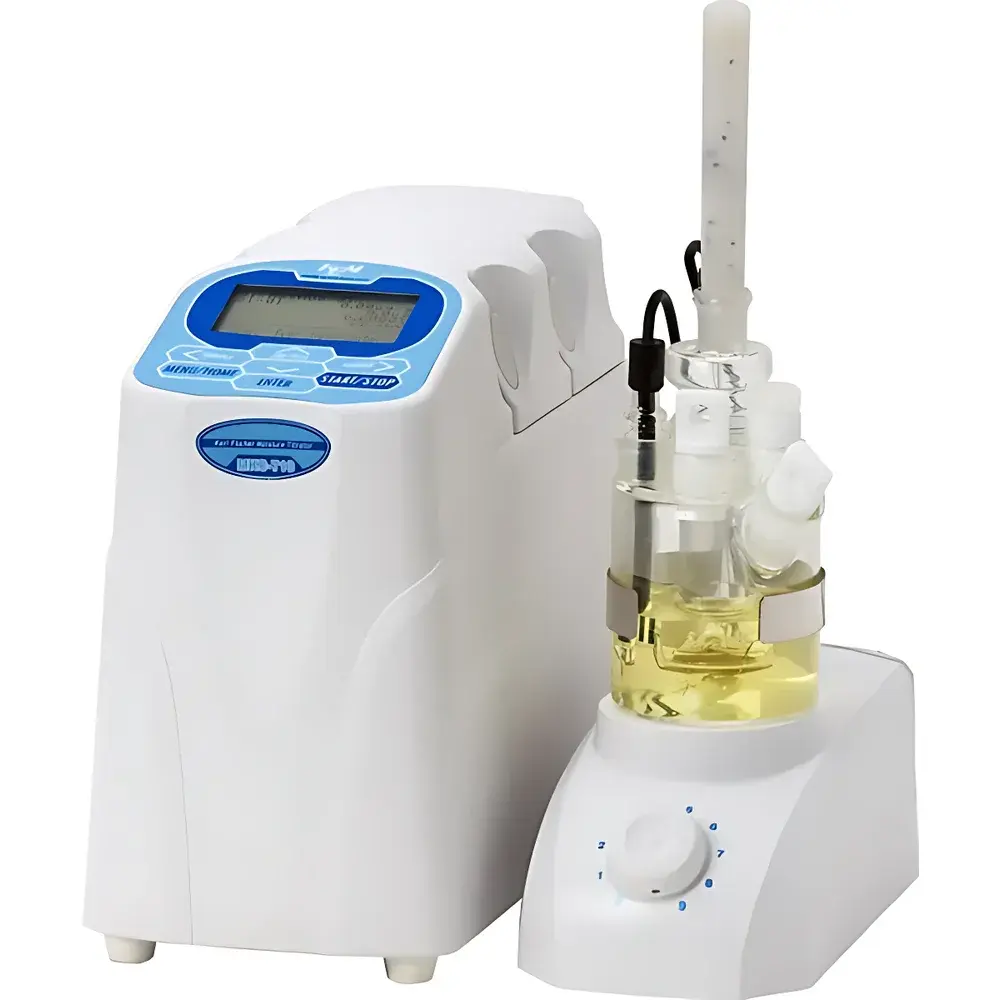
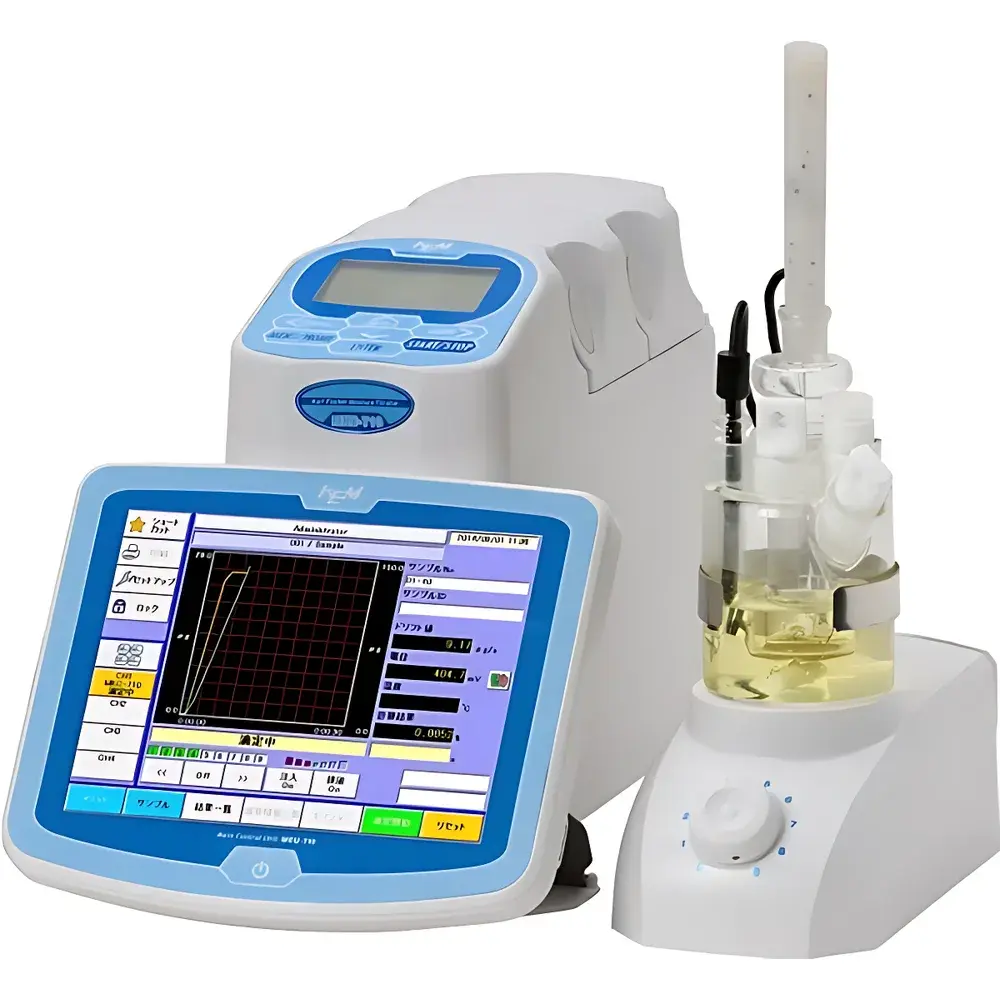
KEM MKC-710B Coulometric Bromine Number and Bromine Index Analyzer (ASTM D1492 Compliant)
| Brand | KEM (Kyoto Electronics Manufacturing) |
|---|---|
| Origin | Japan |
| Manufacturer Type | Original Equipment Manufacturer (OEM) |
| Product Origin | Imported |
| Model | MKC-710B |
| Measurement Principle | Coulometric Titration |
| Measurement Range | 8 µg – 300 mg Br₂ |
| Resolution | 0.1 µg Br₂ |
| Detection Method | Dual Platinum Electrode AC Polarization |
| Endpoint Detection | Real-time Current-Based Endpoint Confirmation |
| Control Mode | Constant-Current Pulse Time Control |
| Data Storage | 100 Sample Records |
| GLP Compliance | Operator ID, Group Management, Reagent Tracking, Performance Verification Logs, Timestamped Audit Trail |
| Connectivity | RS-232C (printer, balance, PC), USB Host (U-disk, thermal printer, barcode scanner, foot switch, USB hub, Android devices) |
| Environmental Operating Conditions | 5–35 °C, ≤85% RH |
| Power Supply | AC 100–240 V ±10%, 50/60 Hz |
| Power Consumption | ~20 W (main unit), ~7 W (optional printer) |
| Dimensions (Titration Unit) | 141 × 292 × 244 mm (W×D×H) |
| Weight (Titration Unit) | ~3.0 kg |
Overview
The KEM MKC-710B Coulometric Bromine Number and Bromine Index Analyzer is a precision laboratory instrument engineered for the quantitative determination of unsaturated hydrocarbon content in aromatic and aliphatic petroleum products. It operates on the fundamental principle of coulometric titration—where bromine generated electrochemically at the anode reacts stoichiometrically with carbon–carbon double bonds in the sample matrix. The amount of bromine consumed is directly proportional to the degree of unsaturation and is calculated from the total electric charge passed during electrolysis, in strict accordance with Faraday’s laws of electrolysis. Designed to meet ASTM D1492-21, SH/T 0630-1996, SH/T 1551-2018, GB/T 1815-2019, and JJF 1569-2016, the MKC-710B delivers trace-level quantification of bromine number (g Br₂/100 g sample) and bromine index (mg Br₂/100 g sample) with high reproducibility and minimal reagent consumption.
Key Features
- Compact benchtop footprint—only A4-sized (141 mm W × 292 mm D)—optimized for space-constrained QC laboratories and refinery analytical workstations.
- Intuitive two-button operation: PRE-TITR. initiates electrode conditioning and background current stabilization; START triggers automated coulometric titration without manual endpoint judgment.
- Integrated PDF report generation: measurement results—including sample ID, operator ID, timestamp, method parameters, raw charge data, and calculated bromine number/index—are exportable to USB mass storage in standardized PDF format.
- Modular interoperability: when coupled with the KEM MCU-710 Multi-Control Unit, the MKC-710B supports synchronized analysis with KEM moisture analyzers (e.g., MKV-710 series), enabling parallel determination of bromine index and water content in single workflow.
- Comprehensive GLP support: built-in audit trail logs record operator identity, group assignment, reagent lot numbers, calibration verification timestamps, and system performance checks—all compliant with FDA 21 CFR Part 11 requirements for electronic records and signatures when used with validated software configurations.
Sample Compatibility & Compliance
The MKC-710B is validated for use with light hydrocarbon fractions including benzene, toluene, xylene (BTX), naphtha, reformate, and hydrogenated pyrolysis gasoline (pygas). It accommodates samples with low volatility and moderate polarity, provided they are dissolved in specified non-aqueous electrolyte solvents (e.g., acetic acid–chloroform mixtures per ASTM D1492). Instrument compliance extends across multiple international regulatory frameworks: ISO/IEC 17025 method validation readiness, ASTM D1492-21 procedural fidelity, USP relevance for residual unsaturation assessment in pharmaceutical-grade solvents, and alignment with ICH Q5C stability-indicating assay expectations for hydrocarbon-based excipients. All hardware and firmware design elements adhere to IEC 61010-1 safety standards for electrical equipment used in laboratory environments.
Software & Data Management
Data acquisition and post-processing are managed via KEM’s proprietary KEM-Link software (Windows-compatible), which enables real-time monitoring of titration curves, charge integration, and endpoint confirmation diagnostics. Raw coulombic data can be exported in native .kem format or converted into industry-standard CSV and Excel (.xlsx) files for integration into LIMS or statistical process control (SPC) platforms. USB host functionality supports direct connection to barcode scanners for sample ID auto-entry, foot switches for hands-free titration initiation, and thermal printers for immediate hard-copy documentation. Internal memory retains up to 100 complete test records with full metadata—each timestamped, operator-tagged, and method-referenced—ensuring full traceability without external dependency.
Applications
- Quality control of aromatic feedstocks in petrochemical plants prior to catalytic hydrogenation or alkylation processes.
- Monitoring bromine index drift in styrene monomer and ethylbenzene storage tanks to assess oxidative degradation and inhibitor efficacy.
- Verification of saturation completeness following hydrotreating units in refineries—critical for meeting ASTM D2067 specifications for aviation turbine fuels.
- Supporting R&D studies on olefin scavenging efficiency in polymer-grade propylene and butadiene streams.
- Regulatory submission testing for EPA Method 8015-compliant hydrocarbon profiling where unsaturation correlates with photochemical reactivity potential.
FAQ
What is the difference between bromine number and bromine index?
Bromine number expresses unsaturation as grams of bromine consumed per 100 g of sample (g Br₂/100 g); bromine index expresses the same reaction in milligrams per 100 g (mg Br₂/100 g). The MKC-710B automatically selects the appropriate calculation scale based on measured charge magnitude.
Can the MKC-710B analyze samples with high water content?
No. Water interferes with the coulometric bromine generation mechanism and must be removed prior to analysis using compatible drying agents or azeotropic distillation per ASTM D6304 guidelines.
Is method validation support available for ISO/IEC 17025 accreditation?
Yes. KEM provides documented IQ/OQ/PQ protocols, uncertainty budget templates, and reference material traceability documentation aligned with EURACHEM/CITAC guidelines for coulometric titration methods.
How often does the electrolyte require replacement?
Typical electrolyte service life is 50–100 analyses under standard operating conditions; the instrument logs cumulative titration cycles and prompts replacement when performance deviation thresholds are approached.
Does the MKC-710B support remote diagnostics or firmware updates?
Firmware updates are performed via USB drive; remote diagnostic access is not embedded but may be enabled through secure, customer-configured network gateways compliant with corporate IT security policies.





