
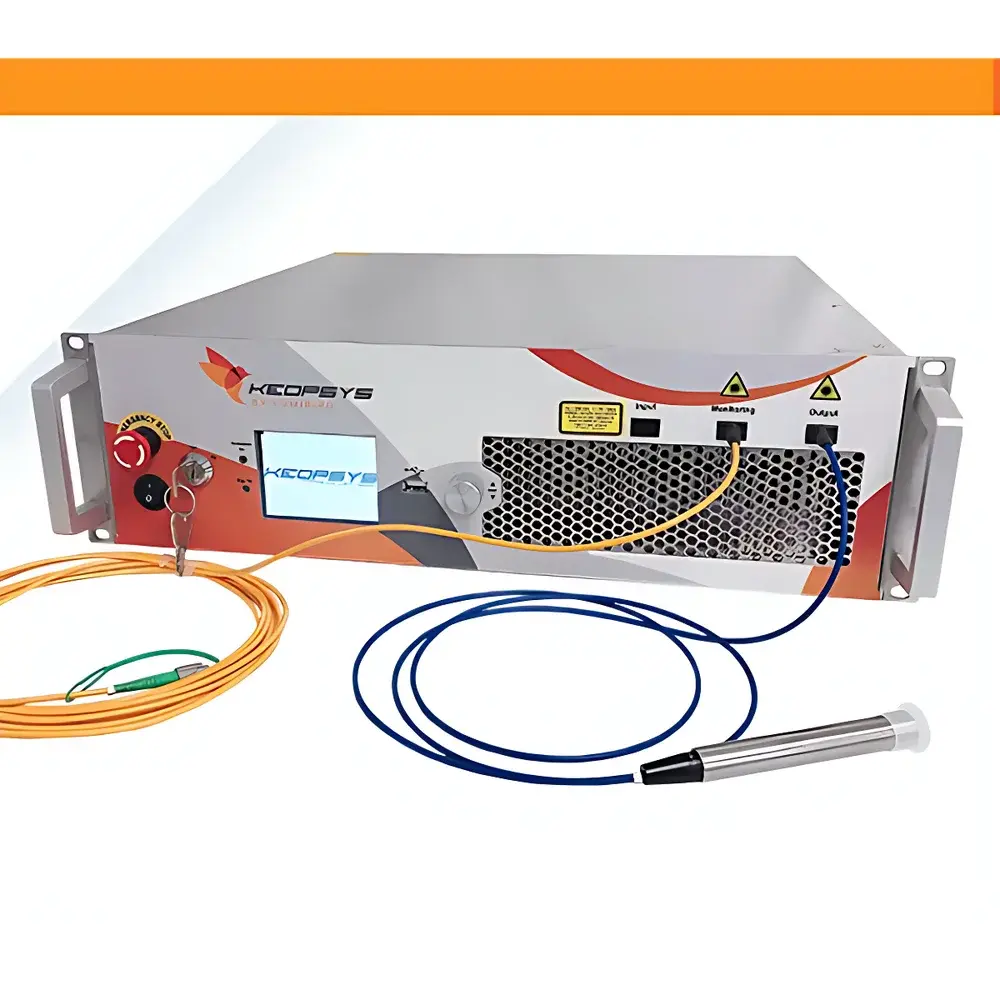
Keopsys CTFA Series Thulium-Doped Fiber Amplifier
| Brand | Keopsys |
|---|---|
| Origin | France |
| Manufacturer Type | Authorized Distributor |
| Product Origin | Imported |
| Model | CTFA |
| Output Power | Up to +40 dBm (10 W) |
| Operating Wavelength Range | 1930–2050 nm |
| Gain Bandwidth | 1900–2050 nm |
| Polarization-Maintaining Option | Available |
| Beam Quality | Diffraction-Limited (M² < 1.1) |
| Input OSNR Enhancement | Built-in Pre-Amplifier Stage |
| Eye-Safety Compliance | EN 60825-1:2014 Class 1M / IEC 60825-1:2014 Class 1M |
Overview
The Keopsys CTFA Series Thulium-Doped Fiber Amplifier (TDFA) is a high-performance, continuous-wave (CW) optical amplifier engineered for precision operation in the eye-safe 1.9–2.05 µm spectral window. Based on thulium-doped silica fiber and optimized cladding-pumped architecture, the CTFA leverages the 3H4 → 3H6 transition to deliver broadband gain across 1930–2050 nm, with full operational bandwidth spanning 1900–2050 nm. Unlike erbium- or ytterbium-based amplifiers, the CTFA operates without quantum defect heating limitations typical of shorter-wavelength systems, enabling stable, low-noise, high-power amplification ideal for demanding scientific, industrial, and defense-grade applications where atmospheric transmission, molecular absorption specificity, and laser safety are critical design constraints.
Key Features
- High saturated output power up to +40 dBm (10 W), scalable via modular pump configuration
- Ultra-broad gain bandwidth: 1930–2050 nm standard; extended coverage from 1900–2050 nm under optimized pumping
- Wavelength-selectable operation via integrated tunable input stage or external filter integration
- Class 1M eye-safe design compliant with EN 60825-1:2014 and IEC 60825-1:2014 — no external interlocks required for standard enclosure configurations
- Integrated low-noise pre-amplifier stage delivering >45 dB small-signal gain and OSNR improvement ≥25 dB at 2000 nm
- Polarization-maintaining (PM) fiber option available with extinction ratio >20 dB and alignment stability <0.1°/°C
- Diffraction-limited beam quality (M² < 1.1) preserved through single-mode, polarization-controlled output delivery
- Ruggedized 19″ rack-mount chassis with convection-cooled thermal management and redundant pump diode monitoring
Sample Compatibility & Compliance
The CTFA series supports direct coupling to single-mode (SMF-28, PM1550, or custom mid-IR fibers) and polarization-maintaining inputs with FC/APC or collimated free-space interfaces. It is compatible with CW seed sources including distributed feedback (DFB) lasers, external cavity diodes (ECDLs), and fiber lasers operating within its gain band. Regulatory compliance includes CE marking per EU Machinery and EMC Directives, RoHS 2015/863/EU, and conformity with IEC 61326-1:2013 for laboratory equipment electromagnetic immunity. For GxP environments, optional firmware supports audit-trail logging and user-access control aligned with FDA 21 CFR Part 11 principles. Device calibration certificates traceable to NIST standards are available upon request.
Software & Data Management
The CTFA is managed via Keopsys’ proprietary K-OPS Control Suite — a Windows/Linux-compatible GUI offering real-time monitoring of pump current, case temperature, output power, and gain flatness across wavelength sweeps. All operational parameters are accessible through SCPI-compliant USB, RS-232, and Ethernet (TCP/IP) interfaces. The software enables automated power stabilization loops, scheduled power ramping profiles, and configurable alarm thresholds with event logging (CSV export). Firmware updates and diagnostic self-tests are performed remotely without hardware intervention. For integration into automated test benches, LabVIEW™, Python (PyVISA), and MATLAB® drivers are provided with full API documentation.
Applications
- LIDAR and range-gated imaging: Exploits strong atmospheric transmission windows near 2.05 µm and low solar background for long-range, daytime-capable coherent detection
- Trace gas sensing: Targets fundamental ro-vibrational absorption lines of CO, CO₂, NH₃, H₂O, HF, and hydrocarbons with high spectral selectivity
- Mid-IR supercontinuum generation: Serves as high-power pump source for ZBLAN or chalcogenide photonic crystal fibers
- Optical component characterization: Enables high-flux testing of coatings, isolators, circulators, and waveguides in the 2 µm band
- Fundamental photonics research: Supports parametric oscillation, frequency comb stabilization, and quantum optics experiments requiring narrow-linewidth, high-coherence amplification
- Medical laser systems: Powers tissue-ablation and lithotripsy platforms operating under ANSI Z136.1-2022 safety guidelines
FAQ
What is the maximum input power the CTFA can accept without saturation or damage?
The CTFA accepts up to +10 dBm (10 mW) continuous-wave input power while maintaining linear gain response; higher inputs require external attenuation to avoid gain compression.
Is the CTFA compatible with pulsed seed sources?
Yes — when operated in CW mode, it supports quasi-CW (QCW) seeds with duty cycles ≤5% and pulse widths ≥100 ns; for true nanosecond pulsing, consult Keopsys Application Notes TN-CTFA-PULSE.
Does the amplifier include automatic power control (APC) or constant gain mode?
Standard firmware includes both APC and AGC modes, selectable via GUI or SCPI command; closed-loop stability is ±0.1 dB over 8 hours at constant ambient temperature.
Can the CTFA be integrated into an ISO-class cleanroom environment?
Yes — the unit meets ISO 14644-1 Class 5 particulate limits when installed with filtered air intake; optional hermetic housing upgrade available for Class 3 compliance.
What maintenance is required during routine operation?
No periodic optical alignment or consumable replacement is required; recommended annual verification of output power calibration and thermal sensor drift using factory-provided reference photodiode kit.





