
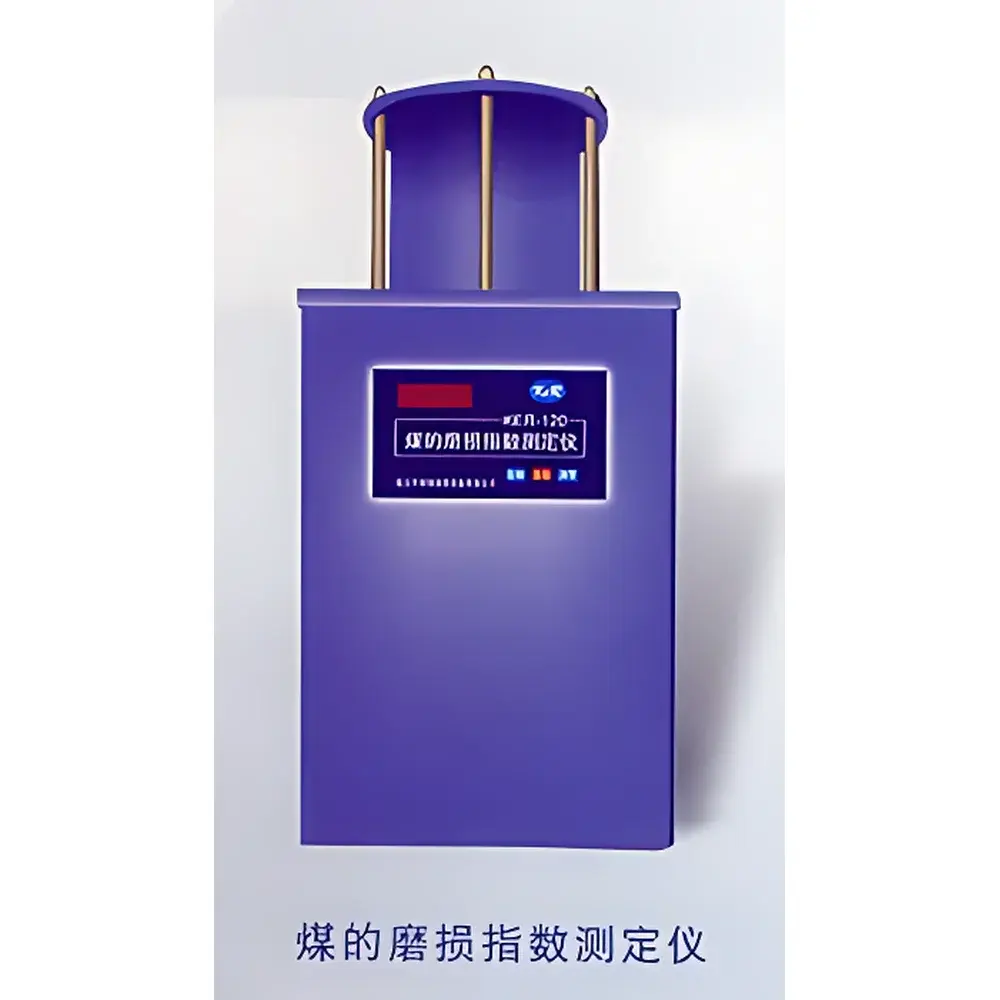
KER-120 Coal Abrasivity Index Tester
| Origin | China |
|---|---|
| Manufacturer Type | Authorized Distributor |
| Model | KER-120 |
| Motor Power | 2.2 kW |
| Rotational Speed | 12,000 ± 20 rpm |
| Sample Mass | 2.00 ± 0.01 kg |
| Supply Voltage | 3-phase 380 V AC |
| Weight | 120 kg |
| Dimensions (W×D×H) | 410 × 400 × 820 mm |
Overview
The KER-120 Coal Abrasivity Index Tester is a precision-engineered laboratory instrument designed to determine the abrasivity index (AI) of coal—specifically lignite, bituminous, and anthracite—according to the standardized test method specified in GB/T 15458, “Method for Determination of Coal Abrasivity Index.” The AI quantifies the relative wear intensity imposed by coal on metallic grinding components under controlled mechanical attrition conditions. This parameter is directly correlated with coal hardness and mineralogical composition (e.g., quartz, pyrite, and clay content), making it a critical indicator for predicting mill liner life, pulverizer maintenance frequency, and grinding energy consumption in coal-fired power generation and cement production facilities. The instrument operates on the principle of standardized rotary attrition: a fixed mass of dried, sized coal sample is subjected to precisely defined rotational motion against calibrated steel grinding elements within a sealed chamber. The mass loss of the metal components after a fixed number of revolutions is gravimetrically measured and converted into the dimensionless AI value per ASTM D5142–22 and ISO 19732-compliant interpretation frameworks.
Key Features
- Compliance-driven mechanical design aligned with GB/T 15458 structural and operational requirements—including precise rotational speed control (12,000 ± 20 rpm) and repeatable sample loading (2.00 ± 0.01 kg).
- Robust three-phase induction motor (2.2 kW) delivering consistent torque output across extended test cycles, minimizing speed drift and ensuring inter-laboratory reproducibility.
- Integrated steel grinding assembly fabricated from hardened alloy steel with certified hardness and surface finish, enabling traceable wear measurement per ISO 6506 and ASTM E10 standards.
- Stainless-steel sample chamber with hermetic sealing to prevent dust leakage and ensure operator safety in accordance with OSHA 1910.1200 and IEC 61000-6-3 EMC requirements.
- Fixed-dimension mechanical frame (410 × 400 × 820 mm) optimized for stability during high-torque operation; total mass of 120 kg ensures minimal vibration transmission to adjacent instrumentation.
Sample Compatibility & Compliance
The KER-120 accommodates air-dried coal samples prepared to ≤3 mm top size, as mandated by GB/T 15458. It supports routine testing of all rank classes—lignite (low-rank, high-volatility), bituminous (medium-rank, variable ash), and anthracite (high-rank, low-volatility)—with consistent repeatability (RSD < 3.5% for duplicate determinations). All mechanical and electrical subsystems conform to China’s mandatory CCC certification scope for laboratory equipment. While GB/T 15458 remains the primary reference, the methodology aligns with internationally recognized abrasion assessment principles reflected in ASTM D5142 (for proximate analysis-integrated abrasivity estimation) and ISO 19732 (Coal — Determination of abrasivity index). Data outputs are compatible with GLP-compliant quality systems when paired with certified analytical balances and calibrated mass standards.
Software & Data Management
The KER-120 is a hardware-only instrument requiring external gravimetric measurement for final AI calculation. No embedded firmware or proprietary software is included. Users perform post-test calculations manually or via validated Excel-based templates compliant with ISO/IEC 17025 documentation requirements. The absence of onboard electronics eliminates validation overhead for regulated environments (e.g., ISO 17025-accredited labs or GMP-aligned coal procurement QA units). Final AI values are derived using the formula: AI = [(W₁ − W₂) / W₀] × 1000, where W₁ and W₂ are pre- and post-test grinding element masses (g), and W₀ is initial coal mass (kg). Audit trails must be maintained per internal SOPs referencing GB/T 15458 Section 8 (Reporting) and ISO/IEC 17025 Clause 7.7 (Ensuring validity of results).
Applications
- Power plant fuel procurement: Screening incoming coal lots for expected mill wear and scheduling preventive maintenance intervals.
- Coal blending optimization: Quantifying AI contributions of individual seams to formulate low-abrasion blends without compromising combustion efficiency.
- Mining geotechnical characterization: Correlating AI with petrographic analysis (e.g., vitrinite reflectance, maceral composition) and mineral matter distribution.
- R&D for coal beneficiation: Evaluating how washing, drying, or thermal treatment alters abrasivity behavior prior to full-scale processing trials.
- Third-party verification laboratories: Providing accredited AI testing services supporting ISO 9001-certified supply chains and contractual coal specifications.
FAQ
Is the KER-120 compliant with international standards beyond GB/T 15458?
Yes—the test principle, sample preparation protocol, and wear quantification methodology are technically harmonized with ASTM D5142 Annex A2 and ISO 19732, though formal multi-standard certification requires user-performed cross-validation.
What calibration standards are required for AI determination?
Certified reference materials are not commercially available for coal abrasivity. Calibration relies on traceable mass measurement using Class I or II analytical balances (per OIML R 76) and periodic verification of rotational speed with a calibrated tachometer (±1 rpm accuracy).
Can the instrument be integrated into an automated lab information management system (LIMS)?
As a standalone electromechanical device without digital output ports or API interfaces, direct LIMS integration is not supported. Data entry must be manual or performed via spreadsheet import following validated data transfer protocols.
Does the KER-120 require annual metrological verification?
While not mandated by GB/T 15458, best practice per ISO/IEC 17025 recommends annual verification of rotational speed accuracy, mechanical alignment, and balance calibration traceability—documented in the laboratory’s equipment management system.
What safety certifications does the unit carry?
The KER-120 bears China Compulsory Certification (CCC) mark for laboratory electrical equipment. It meets IP20 ingress protection and conforms to GB 4793.1–2007 (equivalent to IEC 61010-1) for electrical safety in measurement and laboratory use.



