
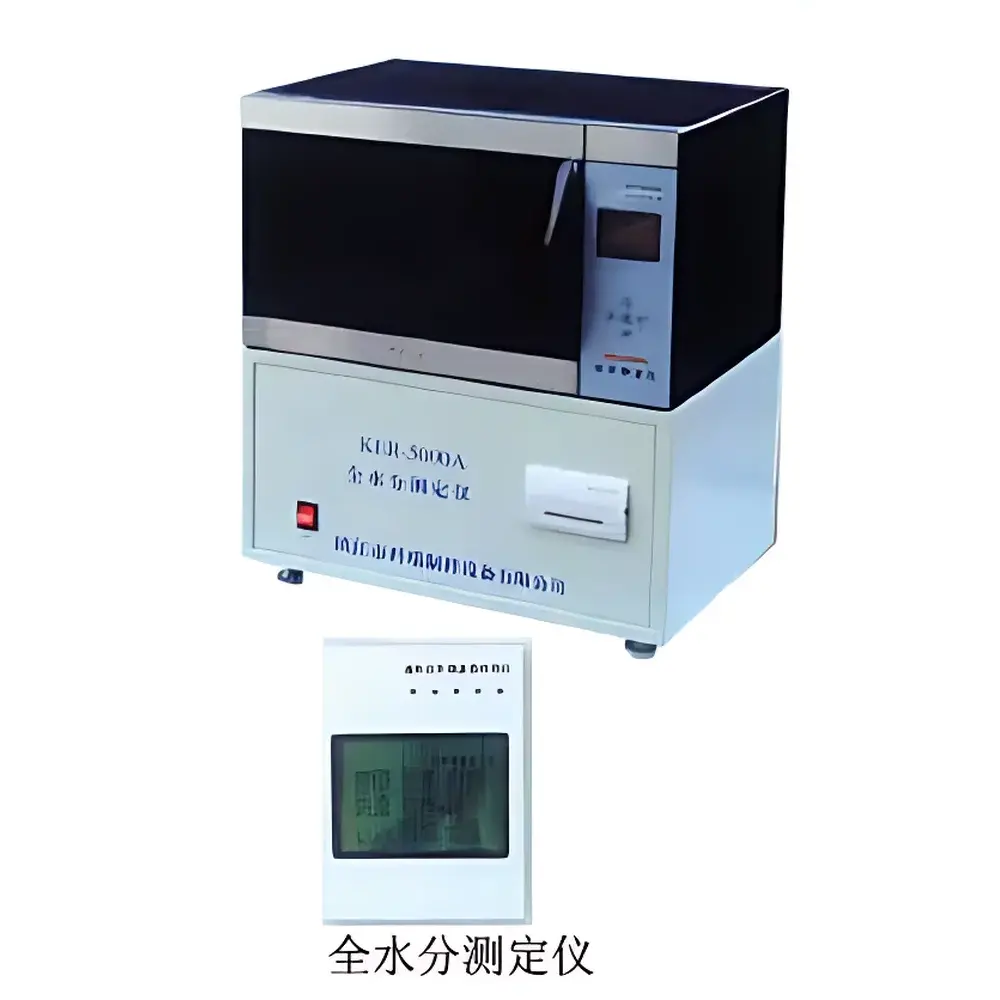
KER-5000A Microwave-Infrared Combined Total Moisture Analyzer for Coal
| Key | Origin: China |
|---|---|
| Manufacturer Type | Authorized Distributor |
| Model | KER-5000A |
| Input Voltage | AC 220 ± 20 V, 50 Hz |
| Microwave Input Power | ≤1400 W |
| Microwave Output Power | ≤900 W |
| Microwave Frequency | 2450 MHz |
| Infrared Heating Power | ≤1200 W |
| Balance Capacity (Total Moisture Mode) | ≤310 g |
| Balance Capacity (Analytical Moisture Mode) | ≤120 g |
| Balance Resolution (Total Moisture) | 0.001 g |
| Balance Resolution (Analytical Moisture) | 0.0001 g |
| Moisture Determination Accuracy (Total Moisture) | ≤0.4% (compliant with GB/T 211) |
| Moisture Determination Accuracy (Analytical Moisture) | ≤0.2% (compliant with GB/T 15334) |
| Max. Sample Capacity per Run | 9 samples |
| Dimensions | 510 × 380 × 540 mm |
Overview
The KER-5000A Microwave-Infrared Combined Total Moisture Analyzer is a laboratory-grade instrument engineered for precise, automated determination of total moisture content in coal and other non-metallic bulk materials. It operates on dual-energy drying principles—microwave irradiation for rapid volumetric heating and infrared radiation for surface-selective, controlled thermal drying—enabling method flexibility aligned with standardized test protocols. Designed to fully comply with the procedural and metrological requirements of GB/T 211 (Determination of Total Moisture in Coal) and GB/T 15334 (Determination of Analytical Moisture in Coal), the analyzer integrates gravimetric measurement with real-time thermal control, delivering traceable, repeatable results under routine QC/QA conditions. Its architecture supports both total moisture (as-received basis) and analytical moisture (air-dried basis) determinations without hardware modification, making it suitable for coal preparation plants, power generation laboratories, third-party testing centers, and regulatory compliance facilities operating within China’s coal quality assurance framework.
Key Features
- Dual-mode drying system: Selectable microwave (2450 MHz, ≤900 W output) or infrared (≤1200 W) heating, each optimized for specific sample matrices—microwave for high-efficiency bulk dehydration; infrared for thermally sensitive, high-ash, or metalliferous coals where charring or oxidation must be minimized.
- High-precision dual-range analytical balance: Factory-calibrated imported load cell with 0.001 g resolution (≤310 g capacity) for total moisture mode and 0.0001 g resolution (≤120 g capacity) for analytical moisture mode—ensuring compliance with weighing uncertainty thresholds defined in GB/T 211 Annex B.
- Intelligent gravimetric validation: Real-time auto-detection of crucible presence, sample loading status, and tare stability; automatic re-weighing triggered upon mass deviation exceeding user-defined tolerance.
- Thermal drift compensation: Embedded algorithm dynamically corrects for convection-induced buoyancy shifts and thermal expansion effects during drying, maintaining mass stability throughout extended heating cycles.
- Robust data integrity architecture: Non-volatile memory with battery-backed real-time clock ensures parameter retention and audit trail continuity during unexpected power loss—fully supporting GLP-aligned operational continuity.
- Onboard thermal protocol management: Preloaded “Rapid Drying” and “Constant-Mass Endpoint” programs; user-definable time/temperature profiles, drying mode selection, and endpoint criteria (e.g., mass change ≤0.1 g/60 s).
Sample Compatibility & Compliance
The KER-5000A is validated for use with bituminous coal, anthracite, lignite, coke, and selected industrial minerals (e.g., limestone, clay, gypsum) where moisture quantification is required per national or enterprise specifications. Sample particle size must conform to GB/T 211 requirements (≤6 mm for total moisture; ≤0.2 mm for analytical moisture). Instrument performance meets repeatability limits stipulated in GB/T 211 (R ≤ 0.4% for total moisture; R ≤ 0.2% for analytical moisture) and is compatible with interlaboratory proficiency testing schemes administered by CNAS-accredited bodies. While not certified to ISO/IEC 17025 as a standalone device, its measurement traceability chain—through NIST-traceable balance calibration and factory-verified microwave power output—is documented in the supplied calibration certificate and maintenance logbook.
Software & Data Management
The analyzer includes an embedded LCD interface with full Chinese menu navigation, real-time mass/time/delta-mass display, and status-driven workflow prompts. All measurement records—including sample ID (auto-generated daily-unique code), start/end timestamps, drying mode, final mass, calculated moisture %, operator ID, and system diagnostics—are stored locally with timestamped metadata. Integrated thermal printer provides immediate hardcopy output compliant with internal QA record retention policies. Optional RS-232 interface enables bidirectional communication with external PCs running proprietary dynamic control software, supporting CSV export, statistical trend analysis (X̄-R charts), electronic signature capture, and 21 CFR Part 11–compatible audit trails when deployed in regulated environments.
Applications
- Coal trading and blending: Rapid total moisture assessment for contractual settlement and calorific value correction (ASTM D3173 / ISO 589).
- Power plant fuel quality control: Incoming coal screening and furnace feedstock optimization.
- Research laboratories: Method development for alternative drying kinetics studies under controlled thermal regimes.
- Mineral processing labs: Moisture monitoring in raw material stockpiles and dried product streams.
- Environmental testing services: Supporting waste-derived fuel (RDF/SRF) characterization per EN 15403 and GB/T 30721.
FAQ
What standards does the KER-5000A comply with for coal moisture testing?
It is fully aligned with GB/T 211 (total moisture) and GB/T 15334 (analytical moisture), including all procedural, apparatus, and reporting requirements.
Can the instrument distinguish between surface moisture and inherent moisture?
No—it measures total gravimetric loss under specified drying conditions; speciation requires complementary techniques such as low-field NMR or Karl Fischer titration.
Is external calibration required before first use?
Yes: The integrated balance must be calibrated using certified weights prior to operation; microwave output power verification is recommended annually using a calibrated power meter.
Does the system support LIMS integration?
Via RS-232, raw data can be parsed into LIMS platforms using configurable delimiter formats; full HL7 or ASTM E1384 support requires middleware configuration.
What maintenance intervals are recommended?
Daily cleaning of cavity and crucible holder; quarterly inspection of waveguide seal integrity and IR emitter alignment; annual recalibration of balance and thermal sensors by authorized service personnel.



