
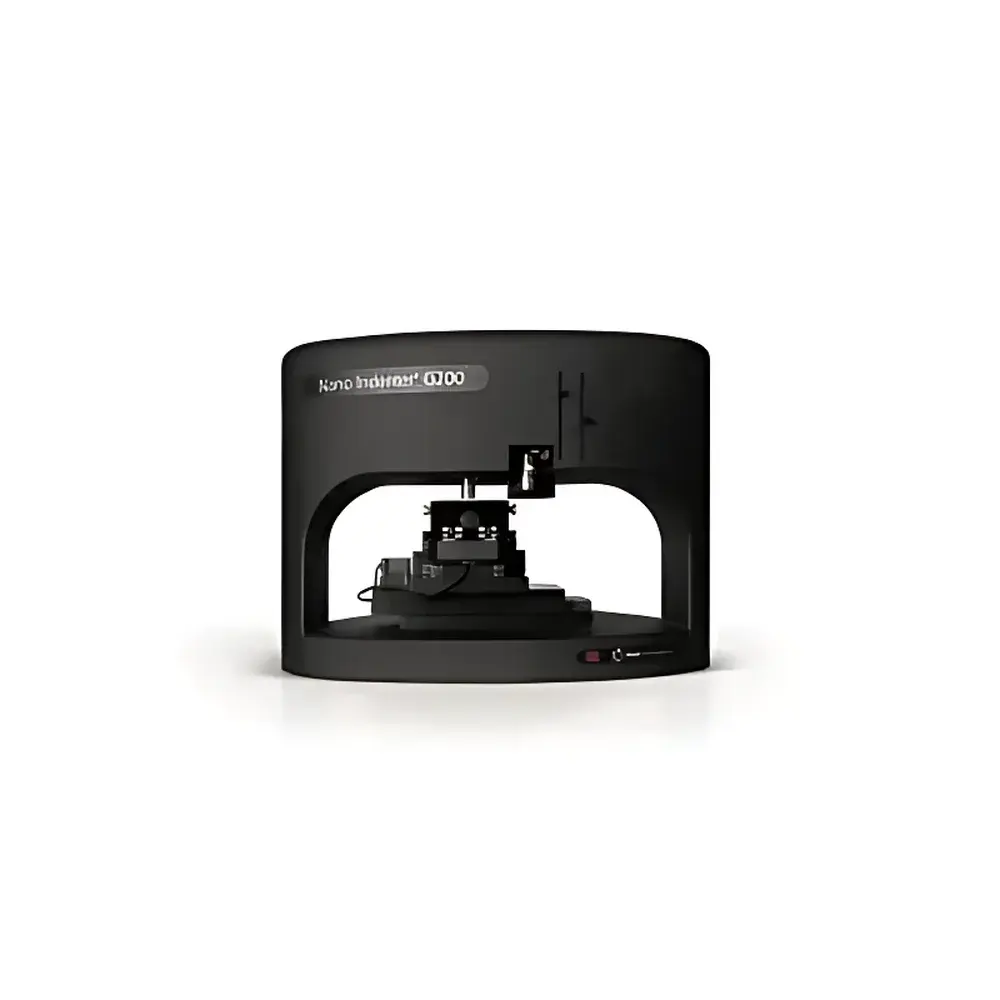
Keysight G200 Nanoindentation and Scratch Testing System
| Brand | Keysight |
|---|---|
| Origin | USA |
| Manufacturer Type | Authorized Distributor |
| Product Category | Imported Instrument |
| Model | G200 |
| Price Range | USD 270,000 – 405,000 (based on configuration) |
| Instrument Type | Integrated Nanoindentation & Scratch Tester |
| Indenter Types | Over 30 standardized and custom tip geometries (Berkovich, cube-corner, spherical, conical, wedge, etc.) |
Overview
The Keysight G200 Nanoindentation and Scratch Testing System is a fifth-generation, electromagnetically actuated platform engineered for high-precision mechanical property characterization at the nanoscale. It operates on the fundamental principles of quasi-static and dynamic contact mechanics, enabling quantitative measurement of hardness, elastic modulus, creep behavior, strain-rate sensitivity, fracture toughness, and interfacial adhesion through controlled indentation and progressive scratch testing. The system’s core architecture eliminates mechanical hysteresis and cross-axis coupling by decoupling load application from displacement sensing—achieved via a voice-coil electromagnetic actuator paired with a differential capacitance transducer (DCT) for sub-angstrom displacement resolution. This design ensures traceable force control across an unprecedented 1 nN–10 N range, spanning six orders of magnitude, while maintaining metrological integrity under ambient laboratory conditions.
Key Features
- Electromagnetic load actuation with real-time closed-loop force control—no servo-motor backlash or thermal drift
- Modular load frame architecture supporting seamless in situ switching between XP (500 mN), DCM II (nano-newton resolution), and High-Load (10 N) modules
- Sub-0.01 nm displacement resolution and <0.2% load linearity across full dynamic range
- Integrated high-stiffness XYZ motorized stage with 100 mm × 100 mm travel and ±1 µm positioning repeatability
- Automated tip calibration, surface detection, and height compensation—enabling consistent contact initiation across heterogeneous topographies
- Compact footprint (≤0.8 m²) suitable for ISO Class 5–7 cleanrooms and standard analytical laboratories
- Compliance with ASTM E2546, ISO 14577-1/2/3, and JIS Z 2244 for indentation testing methodology and uncertainty reporting
Sample Compatibility & Compliance
The G200 accommodates rigid and compliant substrates ranging from single-crystal sapphire and silicon wafers to polymer thin films, metallic coatings, biomaterials, and brittle ceramics. Its adaptive surface detection algorithm tolerates roughness up to Ra = 5 µm without manual intervention. All hardware and firmware comply with IEC 61000-6-3 (EMC) and IEC 61010-1 (safety). Data acquisition and audit trails conform to FDA 21 CFR Part 11 requirements when configured with NanoSuite’s optional electronic signature and role-based access modules. Full GLP/GMP documentation packages—including instrument qualification (IQ/OQ/PQ) templates and uncertainty budgets—are available upon request.
Software & Data Management
NanoSuite v5.x—the industry-standard software platform developed over four decades—provides deterministic real-time analysis of indentation load-displacement curves, including continuous stiffness measurement (CSM), harmonic analysis, and unloading-segment fitting per Oliver–Pharr methodology. It supports automated batch testing across multi-site arrays, customizable test sequences with conditional logic, and intelligent sampling rate adaptation (1–10 kHz) based on signal gradient. All raw data are stored in HDF5 format with embedded metadata (timestamp, environmental conditions, calibration history). Reporting includes PDF export with embedded traceable units, ISO-compliant uncertainty propagation, and user-defined pass/fail thresholds. Advanced users may extend functionality via Python API integration, MATLAB® co-simulation, or proprietary model scripting—enabling implementation of non-standard constitutive models (e.g., viscoelastic–plastic coupling, size-effect corrections).
Applications
- Thin-film hardness and modulus mapping for semiconductor metallization stacks (Cu/Ta/TaN/SiO₂)
- Adhesion quantification of DLC, TiN, and Al₂O₃ PVD/CVD coatings via progressive scratch testing with acoustic emission monitoring
- Mechanical depth profiling of graded interfaces in thermal barrier coatings (YSZ/NiCrAlY)
- Nanomechanical phenotyping of hydrogels, decellularized tissues, and bone-mimetic scaffolds under hydrated conditions
- Creep and stress relaxation analysis of amorphous polymers and glassy metals at sub-Tg temperatures
- High-throughput screening of composition-spread libraries in combinatorial materials science
FAQ
Does the G200 support ISO 14577-compliant testing out of the box?
Yes—NanoSuite includes pre-validated test methods aligned with ISO 14577 Parts 1–3, including automatic calculation of reduced modulus, hardness, and indentation strain rate, with built-in uncertainty estimation per GUM guidelines.
Can multiple indenter geometries be mounted simultaneously?
No—indenter exchange is manual but tool-free and typically completed in <90 seconds; however, NanoSuite stores individual calibration matrices per tip, ensuring metrological continuity across tip changes.
Is remote operation supported for unattended overnight testing?
Yes—NanoSuite offers secure HTTPS-based web interface and Windows Remote Desktop compatibility, with full logging of all remote commands and session timestamps for audit compliance.
What environmental conditions are required for optimal DCM II performance?
DCM II achieves its specified 1 nN resolution and 0.1 nm displacement sensitivity without active vibration isolation; it operates reliably in standard lab environments (ambient temperature stability ±1°C/h, floor vibration ≤25 µm/s RMS below 10 Hz).
How is traceability maintained across load module changes?
Each module carries NIST-traceable calibration certificates; NanoSuite auto-detects connected modules and applies corresponding gain/offset/linearity corrections derived from factory-accredited verification runs.
Related Products



