
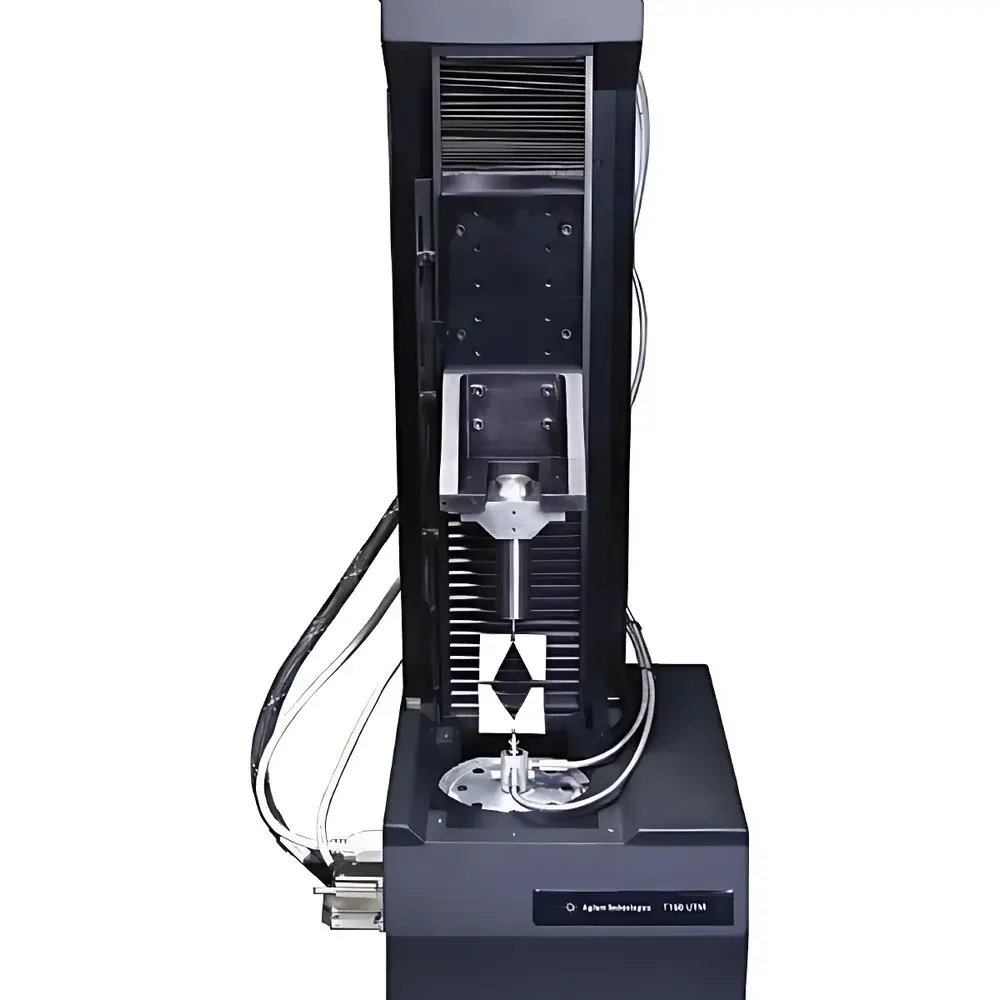
Keysight UTM 150 High-Precision Micro- and Nanoscale Tensile Testing System
| Brand | Keysight |
|---|---|
| Origin | USA |
| Manufacturer Type | Authorized Distributor |
| Product Category | Imported Instrument |
| Model | UTM 150 |
| Maximum Test Force | ±500 mN |
| Force Resolution | 50 nN |
| Actuator Displacement Range | ±1 mm |
| Displacement Resolution | 0.1 nm |
| Dynamic Displacement Resolution | < 0.001 nm |
| Crosshead Travel | 150 mm |
| Tensile Resolution | 35 nm |
| Tensile Rate | 0.5 µm/s to 5 mm/s |
| Dynamic Frequency Range | 0.1 Hz to 2.5 kHz |
| Loading Modes | Constant Load Rate, Constant Displacement Rate, Constant Strain Rate, Step Loading |
| Compliance | ASTM E8/E21, ISO 6892-1, USP <1042>, GLP/GMP-ready data audit trail |
Overview
The Keysight UTM 150 High-Precision Micro- and Nanoscale Tensile Testing System is an electromechanically actuated, closed-loop nanomechanical testing platform engineered for quantitative mechanical characterization of microscale and nanoscale specimens—including thin films, freestanding nanowires, MEMS structures, biomaterials, and advanced composites. It operates on the principle of high-fidelity force-displacement transduction using a patented nano-mechanical excitation sensor architecture, enabling simultaneous static tensile testing (e.g., stress–strain curve acquisition) and dynamic mechanical analysis (DMA) under continuous loading. Unlike conventional macro-scale tensile testers, the UTM 150 integrates sub-nanometer displacement metrology with femto-Newton-level force feedback control, permitting true in-situ measurement of elastic modulus, yield strength, ultimate tensile strength, fracture strain, and time-dependent viscoelastic parameters—including storage modulus (E′) and loss modulus (E″)—across a broad frequency spectrum (0.1 Hz to 2.5 kHz). Its design conforms to fundamental metrological traceability requirements for nanomechanics, supporting calibration against NIST-traceable standards.
Key Features
- Ultra-high-resolution force measurement: ±500 mN full-scale range with 50 nN resolution—enabling detection of interfacial adhesion forces and surface-dominated deformation mechanisms.
- Sub-angstrom displacement sensing: 0.1 nm static resolution and < 0.001 nm dynamic resolution via differential capacitive transduction and real-time PID compensation.
- Multi-mode actuation architecture: Supports constant-load-rate, constant-displacement-rate, constant-strain-rate, and programmable step-loading protocols—fully configurable via Keysight’s NanoTest Control Suite.
- Integrated Continuous Dynamic Analysis (CDA): Proprietary Keysight technology that superimposes a nanoscale harmonic perturbation onto monotonic loading, allowing concurrent extraction of E′ and E″ at discrete strain states without interrupting the primary test.
- Modular environmental compatibility: Designed for integration with SEM/TEM stages, vacuum chambers (10⁻⁶ mbar), and temperature-controlled stages (−100 °C to +300 °C) without performance degradation.
- Third-generation digital control electronics: Enables 100 kHz real-time data acquisition, onboard signal conditioning, and deterministic latency (< 10 µs) for closed-loop stability during high-frequency DMA.
Sample Compatibility & Compliance
The UTM 150 accommodates specimens ranging from 100 nm-thick polymer films to 50 µm-diameter metallic micropillars and brittle ceramic nanobeams. Sample mounting utilizes precision-engineered microgrippers with integrated piezoresistive load cells and optical alignment fiducials. All firmware and data logging modules comply with FDA 21 CFR Part 11 requirements for electronic records and signatures, including role-based access control, immutable audit trails, and automated electronic signature capture. Mechanical testing protocols adhere to ASTM E8/E21 (tensile testing of metallic materials), ISO 6892-1 (metallic materials — tensile testing — part 1: method of test at room temperature), and USP (mechanical testing of pharmaceutical dosage forms). Full GLP and GMP validation documentation packages—including IQ/OQ/PQ protocols and calibration certificates traceable to NIST SRM 2462—are available upon request.
Software & Data Management
Control and analysis are performed using Keysight NanoTest Control Suite v5.2—a Windows-based application built on .NET Framework with native support for Python scripting (via PyNanoTest API) and MATLAB interoperability. The software provides real-time visualization of force–displacement curves, dynamic modulus spectra, hysteresis loops, and creep/recovery profiles. All raw data are stored in HDF5 format with embedded metadata (timestamp, operator ID, calibration history, environmental conditions). Export options include CSV, Excel (.xlsx), and MDF4 for integration with third-party statistical process control (SPC) or LIMS platforms. Audit trail logs record every parameter change, test initiation, and data export event with cryptographic hashing to ensure forensic integrity.
Applications
- Quantitative mechanical mapping of thin-film adhesion and delamination thresholds in semiconductor interconnect stacks.
- In-situ tensile failure analysis of carbon nanotube yarns and graphene oxide membranes under controlled humidity.
- Viscoelastic characterization of hydrogels and extracellular matrix mimics across physiologically relevant strain rates (10⁻³ s⁻¹ to 10² s⁻¹).
- Mechanical property screening of additively manufactured micro-lattices for aerospace thermal management components.
- Calibration and validation of molecular dynamics simulations through direct comparison of simulated and measured stress–strain responses.
- Regulatory-compliant mechanical testing of drug-eluting stent coatings per ISO 14630 and ISO 25539-2.
FAQ
What is the minimum specimen thickness the UTM 150 can reliably test?
The system has been validated for specimens as thin as 50 nm when mounted on silicon nitride membranes; thinner layers require substrate-supported configurations with compensatory bending correction algorithms.
Does the UTM 150 support high-temperature tensile testing?
Yes—when coupled with Keysight’s optional HT-Stage (−100 °C to +300 °C), all force and displacement specifications remain within published tolerances; thermal drift compensation is applied automatically in real time.
Can test data be exported for regulatory submission (e.g., FDA IND/IDE)?
Yes—data files include embedded electronic signatures, version-controlled metadata, and full audit trails compliant with 21 CFR Part 11 Subpart B; validation documentation supports FDA pre-submission review.
Is remote operation supported?
The NanoTest Control Suite supports secure TLS 1.3-enabled remote desktop sessions and RESTful API access for integration into automated lab workflows.
What calibration standards are used for force and displacement verification?
Force calibration uses NIST-traceable deadweight standards (SRM 2462); displacement calibration employs laser interferometry referenced to NIST SRM 2036, with annual recalibration recommended.



