
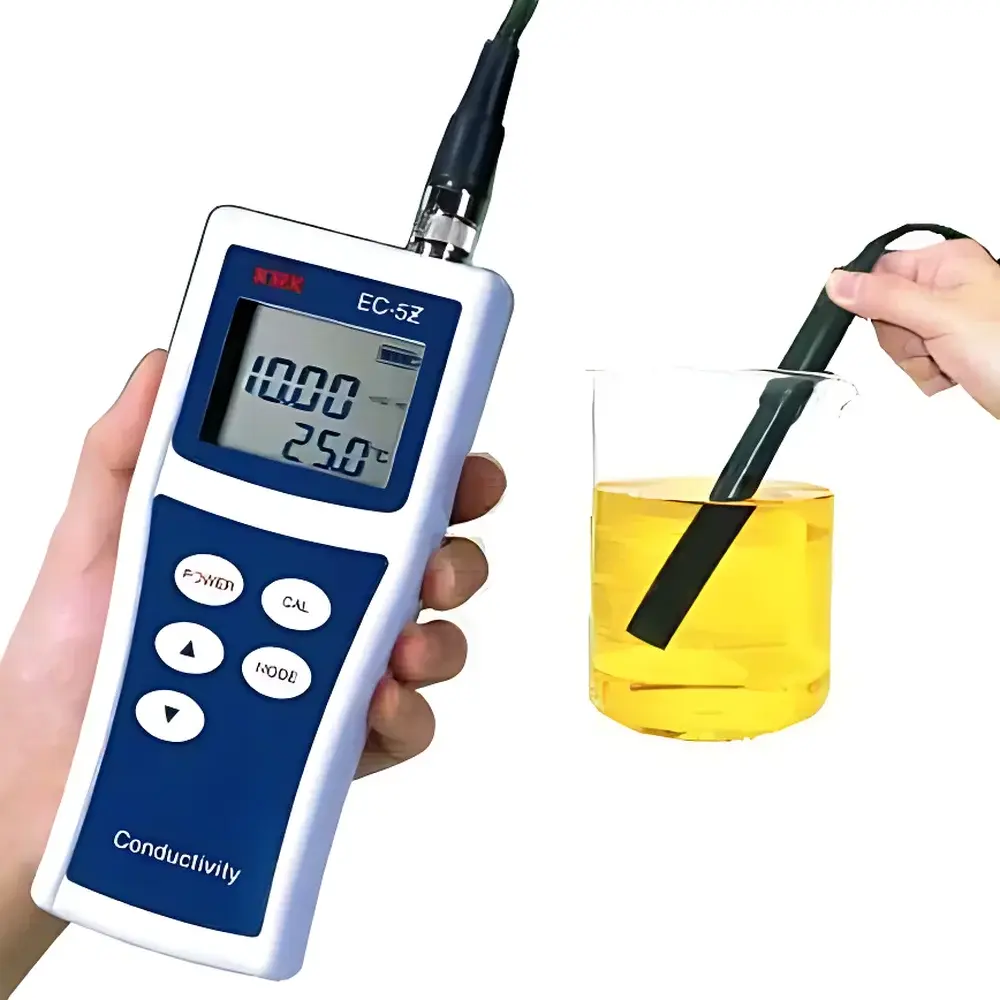
Kikuchi EC-5Z Portable Conductivity Meter
| Brand | Kikuchi |
|---|---|
| Origin | Japan |
| Model | EC-5Z |
| Measurement Principle | AC 3-Electrode Conductometry |
| Display | 4-digit, dual-line LCD (simultaneously shows conductivity and temperature) |
| Temperature Compensation | Automatic (NTC thermistor), user-selectable temperature coefficient (0.00–9.99 %/°C) |
| Electrode Constant Adjustment | Fully programmable (100 m⁻¹ or 400 m⁻¹ preconfigured |
| Operating Temperature Range | 0–100 °C |
| IP Rating | IP66 |
| Power Supply | 3 × LR03 (AAA) alkaline batteries with auto-power-off |
| Dimensions | 38 × 75 × 180 mm (H×W×D) |
| Weight | ~300 g |
| Electrode Materials | PPS housing, fluorocarbon O-rings, carbon sensing elements, polypropylene cable |
| Cable Length | 2 m standard |
| Compatible Electrodes | ECD-1C (100 m⁻¹, for low–mid range), ECD-4C (400 m⁻¹, for mid–high range) |
| Units | SI (S/m, mS/cm, µS/cm) and legacy units (mho/cm, etc.) switchable |
| Measurement Parameters | Conductivity, salinity (calculated), temperature |
Overview
The Kikuchi EC-5Z is a handheld, field-deployable conductivity meter engineered for reliable, high-reproducibility measurements across diverse aqueous matrices—from ultrapure process water to highly concentrated industrial effluents and brines. It employs AC-driven 3-electrode conductometry to eliminate polarization errors and minimize electrode fouling, ensuring stable readings in aggressive chemical environments. Unlike 2-electrode systems, the third reference electrode enables precise current control and voltage measurement, significantly improving accuracy at both low (200 mS/cm) conductivity ranges. Designed for continuous operation in demanding settings—including wastewater treatment plants, chemical manufacturing lines, agricultural irrigation monitoring, and river basin surveillance—the EC-5Z integrates robust physical construction with metrologically sound signal conditioning. Its automatic temperature compensation (ATC) utilizes an embedded NTC thermistor in the sensor tip, supporting user-defined temperature coefficients per ISO 7888 and ASTM D1125 standards to accommodate non-linear thermal behavior of complex electrolytes.
Key Features
- Rugged IP66-rated enclosure resistant to dust ingress and high-pressure water jets—suitable for outdoor and wet-industrial use.
- Programmable electrode constant (k = 0.01–1000 m⁻¹), enabling calibration traceability to certified standard solutions and adaptation to custom cell geometries.
- Dual-parameter LCD display showing real-time conductivity and temperature simultaneously—no mode-switching required.
- Chemically inert wetted materials: PPS (polyphenylsulfone) body, FKM fluorocarbon O-rings, and carbon-based electrodes ensure compatibility with acidic, alkaline, and oxidizing solutions up to 100 °C.
- Low-power design with auto-shutdown and battery status indicator—supports >200 hours of continuous operation on three AAA alkaline cells.
- Unit flexibility: seamless switching between SI units (µS/cm, mS/cm, S/m) and legacy units (mho/cm, mmho/cm) without recalibration.
Sample Compatibility & Compliance
The EC-5Z accommodates a broad spectrum of liquid samples typical in environmental and industrial QA/QC workflows: municipal and industrial wastewater, cooling tower water, boiler feedwater, hydroponic nutrient solutions, seawater dilutions, and chemical process streams. Its ECD-1C (k = 0.1 cm⁻¹) and ECD-4C (k = 4.0 cm⁻¹) electrodes are validated per JIS K 0101 and ISO 7888 for conductivity determination in natural waters and effluents. The instrument’s ATC algorithm conforms to the temperature correction methodology specified in USP for purified water testing. While not FDA 21 CFR Part 11–compliant out-of-the-box (as it lacks electronic audit trail functionality), its measurement records meet GLP documentation requirements when paired with manual logbook entries and calibrated reference standards.
Software & Data Management
The EC-5Z operates as a standalone field instrument with no onboard data logging or Bluetooth/Wi-Fi connectivity. All measurements are intended for immediate visual verification and manual transcription. For laboratory integration, users may pair the device with external recording systems via analog output (optional accessory) or employ standardized calibration logs aligned with ISO/IEC 17025 quality management frameworks. Calibration certificates for supplied electrodes (ECD-1C/ECD-4C) are traceable to NMIJ (National Metrology Institute of Japan) reference materials. Firmware updates are not supported—hardware stability and long-term repeatability are prioritized over feature expansion.
Applications
- Real-time monitoring of conductivity drift in reverse osmosis permeate and reject streams.
- Salinity assessment in aquaculture ponds and coastal groundwater wells.
- Concentration control of acid/base cleaning solutions in food processing CIP systems.
- Field verification of conductivity specifications in pharmaceutical purified water loops (per EP 2.2.38 and USP ).
- Trend analysis of ionic load in stormwater runoff prior to discharge compliance reporting.
- Process validation support during chemical dosing trials in municipal wastewater nitrification basins.
FAQ
Does the EC-5Z support GLP-compliant calibration records?
No built-in electronic recordkeeping is provided; however, its calibration procedure—including standard solution lot numbers, date, temperature, and measured value—is fully documentable using paper-based or LIMS-integrated templates compliant with ISO/IEC 17025.
Can the EC-5Z measure conductivity in viscous or suspended-laden samples?
Yes—its 3-electrode AC method reduces coating-related drift, but routine mechanical cleaning of the carbon electrodes is recommended for samples with >50 mg/L total suspended solids.
Is the ECD-4C electrode suitable for seawater (≈50 mS/cm)?
Yes—the 400 m⁻¹ cell constant optimizes resolution and linearity in high-conductivity media; full-scale accuracy is maintained up to 200 mS/cm at 25 °C.
What is the minimum detectable conductivity with the ECD-1C electrode?
At k = 0.1 cm⁻¹, the practical lower limit is ≈1 µS/cm under controlled lab conditions; field measurements below 10 µS/cm require temperature-stabilized sampling and air-saturated deionized water blanks.
Does the instrument comply with ATEX or IECEx for hazardous area use?
No—the EC-5Z is not intrinsically safe certified and must be operated outside classified zones per IEC 60079-0.







