
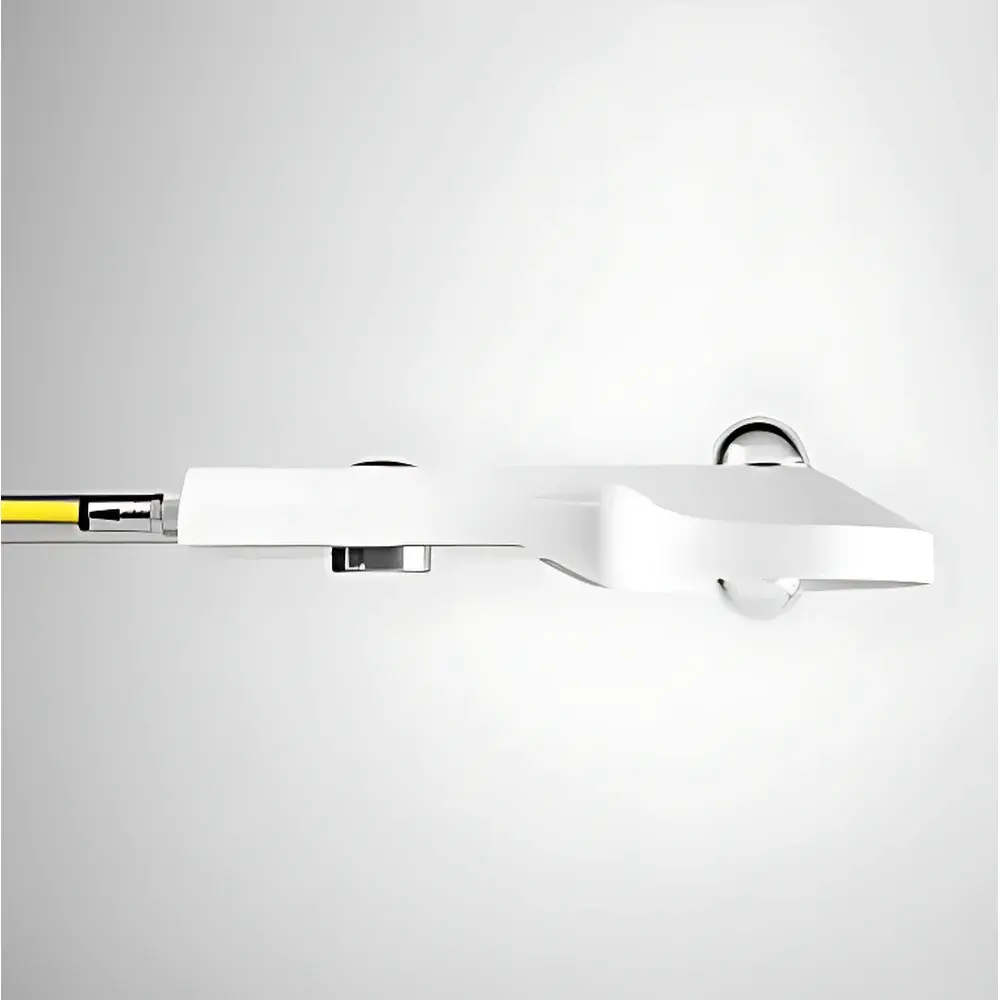
Kipp & Zonen CNR4 Net Radiometer
| Brand | Kipp & Zonen |
|---|---|
| Origin | Netherlands |
| Model | CNR4 |
| Spectral Range (Shortwave) | 300–2800 nm |
| Spectral Range (Longwave) | 4500–42000 nm |
| Sensitivity | 5–20 µV/W/m² |
| Temperature Dependence of Sensitivity (−10 to +40 °C) | < 4 % |
| Response Time | < 18 s |
| Non-linearity Error | < 1 % |
| Operating Temperature Range | −40 to +80 °C |
| Ventilation Power (Optional CNF4) | 10 W |
Overview
The Kipp & Zonen CNR4 Net Radiometer is a high-precision, four-component pyranometer/pyrgeometer system engineered for continuous, autonomous measurement of surface energy balance in meteorological, climatological, and environmental research applications. It operates on the fundamental principle of net radiation—the algebraic sum of incoming shortwave (solar) and longwave (terrestrial infrared) radiation incident on a surface, minus the reflected shortwave and outgoing longwave radiation. This dual-pair configuration enables simultaneous, co-located quantification of all four radiative flux components: downward shortwave (global solar), upward shortwave (reflected solar), downward longwave (atmospheric infrared), and upward longwave (surface-emitted infrared). The instrument adheres to World Meteorological Organization (WMO) “high-quality” classification standards for net radiometers, making it suitable for use in reference-grade networks including BSRN (Baseline Surface Radiation Network) and FLUXNET.
Key Features
- Integrated dual-pair design: Two thermopile-based pyranometers (upward/downward) for shortwave (300–2800 nm) and two thermopile-based pyrgeometers (upward/downward) for longwave (4500–42000 nm), all factory-calibrated individually and mounted directly within a single robust aluminum housing.
- Optimized longwave detection: Upper pyrgeometer features a meniscus-shaped silicon dome—providing near-hemispherical (≈180°) field of view versus standard flat-window limitations (~150°)—and minimizing dew formation through hydrophobic geometry and rapid drainage.
- Thermal stabilization architecture: Two integrated temperature sensors—a Pt-100 RTD and a thermistor—are located adjacent to the longwave detector pair to monitor housing temperature with high spatial fidelity; this enables real-time correction of longwave thermal offset errors in post-processing or embedded firmware.
- Passive thermal management: Lightweight construction combined with an integrated sun shield reduces convective heating effects on both shortwave and longwave sensors, improving signal stability under high insolation conditions.
- Modular ventilation compatibility: Optional CNF4 ventilator unit mounts directly onto the sun shield, delivering laminar airflow across domes and windows at low power (10 W). Its compact design ensures rapid air exchange above optical surfaces, significantly suppressing dew, frost, and dust accumulation without compromising mechanical integrity.
- Environmental resilience: Rated for operation from −40 °C to +80 °C; supplied with IP67-rated yellow cable featuring waterproof M12 connectors; mounting hardware includes quick-release screws for transport and field repositioning.
Sample Compatibility & Compliance
The CNR4 is designed for open-field deployment on meteorological masts, flux towers, and automated weather stations. Its optical design ensures compatibility with natural surfaces—including vegetated canopies, bare soil, snowpack, and water bodies—without requiring spectral correction under typical atmospheric conditions. All sensors meet ISO 9060:2018 classifications (Secondary Standard for pyranometers; First Class for pyrgeometers) and conform to WMO Guide to Meteorological Instruments and Methods of Observation (CIMO Guide, Chapter 7). Data outputs are compatible with industry-standard dataloggers supporting analog voltage input (e.g., Campbell Scientific CR series, Delta-T DL6, Vaisala WXT530), and support integration into GLP/GMP-compliant environmental monitoring systems when paired with audit-trail-capable data acquisition software.
Software & Data Management
Kipp & Zonen provides the optional Solys 2 Sun Tracker and UVR-NET software suite for automated alignment, diagnostic logging, and real-time quality control. Raw sensor voltages (mV) are converted to irradiance (W/m²) using individual calibration coefficients traceable to the World Radiometric Reference (WRR) and the World Infrared Standard Group (WISG). Firmware supports configurable linearization and temperature compensation algorithms per sensor channel. When deployed with compliant data loggers, the CNR4 supports timestamped, metadata-rich output formats (e.g., CSV, NetCDF) suitable for ingestion into FAO-56 evapotranspiration models, CMIP6 model validation workflows, and IPCC AR6 land-surface diagnostics. Optional firmware updates maintain compliance with evolving IEC 61724-1 (photovoltaic monitoring) and ASTM E892 (radiation measurement) annexes.
Applications
- Surface energy budget analysis in eddy covariance flux towers (e.g., AmeriFlux, ICOS)
- Validation of satellite-derived radiation products (e.g., CERES, GERB, CLARA-A3)
- Long-term climate monitoring in BSRN and GCOS reference sites
- Albedo and emissivity characterization across seasonal transitions (snowmelt, phenology, drought stress)
- Performance assessment of solar resource forecasting models and PV plant yield simulations
- Boundary-layer modeling and land-atmosphere coupling studies in mesoscale meteorology
FAQ
What is the calibration traceability of the CNR4 sensors?
All four sensors are calibrated individually against primary standards maintained by the Physikalisch-Technische Bundesanstalt (PTB) and the Royal Netherlands Meteorological Institute (KNMI), with certificates issued per ISO/IEC 17025 requirements.
Can the CNR4 operate unattended for extended periods?
Yes—its passive thermal design, low-power ventilation option (CNF4), and wide operating temperature range enable multi-year deployments in remote locations when paired with appropriate power management and telemetry infrastructure.
Is the CNF4 ventilator required for routine operation?
No; it is optional but strongly recommended for high-humidity, low-wind, or frost-prone environments to maintain optical clarity and reduce manual maintenance intervals.
How is thermal offset corrected in longwave measurements?
The integrated Pt-100 and thermistor provide redundant housing temperature readings; these feed into a physics-based correction algorithm that compensates for detector-body thermal gradients affecting pyrgeometer zero-offset drift.
Does the CNR4 comply with FDA 21 CFR Part 11 for regulated environmental monitoring?
While the CNR4 itself is not a regulated medical device, its analog output and calibration documentation support integration into Part 11–compliant data acquisition systems when configured with electronic signature, audit trail, and secure archiving capabilities.
Related Products







