
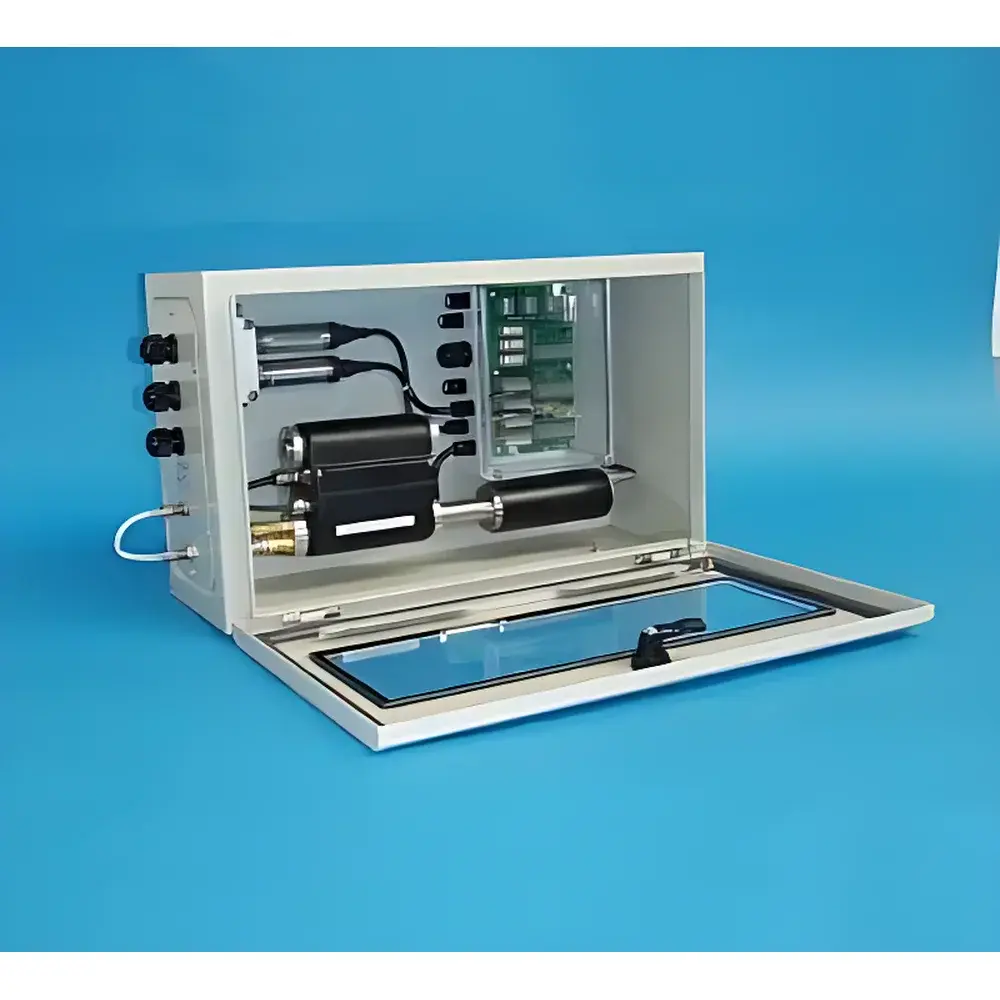
Kittiwake FG Integrated Online Oil Condition Sensor
| Brand | Kittiwake |
|---|---|
| Origin | United Kingdom |
| Model | FG |
| Operating Temperature Range | 0–70°C |
| Ferrous Debris Detection Range | 0–2000 ppm (uncombined, by weight) |
| Oil Quality Index Scale | 0–100 |
| Relative Humidity Measurement | 0–100% RH |
| Temperature Sensing Range | −20–120°C |
| Analog Output | 4–20 mA |
| Digital Interfaces | RS232, RS485, CAN bus, Wi-Fi |
| Maximum System Pressure | 10 bar |
| Maximum Oil Viscosity | 350 cSt @ 40°C |
| Power Supply | 18–30 V DC |
| Ingress Protection Rating | IP65 |
| Weight | 15 kg |
Overview
The Kittiwake FG Integrated Online Oil Condition Sensor is an engineered solution for real-time, in-situ monitoring of critical lubricant health parameters in industrial rotating equipment. Designed around a multi-sensor fusion architecture, the FG platform simultaneously quantifies three primary degradation indicators—ferrous particle concentration (by weight), water content (via relative humidity), and bulk oil quality index—within a single, compact, field-installable housing. Its measurement principle relies on calibrated electromagnetic induction for ferrous debris detection, capacitive dielectric sensing for moisture assessment, and multi-parameter algorithmic correlation for oil oxidation and additive depletion status. Unlike offline laboratory-based particle counters or discrete handheld testers, the FG operates continuously under process conditions, enabling predictive maintenance strategies aligned with ISO 4406:2017 (fluid cleanliness), ASTM D6786 (ferrographic analysis), and ISO 11171 (calibration standards for particle counters). The sensor is specifically validated for use with mineral oils, synthetic hydrocarbons (PAOs), and polyalkylene glycols (PAGs), supporting both stationary and mobile hydraulic, turbine, gear, and engine oil systems.
Key Features
- Triple-parameter integration: Simultaneous measurement of uncombined ferrous debris (0–2000 ppm), relative humidity (0–100% RH), and oil quality index (0–100 scale) in one sensor body.
- Robust process compatibility: Rated IP65 for dust- and water-resistant operation; capable of continuous duty at up to 10 bar system pressure and ambient temperatures from −20°C to 70°C.
- Multi-protocol digital connectivity: Native support for RS232, RS485, CAN bus, and IEEE 802.11 Wi-Fi—enabling seamless integration into SCADA, CMMS, and IIoT edge platforms without gateway dependency.
- Wide fluid applicability: Validated for oils ranging from 10 to 350 cSt @ 40°C, including Group I–V base stocks and common additives packages used in power generation, marine propulsion, wind turbine gearboxes, and heavy-duty hydraulics.
- Low-power, industrial-grade electronics: Operates on a wide-input 18–30 V DC supply, minimizing dependency on dedicated power conditioning hardware in remote or hazardous-area installations.
Sample Compatibility & Compliance
The FG sensor is designed for direct inline installation in pressurized oil circulation loops, requiring no bypass sampling or flow conditioning. It maintains measurement stability across viscosity ranges typical of turbine oils (ISO VG 32–68), hydraulic fluids (ISO VG 46–100), and gear oils (ISO VG 220–320). Calibration traceability follows UKAS-accredited procedures per ISO/IEC 17025, with factory verification against NIST-traceable reference standards for ferrous mass loading and humidity response. The device complies with EMC Directive 2014/30/EU and Low Voltage Directive 2014/35/EU. Its analog output meets IEC 61000-4-4 (electrical fast transient immunity) and IEC 61000-4-5 (surge immunity) requirements. For regulated environments—including pharmaceutical manufacturing, food-grade lubrication, and nuclear auxiliary systems—the FG supports audit-ready data logging when paired with compliant software (see Software & Data Management section).
Software & Data Management
The FG sensor outputs time-stamped, linearized parameter sets via its digital interfaces, compatible with standard OPC UA and Modbus TCP protocols. Kittiwake’s optional K-Suite™ software provides configuration, trend visualization, alarm thresholding (with hysteresis), and export to CSV or XML for integration into enterprise asset management (EAM) databases. When deployed with a Part 11-compliant server environment, K-Suite supports electronic signatures, user role-based access control, and immutable audit trails—meeting FDA 21 CFR Part 11 and EU Annex 11 requirements for GxP-aligned condition monitoring. Raw sensor data retains full timestamp resolution (1 Hz default, configurable up to 10 Hz), enabling spectral analysis of transient contamination events and correlation with vibration or thermal telemetry.
Applications
- Wind turbine gearbox oil health monitoring—tracking ferrous wear onset prior to catastrophic gear failure.
- Marine main engine lube oil surveillance—detecting water ingress from jacket coolant leaks or seawater contamination.
- Power plant turbine oil systems—assessing oxidation stability and demulsibility performance over extended drain intervals.
- Mining and quarrying hydraulic systems—identifying abnormal particle generation linked to pump or valve wear.
- Rail traction motor lubrication—supporting rolling stock reliability programs with automated, non-intrusive oil condition reporting.
FAQ
Can the FG sensor be installed in high-vibration environments?
Yes—the mechanical housing is qualified to ISO 5344 vibration endurance standards (5–2000 Hz, 5 g RMS) and features dual O-ring sealing and strain-relieved cable glands for sustained operation on diesel engines and gearboxes.
Does the sensor require periodic recalibration?
No field recalibration is required under normal operating conditions. Factory calibration remains valid for 24 months or 10,000 operational hours, whichever occurs first. Recalibration services are available through Kittiwake’s UK service center with UKAS-certified turnaround.
Is the oil quality index traceable to a standardized test method?
The index is derived from multivariate regression models trained on ASTM D2440 acid number, ASTM D4310 varnish potential, and ASTM D943 TOST life data—but it is not a direct substitute for lab testing. It serves as a sensitive early-warning indicator of chemical degradation trends.
What maintenance does the FG sensor require?
Zero scheduled maintenance. The sensor contains no moving parts, consumables, or optical windows subject to fouling. Routine visual inspection of the mounting flange and electrical connections is recommended during planned shutdowns.



