
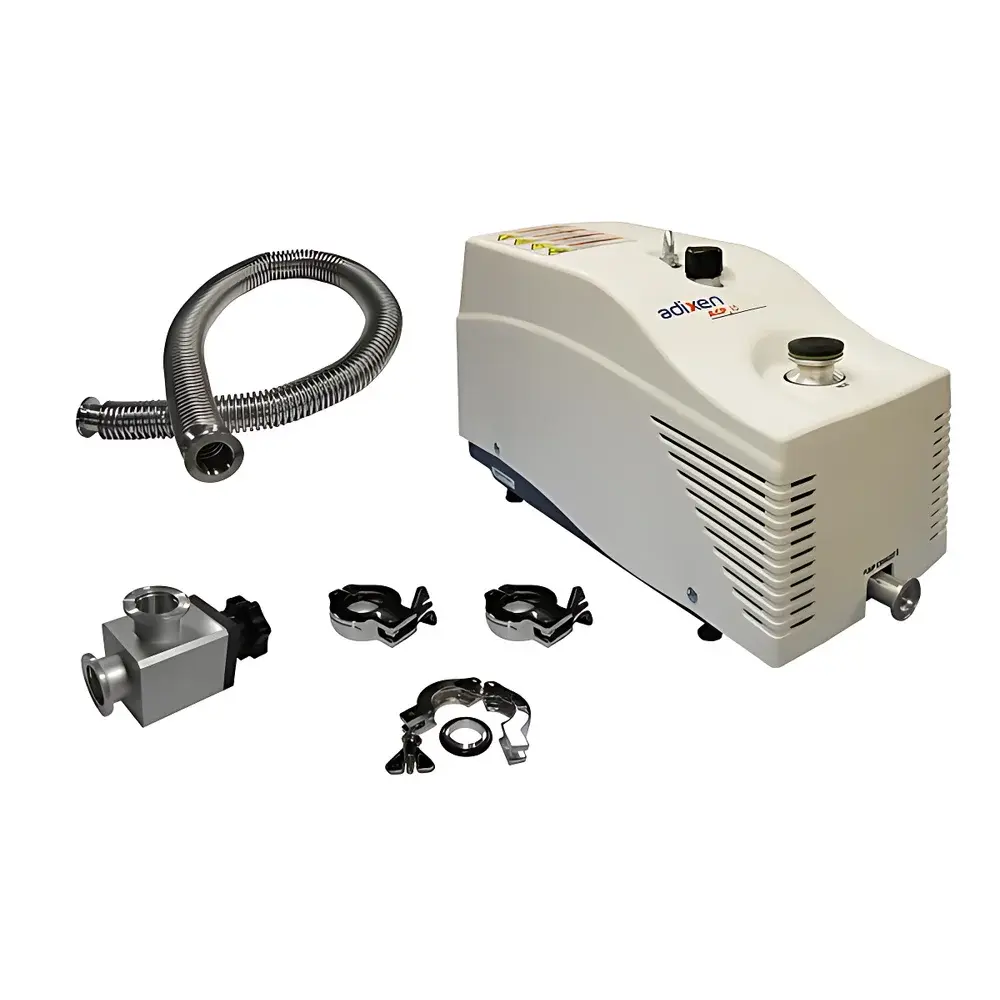
KJ GROUP ACP15 Oil-Free Vacuum Pump (226 L/min)
| Brand | KJ GROUP |
|---|---|
| Origin | Liaoning, China |
| Manufacturer Type | Authorized Distributor |
| Model | ACP15 |
| Power Supply | 110–240 V, 50/60 Hz |
| Pumping Speed | 3.7 L/s |
| Ultimate Vacuum | 2.2 × 10⁻² Torr |
| Inlet Port | KF25 |
| Exhaust Port | KF16 |
| Operating Temperature Range | 12–40 °C |
| Dimensions (L×W×H) | 514 × 190 × 270 mm |
| Weight | 23 kg |
Overview
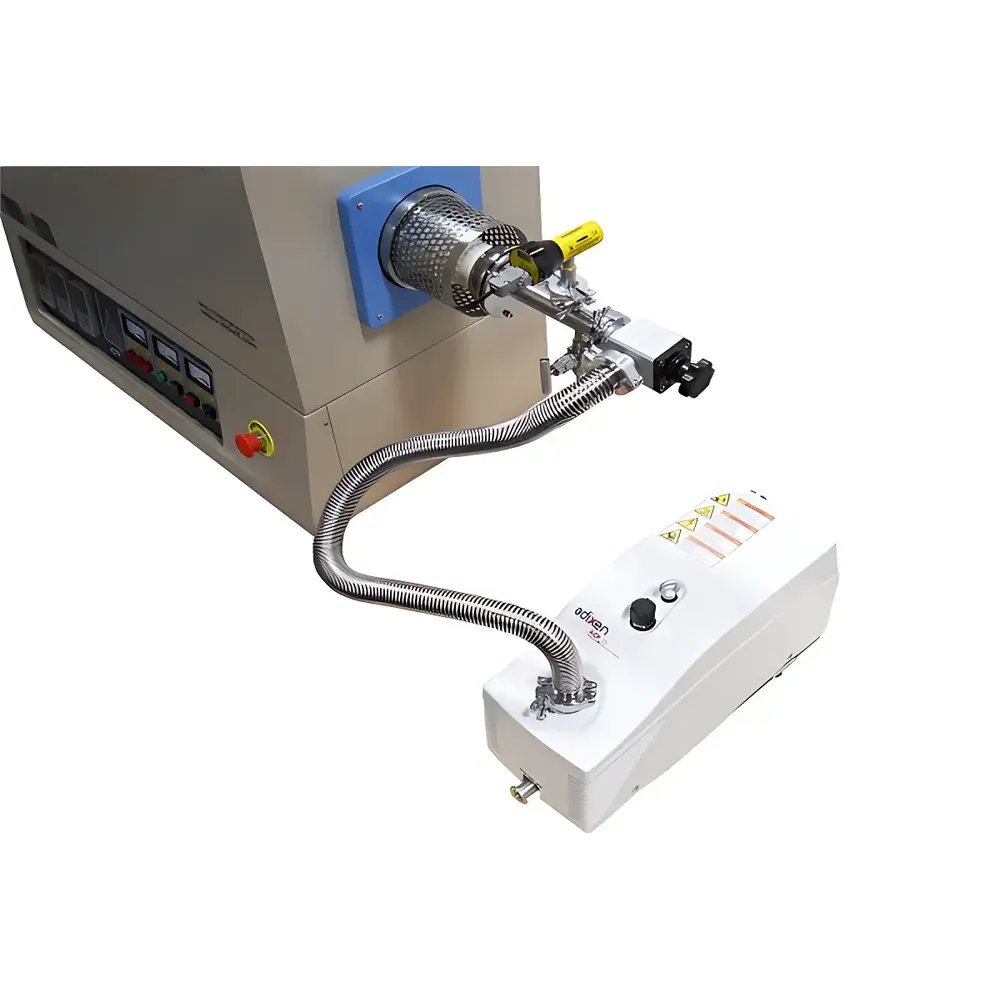
The KJ GROUP ACP15 Oil-Free Vacuum Pump is an engineered solution for laboratory and materials synthesis applications requiring clean, hydrocarbon-free vacuum environments. Utilizing a dry scroll pumping mechanism, the ACP15 achieves continuous operation without lubricating oil—eliminating oil backstreaming, vapor contamination, and maintenance associated with oil-sealed rotary vane pumps. This design ensures consistent vacuum integrity essential for sensitive processes such as low-pressure chemical vapor deposition (CVD), thin-film growth, and inert-atmosphere annealing in tube furnaces. With a nominal pumping speed of 3.7 L/s (226 L/min), the ACP15 delivers stable base pressure down to 2.2 × 10⁻² Torr under standard test conditions, making it suitable for primary vacuum generation in systems operating from rough vacuum to high vacuum transition ranges. Its compact footprint and KF-flanged ports facilitate seamless integration into modular vacuum train configurations, particularly when paired with KJ GROUP’s line of high-temperature tube furnaces.
Key Features
- Dry scroll technology ensures zero oil contamination—critical for CVD precursor purity and surface-sensitive deposition processes.
- Wide-input universal power supply (110–240 V, 50/60 Hz) enables global deployment without voltage conversion hardware.
- KF25 inlet and KF16 exhaust flanges conform to ISO-KF vacuum standards, ensuring compatibility with common laboratory vacuum components and gauges.
- Robust aluminum alloy housing provides thermal stability and mechanical rigidity across ambient temperatures from 12 °C to 40 °C.
- Integrated thermal protection circuitry prevents motor overload during extended duty cycles or elevated ambient conditions.
- Low-vibration operation minimizes mechanical coupling to sensitive optical or metrology equipment mounted on shared optical tables.
Sample Compatibility & Compliance
The ACP15 is compatible with a broad range of vacuum-compatible sample holders, quartz tubes, ceramic crucibles, and gas distribution manifolds used in thermal processing systems. It meets general safety requirements per IEC 61000-6-3 (EMC emission limits) and IEC 61000-6-2 (immunity). While not certified for explosive atmospheres (ATEX) or medical device use, its oil-free architecture supports compliance with ISO 8573-1 Class 0 air purity requirements when used with appropriate filtration—making it suitable for GLP-aligned research environments where trace hydrocarbon exclusion is mandated. For FDA-regulated applications involving material synthesis for biomedical devices, the pump may be included in system-level validation protocols provided that full traceability of maintenance logs and operational parameters is maintained.
Software & Data Management
The ACP15 operates as a standalone analog-controlled vacuum source and does not include embedded digital interfaces or firmware. However, it is fully compatible with third-party vacuum monitoring systems via standard analog output signals (0–10 V or 4–20 mA) when integrated with optional pressure transducers (e.g., capacitance manometers or Pirani gauges). When deployed in automated CVD platforms, the pump can be sequenced through PLC-based control logic using dry-contact relay outputs. All operational data—including runtime hours, thermal event history, and manual maintenance records—should be documented per institutional GLP or internal QA procedures. No onboard data logging or FDA 21 CFR Part 11-compliant audit trail functionality is provided; such capabilities must be implemented at the system integration level.
Applications
- Primary vacuum stage for low-pressure CVD and PECVD reactors coupled with horizontal tube furnaces.
- Evacuation and purge cycling in glovebox antechambers and inert-gas transfer lines.
- Backing pump for turbomolecular or cryogenic high-vacuum systems requiring oil-free foreline support.
- Vacuum drying of hygroscopic powders, MOFs, and battery electrode slurries where solvent residue control is critical.
- Pre-evacuation of electron microscopy sample chambers and XRD sample stages prior to inert gas fill.
- Gas-phase reaction studies involving reactive precursors (e.g., silanes, metal alkyls) where catalytic decomposition on oil residues must be avoided.
FAQ
Is the ACP15 certified for use in Class 100 cleanrooms?
No—the ACP15 is not ISO 14644-1 certified for cleanroom use. While its oil-free operation eliminates hydrocarbon outgassing, particulate generation from scroll wear and lack of HEPA-filtered exhaust require external filtration for cleanroom integration.
Can the pump handle condensable vapors such as water or ethanol?
It is not recommended for continuous condensable vapor loads. Moisture accumulation may impair scroll clearance; users must perform post-use venting (as specified in the manual) after exposure to humid or solvent-laden gases.
What maintenance intervals are recommended?
Inspect scroll alignment and bearing play every 2,000 operating hours. Replace the scroll set and front bearing assembly every 6,000 hours or sooner if vibration or noise increases beyond baseline levels.
Does the ACP15 comply with RoHS or REACH directives?
Yes—materials of construction comply with EU Directive 2011/65/EU (RoHS2) and Regulation (EC) No. 1907/2006 (REACH), with full declaration available upon request from KJ GROUP technical support.
Is technical documentation available in English with calibration traceability?
Yes—English-language operation manuals, dimensional drawings, and factory performance test reports (including pumping speed vs. pressure curves) are supplied. Calibration certificates are issued per ISO/IEC 17025-accredited third-party labs upon request.



