
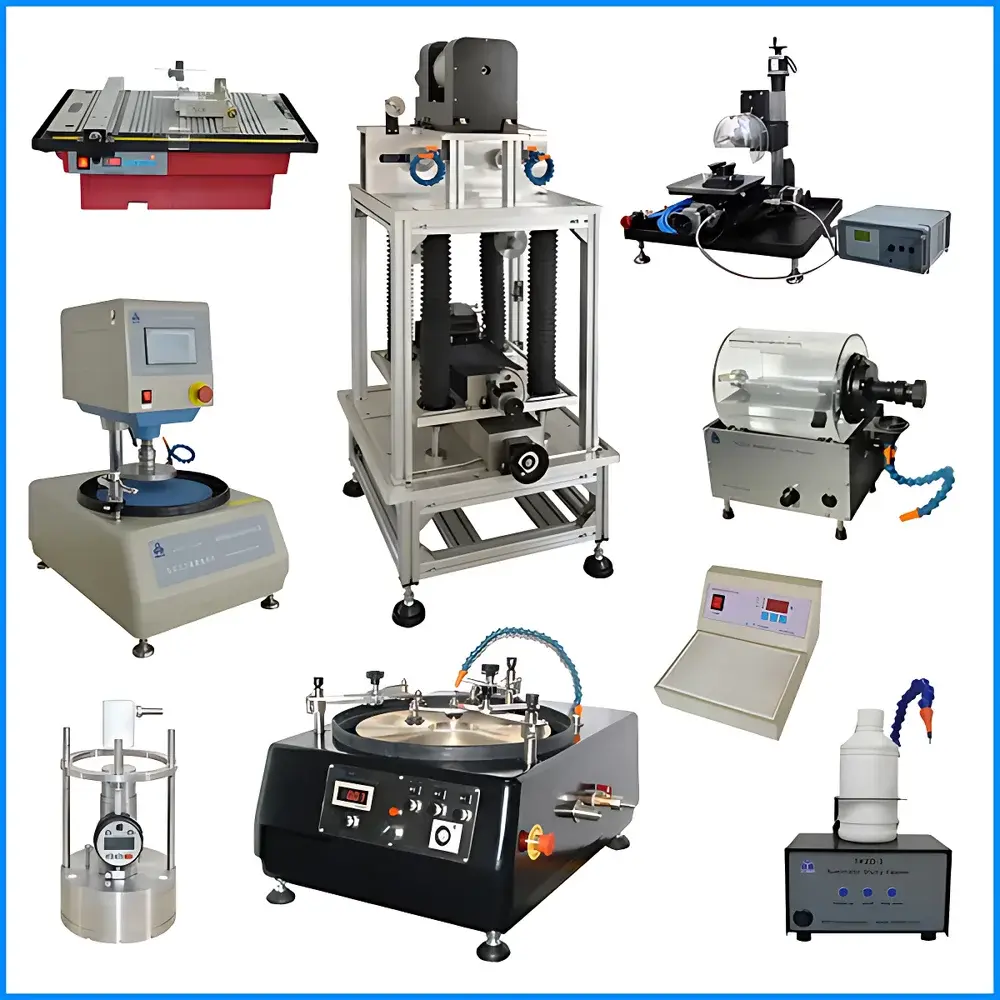
KJ GROUP Advanced Brittle Materials Sample Preparation System
| Brand | KJ GROUP |
|---|---|
| Origin | Liaoning, China |
| Manufacturer Type | Authorized Distributor |
| Product Category | Domestic Equipment |
| Model | Advanced Brittle Materials Sample Preparation System (Ceramics, Glass, Crystals) |
| Pricing | Available Upon Request |
Overview
The KJ GROUP Advanced Brittle Materials Sample Preparation System is an integrated, laboratory-grade platform engineered for high-precision sectioning, lapping, and polishing of inherently fragile and ultra-hard inorganic materials—including technical ceramics (e.g., Al₂O₃, SiC, ZrO₂), optical and structural glasses, single crystals (e.g., sapphire, quartz, LiNbO₃), geological specimens, and brittle intermetallics. Unlike general-purpose metallographic systems, this suite applies principles of controlled mechanical stress distribution, kinematic constraint, and thermal stabilization to mitigate microcracking, edge chipping, and subsurface damage during sample fabrication. The system is designed to support rigorous materials characterization workflows requiring cross-sectional integrity for subsequent SEM/EBSD, TEM lamella preparation, XRD texture analysis, or optical birefringence mapping—where surface finish, planarity deviation (<0.1 µm over 10 mm), and layer removal repeatability are critical.
Key Features
- Multi-stage precision cutting architecture: Combines manual rapid sectioning (SYJ-200H), CNC-guided scribing/cutting (SYJ-400), and wire-saw slicing (STX-603) to accommodate coarse trimming, feature-defined patterning, and sub-50 µm thickness slicing with minimal kerf loss.
- Thermally stabilized mounting: MTI-250 heated stage (up to 250 °C) enables controlled wax bonding with uniform thermal expansion matching, reducing interfacial shear during cutting and grinding.
- Force-regulated lapping & polishing: UNIPOL-1200S employs closed-loop pneumatic pressure control (0.5–20 N/cm² range) with real-time load feedback, enabling adaptive force application for both high-strength ceramics and cleavage-prone layered crystals (e.g., graphite, mica).
- Quantitative material removal: GPC-100A digital controller integrates vacuum chuck actuation, rotational speed modulation (50–300 rpm), and time-based dwell logic to achieve reproducible volumetric removal rates (±0.5 µm per minute, calibrated via profilometry).
- Automated abrasive delivery: SKZD-2 (for diamond suspension slurries) and SKZD-3 (for colloidal silica or alumina-based polishing fluids) provide programmable flow-rate control (0.1–5 mL/min) synchronized with platen rotation and pressure cycles.
- Modular interoperability: All subsystems adhere to ISO 9001-aligned mechanical interfaces and electrical safety standards (IEC 61000-6-2/6-4), permitting integration into GLP-compliant lab management systems via RS-485 or optional Ethernet gateway.
Sample Compatibility & Compliance
The system accommodates specimens up to Ø120 mm × 50 mm height, supporting brittle materials with Vickers hardness ranging from 500 HV (soda-lime glass) to >2500 HV (polycrystalline diamond compacts). It complies with ASTM E3–22 (Standard Guide for Preparation of Metallographic Specimens), ISO 14722:2021 (Ceramic microstructure preparation), and USP (Instrument Qualification for Analytical Sample Prep Equipment). Vacuum-chuck fixation and low-vibration motor drives meet requirements for ISO 14644-1 Class 7 cleanroom environments when operated within enclosed enclosures.
Software & Data Management
GPC-100A and UNIPOL-1200S controllers log timestamped operational parameters—including applied pressure, rotational speed, elapsed time, fluid dispensing volume, and vacuum status—to internal SD card storage (16 GB). Export formats include CSV and XML, compatible with LIMS platforms. Audit trail functionality satisfies FDA 21 CFR Part 11 requirements when paired with user authentication modules and electronic signature validation (optional firmware upgrade). No cloud connectivity is embedded; all data remains on-device unless explicitly exported.
Applications
- Preparation of transmission electron microscopy (TEM) foils from silicon carbide ceramic matrix composites.
- Sectioning of optical-grade fused silica blanks for interferometric flatness verification.
- Lapping of piezoelectric PZT wafers prior to electrode patterning and poling studies.
- Controlled thinning of geological thin sections (e.g., basalt, granite) for petrographic analysis under polarized light.
- Surface planarization of GaN-on-sapphire substrates for epitaxial growth qualification.
- Production of standardized fracture toughness test specimens (ASTM C1161) from reaction-bonded silicon nitride.
FAQ
What types of brittle materials are explicitly validated for use with this system?
Ceramics (Al₂O₃, Si₃N₄, ZrO₂, SiC), oxide and chalcogenide glasses, single crystals (sapphire, quartz, CaF₂), geological aggregates, and semiconductor-grade brittle substrates.
Is the system suitable for preparing TEM lamellae?
Yes—when combined with STX-603 wire sawing (≤30 µm kerf) and UNIPOL-1200S low-force polishing (≤2 N/cm²), it achieves electron-transparent regions suitable for FIB-free TEM prep workflows.
Does the GPC-100A support automated endpoint detection?
No—endpoint determination requires external metrology (e.g., optical interferometry or stylus profilometry); the GPC-100A provides precise, repeatable removal but does not incorporate in-situ sensors.
Can the system be qualified under GMP/GLP protocols?
Yes—full IQ/OQ documentation packages, calibration certificates traceable to NIST standards, and electronic audit trail options are available upon request.
Are consumables such as diamond wires and polishing pads supplied by KJ GROUP?
KJ GROUP offers OEM-compatible consumables including electroplated diamond wires (Ø0.1–0.35 mm), graded SiC lapping films (P80–P2000), and colloidal silica suspensions (pH 10.5, 30 nm nominal particle size).
Related Products



