
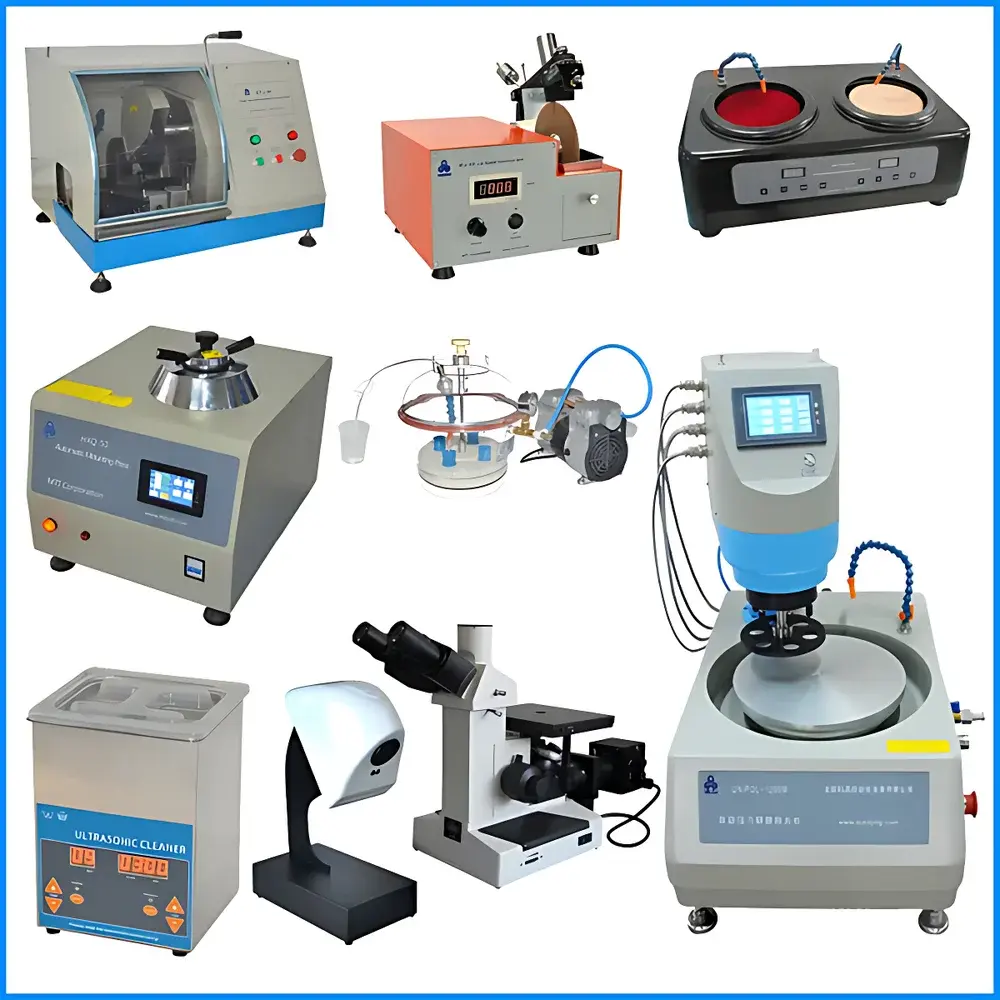
KJ GROUP Advanced Metallographic Sample Preparation System
| Brand | KJ GROUP |
|---|---|
| Origin | Liaoning, China |
| Manufacturer Type | Authorized Distributor |
| Country of Origin | China |
| Model | Advanced Metallographic Sample Preparation System |
| Pricing | Available Upon Request |
Overview
The KJ GROUP Advanced Metallographic Sample Preparation System is a fully integrated, workflow-optimized suite engineered for precision metallographic specimen preparation in academic research laboratories, industrial quality control departments, and materials science testing centers. Designed around the fundamental principles of metallurgical sample preparation—sectioning, mounting, grinding, polishing, cleaning, drying, and microscopic evaluation—the system ensures high reproducibility and minimal artifact generation across all stages. Each module complies with standard metallographic practice protocols defined by ASTM E3, ISO 16407, and EN 1071-1, supporting both rapid throughput for routine QC and ultra-fine surface finish requirements for advanced microstructural analysis (e.g., grain boundary characterization, phase distribution mapping, inclusion quantification). The system architecture prioritizes operator safety, process traceability, and cross-module compatibility—enabling seamless transition from raw sample to high-resolution optical imaging without manual rehandling or environmental contamination.
Key Features
- Modular, scalable configuration: All components are independently operable yet mechanically and software-coordinated for end-to-end automation readiness.
- Dual-sectioning capability: SYJ-50 high-speed abrasive cutter for coarse sectioning of bulk metals; SYJ-160 low-speed diamond saw for precision cutting of brittle, layered, or heat-sensitive specimens (e.g., coated alloys, composites, electronic interconnects).
- Vacuum-assisted cold mounting (CXQ-2500): Eliminates void formation in porous or cracked samples via vacuum impregnation of acrylic resins; ideal for powder metallurgy parts, sintered ceramics, and corrosion-damaged sections.
- Programmable hot mounting (HXQ-50): PID-controlled temperature/pressure cycles with automatic ejection—optimized for irregular geometries and thermally unstable materials.
- Multi-stage planarization: UNIPOL-820 delivers fine-grit grinding and semi-automatic polishing with variable speed (50–600 rpm) and digital load control (0.5–50 N); UNIPOL-1200M extends capacity to six mounted specimens simultaneously under programmable pressure profiles (0.1–30 N per station).
- Non-destructive cleaning: VGT-1620QTD ultrasonic cleaner operates at 40 kHz with degassing and sweep modes, compatible with aqueous and mild solvent-based solutions to remove residual abrasives and embedding media without surface pitting.
- Oxidation prevention: SKCS-1 forced-air dryer provides laminar, particle-filtered airflow at ambient temperature—critical for ferrous alloys and reactive non-ferrous systems post-polishing.
- Optical validation: 4XC-PC inverted metallurgical microscope features infinity-corrected optics, 5×–100× objective turret, coaxial illumination, and USB-C digital camera interface compliant with ISO 10951 resolution standards for quantitative image analysis (grain size per ASTM E112, inclusion rating per ASTM E45).
Sample Compatibility & Compliance
The system accommodates metallic specimens ranging from soft aluminum alloys (HB 65), as well as cemented carbides, titanium alloys, and nickel-based superalloys. Non-metallic inclusions, intermetallic phases, and thermal spray coatings are preserved without pull-out or smearing when protocol-matched consumables are applied. All instruments meet CE marking requirements for electromagnetic compatibility (EMC Directive 2014/30/EU) and low-voltage safety (LVD Directive 2014/35/EU). Mounting resins and polishing agents conform to REACH Annex XVII restrictions on hazardous substances. Documentation packages support GLP/GMP audit readiness, including calibration certificates, maintenance logs, and SOP templates aligned with ISO/IEC 17025 accreditation criteria.
Software & Data Management
UNIPOL series units integrate with KJ-LabControl™ v3.2 software (Windows 10/11), enabling full parameter logging (time, speed, pressure, coolant flow), user-defined method storage, and export of CSV-formatted process metadata. The 4XC-PC microscope includes ImagePro® LE acquisition software with measurement tools certified per ISO 9276-2 for particle size distribution analysis. All digital outputs are timestamped and user-ID tagged—supporting FDA 21 CFR Part 11-compliant electronic records when deployed with network authentication and audit trail activation.
Applications
- Failure analysis of structural components (fracture surface preparation, fatigue crack propagation studies)
- Heat treatment verification (case depth measurement, martensite/austenite ratio assessment)
- Weldment microstructure evaluation (HAZ characterization, intergranular corrosion susceptibility screening)
- Coating adhesion and delamination analysis (cross-sectional interface integrity)
- Research-grade microhardness correlation (Vickers/Knoop indentation site preparation)
- ISO/ASTM-certified interlaboratory round-robin testing programs
FAQ
Is this system suitable for preparing non-metallic samples such as ceramics or geological specimens?
Yes—when paired with diamond-impregnated sectioning blades, low-viscosity cold-mount resins, and silicon carbide-free polishing sequences, the system supports brittle-phase preservation in technical ceramics, concrete, and mineralogical thin sections.
Can the UNIPOL-1200M be upgraded to include electrolytic polishing modules?
Not natively; however, KJ GROUP offers the EP-2000 Electrolytic Polishing Station as a standalone, interoperable unit with shared sample holder dimensions and compatible mounting fixtures.
Are consumables supplied with batch traceability and CoA documentation?
All consumables listed in Appendix 1—including diamond suspensions, synthetic polishing cloths, and abrasive papers—are provided with lot-specific Certificates of Analysis referencing ISO 8501-1 surface cleanliness grades and ASTM D7234 binder content specifications.
What warranty and service coverage is included?
Standard 24-month parts-and-labor warranty; extended service plans (up to 5 years) include annual preventive maintenance, on-site calibration verification, and priority remote diagnostics support.



