
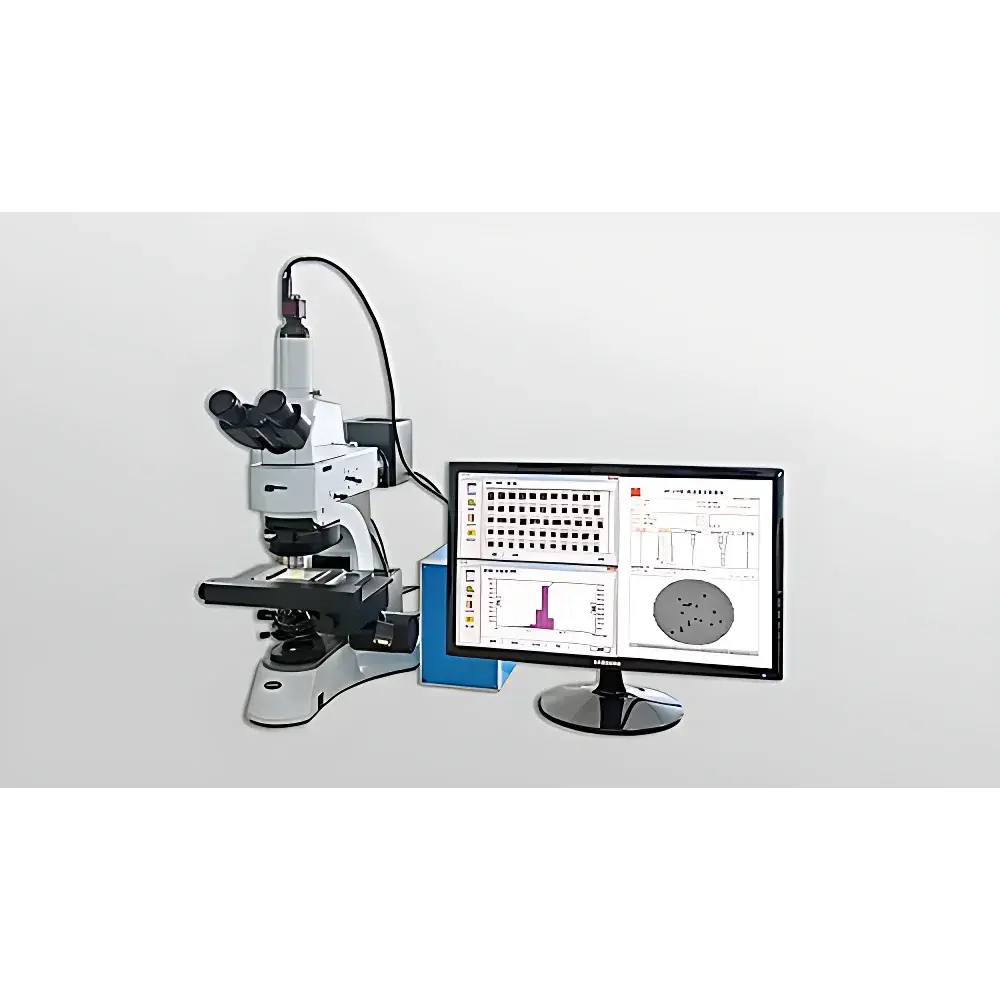
KJ GROUP BT-1700 Filter Paper Cleanliness Analysis System
| Brand | KJ GROUP |
|---|---|
| Origin | Liaoning, China |
| Manufacturer Type | Authorized Distributor |
| Country of Origin | China |
| Model | BT-1700 |
| Price | Upon Request |
| Particle Size Range | 1–10,000 µm |
| Maximum Particle Count per Analysis | >1,000,000 |
| Magnification | 30×–1000× |
| Scan Area Diameter | 55 mm |
| Analysis Time | ≤10 minutes |
| Detection Efficiency | ≥97% (for particles ≥10 µm) |
Overview
The KJ GROUP BT-1700 Filter Paper Cleanliness Analysis System is a fully automated digital microscopy platform engineered for quantitative particulate contamination assessment on filtration media—primarily filter papers used in hydraulic fluids, lubricants, pharmaceutical manufacturing, and aerospace fluid conditioning. It operates on the principle of high-resolution optical imaging coupled with morphological image analysis, enabling trace-level particle enumeration, sizing, and classification in accordance with internationally recognized cleanliness standards including ISO 4406, ISO 11171, ISO 16232 (especially VDA 19.1/19.2), and ASTM D7619. The system integrates a precision motorized microscope, a high-sensitivity CMOS camera, a programmable XYZ stage, and an intelligent illumination module to ensure consistent contrast, depth-of-field control, and spatial repeatability across large-area scans.
Key Features
- Fully automated XYZ stage with programmable scan path, speed, dwell time, and real-time positional feedback—enabling reproducible coverage of circular 55 mm diameter filter samples.
- Auto-focus algorithm synchronized with stage movement, maintaining optimal focus across variable topography and thickness gradients typical of cellulose or glass-fiber filter substrates.
- Seamless panoramic image stitching using sub-pixel registration and intensity-normalized blending, eliminating edge artifacts and ensuring geometric fidelity over full-scan mosaics.
- Multi-threshold segmentation engine supporting adaptive grayscale thresholding, Otsu’s method, and user-defined dynamic range clipping for robust particle isolation under varying lighting and background conditions.
- Morphometric analysis suite computing over 100 standardized parameters—including equivalent circular diameter (ECD), Feret min/max, aspect ratio, convexity, solidity, roundness, and opacity—each traceable to NIST-traceable calibration references.
- Real-time exposure control, objective lens switching (30×–1000×), and configurable color/shading correction to accommodate diverse filter matrix types (e.g., white cellulose, black polycarbonate, or translucent membrane filters).
Sample Compatibility & Compliance
The BT-1700 accommodates standard filter paper formats up to 55 mm in diameter, including but not limited to: Whatman GF/A, Sartorius SM17580, Pall Gelman A/E, and Millipore HAWP membranes. Its hardware architecture supports both dry-mounted and solvent-rinsed filters, with optional environmental enclosure compatibility for controlled-humidity or inert-gas handling. All measurement workflows comply with GLP documentation requirements, supporting audit-ready metadata logging—including operator ID, timestamp, instrument configuration, calibration status, and raw image provenance. Data export formats include CSV, TIFF (with embedded EXIF metadata), and XML-compliant reports compatible with LIMS integration and FDA 21 CFR Part 11–enabled electronic signatures when deployed with validated software modules.
Software & Data Management
The proprietary BT-Analysis Suite v3.2 provides a deterministic, scriptable workflow environment built on Qt/C++ with HDF5-based data storage architecture. Each analysis session generates a self-contained project file containing raw image tiles, stitched mosaics, particle ROI masks, morphometric tables, and statistical summaries (e.g., cumulative size distribution, ISO cleanliness code assignment). Batch processing supports scheduled unattended operation with email alerts upon completion or anomaly detection. Audit trail functionality records all parameter modifications, image reprocessing events, and user authentication actions—fully aligned with ISO/IEC 17025 and ICH Q5A quality system expectations. Export modules support direct mapping to SAP QM, LabWare LIMS, and Oracle Clinical One.
Applications
- Quantitative validation of filter manufacturing process consistency (e.g., fiber dispersion uniformity, binder residue levels).
- Post-use contamination profiling of hydraulic system filters per ISO 16232-C and VDA 19.2 protocols.
- Pharmaceutical pre-filter and final filter integrity verification under USP particulate matter testing guidelines.
- Automotive OEM supplier qualification where cleanliness thresholds are defined by ZF-00021 or Ford WSS-M99P1111-A.
- Research into filtration efficiency degradation mechanisms via longitudinal particle accumulation mapping.
- Calibration verification of liquid particle counters (LPCs) using reference filter slides with certified particle loading.
FAQ
What particle size range is reliably quantified by the BT-1700?
The system achieves validated detection from 1 µm to 10,000 µm using calibrated optical magnification and pixel-scale metrology; particles ≥10 µm exhibit ≤3% false-negative rate under standard illumination and focus conditions.
Can the BT-1700 analyze non-circular or irregularly shaped filters?
Yes—the motorized stage accepts custom coordinate-defined scan boundaries; users may define polygonal or elliptical regions of interest beyond the default 55 mm circular aperture.
Is the software compliant with FDA 21 CFR Part 11 requirements?
Out-of-the-box, the system supports electronic signatures and audit trails; full Part 11 compliance requires deployment within a validated IT infrastructure and documented SOPs per client-specific validation protocol.
How does the BT-1700 handle overlapping or agglomerated particles?
The software applies watershed segmentation with shape-prior constraints and optional manual ROI splitting; morphology-based deconvolution algorithms distinguish touching particles based on convex hull separation and gradient topology.
What maintenance intervals are recommended for optical calibration?
Stage positioning accuracy and magnification calibration should be verified quarterly using NIST-traceable stage micrometers and resolution test targets; illumination uniformity checks are advised before each daily shift.



