
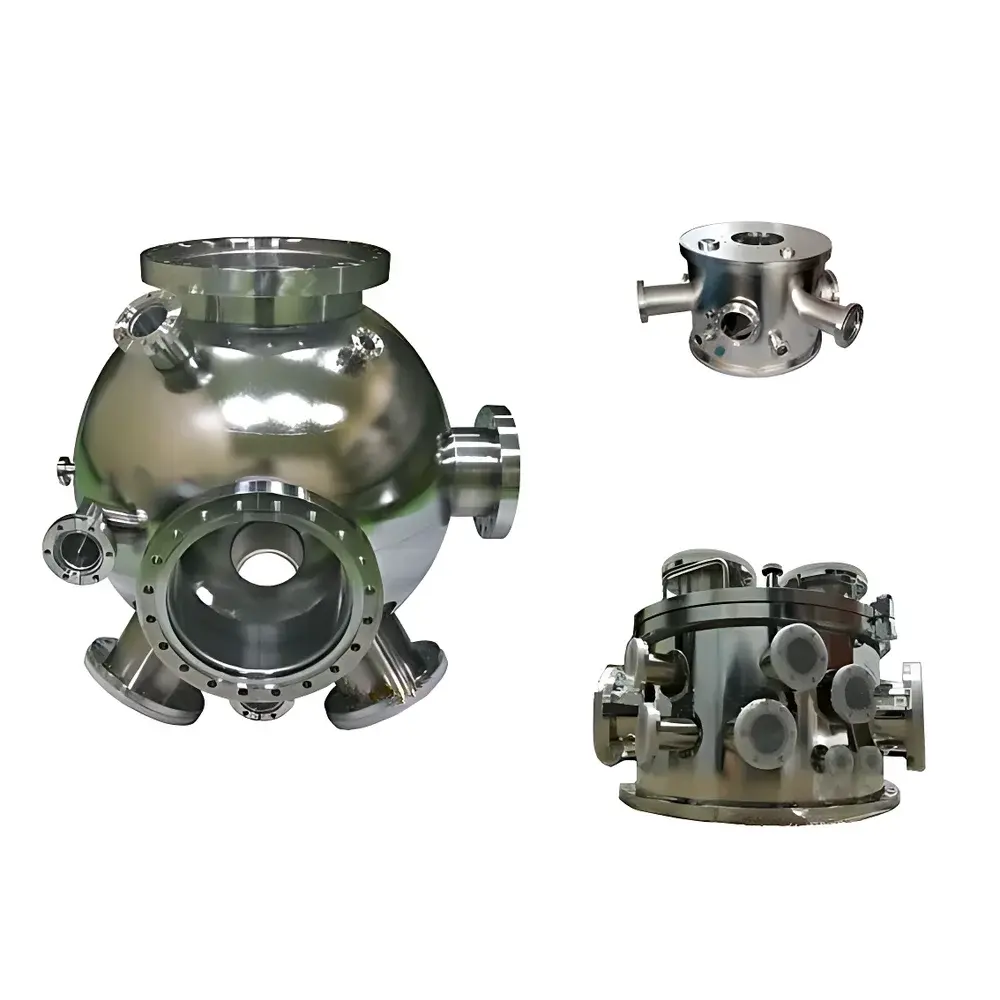
KJ GROUP Custom-Built Vacuum Chamber Systems
| Brand | KJ GROUP |
|---|---|
| Origin | Liaoning, China |
| Manufacturer Type | Authorized Distributor |
| Country of Origin | China |
| Model | Custom Vacuum Chamber |
| Pricing | Available Upon Request |
| Chamber Geometry Options | Cylindrical |
Overview
KJ GROUP Custom-Built Vacuum Chamber Systems are engineered for precision vacuum environments in thin-film deposition, materials research, surface science, and plasma processing applications. These chambers operate on fundamental ultra-high vacuum (UHV) and high-vacuum (HV) principles, utilizing standardized flange interfaces (CF, KF, ISO-K, or ISO-F), vacuum-tight sealing via copper or elastomer gaskets, and compatibility with turbomolecular, diffusion, and scroll pumping systems. Designed to meet the mechanical, thermal, and outgassing requirements of academic labs and industrial R&D facilities, each chamber is fabricated from 304 or 316 stainless steel—electropolished to minimize surface area and residual gas desorption. Structural integrity is validated per ASME BPVC Section VIII Division 1 guidelines for pressure boundary design, with leak-rate performance typically ≤1×10⁻⁹ mbar·L/s (He) after bake-out.
Key Features
- Full custom configurability: geometry (cylindrical, spherical, rectangular, U-shaped, or fully bespoke profiles), internal volume (0.5 L to >500 L), and wall thickness (3–25 mm) optimized for target operating pressure range (10⁻³ to 10⁻¹¹ mbar)
- Standardized vacuum interface architecture: CF-35/63/100/160/200 flanges with centering rings and knife-edge seals; optional KF-25/40/50 quick-connect ports for auxiliary feedthroughs
- Integrated mounting provisions: pre-drilled and tapped holes (M4–M12) on chamber walls and baseplates for sputtering targets, substrate holders, viewports, ion gauges, and residual gas analyzers
- Surface finish options: as-welded (Ra ≤ 0.8 µm), mechanically polished (Ra ≤ 0.4 µm), or electropolished (Ra ≤ 0.2 µm) to reduce hydrogen and water vapor outgassing
- Thermal management compatibility: provisions for water-cooled jackets, heater bands, or cryo-shields; maximum operational temperature up to 200 °C (with appropriate gasket selection)
Sample Compatibility & Compliance
Chambers support a broad spectrum of sample configurations—including wafers (up to 8″ diameter), bulk substrates, powder samples in crucibles, and MEMS devices mounted on custom stages. All standard chambers comply with ISO 2749 (vacuum technology — vocabulary), ISO 14644-1 (cleanroom classification for assembly environments), and GB/T 32212–2015 (Chinese national standard for vacuum chamber testing). Electropolished variants meet ASTM E1557 specifications for surface roughness verification. For regulated environments, chambers can be supplied with traceable material certifications (EN 10204 3.1), weld procedure specifications (WPS), and non-destructive testing reports (radiographic or dye-penetrant).
Software & Data Management
While the vacuum chamber itself is a passive mechanical system, KJ GROUP provides full integration support for third-party control ecosystems. Chambers include standardized electrical feedthroughs (SHV, BNC, D-sub, or hermetic ceramic pins) compatible with LabVIEW, MATLAB, and Python-based automation frameworks. Optional integrated vacuum instrumentation packages include capacitance manometers (Baratron®), Bayard-Alpert ionization gauges, and residual gas analyzers (RGA) with spectral logging capabilities. All digital instrumentation supports RS485/Modbus RTU or Ethernet/IP protocols, enabling audit-trail-ready data acquisition aligned with GLP/GMP documentation practices per FDA 21 CFR Part 11 when paired with compliant SCADA software.
Applications
- Magnetron sputtering system assembly: integration with DC/RF/MF power supplies, rotating or stationary magnetrons, and planetary substrate rotation stages
- Electron beam evaporation: mounting of e-beam sources, water-cooled hearths, and quartz crystal microbalances (QCM)
- Plasma-enhanced chemical vapor deposition (PECVD): RF matching network integration, showerhead gas inlets, and impedance monitoring ports
- In-situ characterization: integration with RHEED, XRD, or optical emission spectroscopy (OES) viewports (UV-grade fused silica or MgF₂ windows)
- Low-energy ion implantation and surface modification studies requiring differential pumping stages and beamline collimation
FAQ
Can KJ GROUP provide vacuum chamber drawings and stress analysis reports prior to fabrication?
Yes—upon receipt of technical specifications and intended use case, we supply detailed 3D STEP models, flange layout schematics, and FEA-based structural analysis reports (per EN 13445-3) for customer review and approval.
What vacuum level can be achieved with a standard KJ GROUP chamber?
Achievable base pressure depends on pump selection, chamber surface finish, and bake-out protocol. With electropolished 316L stainless steel, turbomolecular pumping, and 200 °C bake-out, pressures below 5×10⁻¹⁰ mbar are routinely attainable in research-grade configurations.
Do you offer vacuum certification and helium leak testing?
All chambers undergo mandatory helium mass spectrometer leak testing (ASTM E499) at 1×10⁻⁹ mbar·L/s sensitivity prior to shipment. Optional ISO 10110-compliant optical viewport certification and UHV-compatible bake-out validation reports are available.
Is it possible to retrofit existing chambers with additional feedthroughs or ports?
Yes—KJ GROUP offers certified field retrofit services including welding of new CF/KF ports, installation of electrical or pneumatic feedthroughs, and re-polishing of modified surfaces to maintain vacuum integrity.
What documentation accompanies each chamber shipment?
Each unit ships with a comprehensive technical dossier: material test reports (MTR), weld maps, dimensional inspection reports, leak test certificates, flange torque specifications, and vacuum compatibility guidelines per ISO 2749 and GB/T 32212.



