
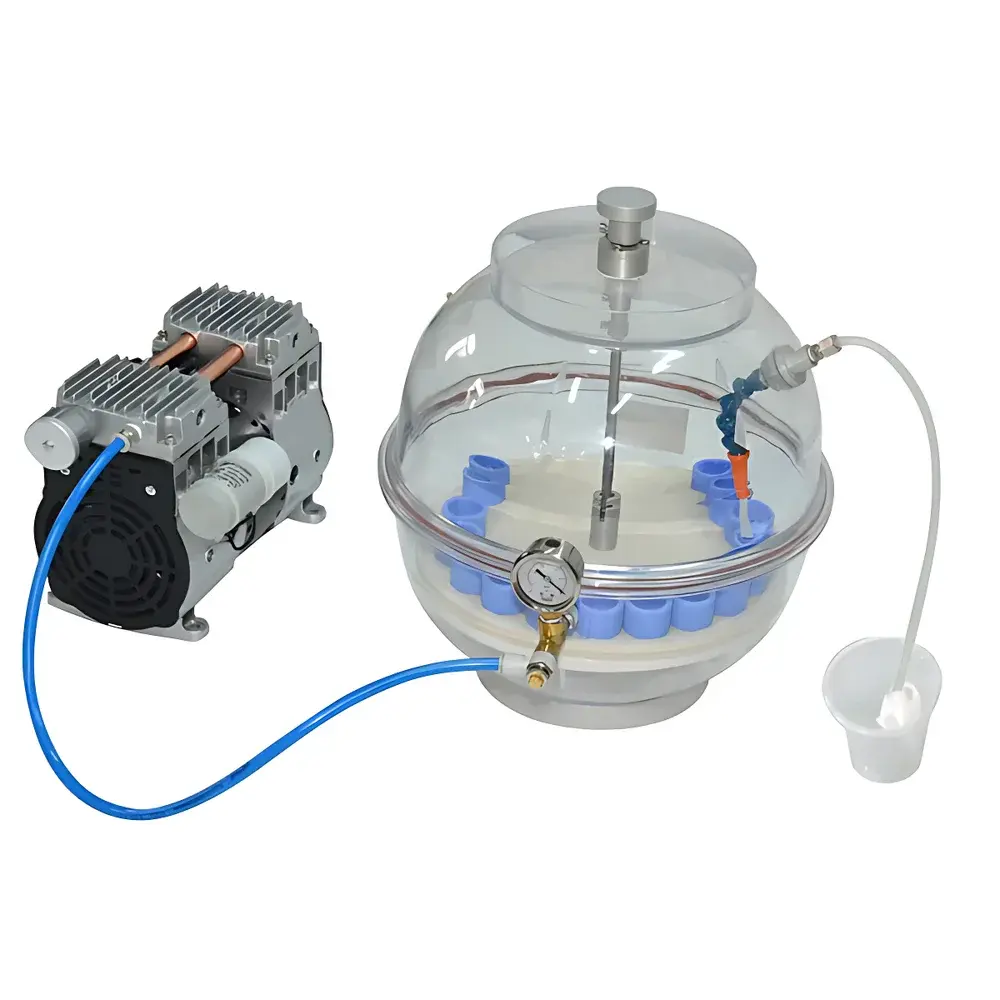
KJ GROUP CXQ-2700 High-Throughput Vacuum Cold Mounting Press
| Brand | KJ GROUP |
|---|---|
| Origin | Liaoning, China |
| Model | CXQ-2700 |
| Instrument Type | Cold Mounting Press |
| Vacuum Level | −0.08 MPa |
| Rotating Plate Diameter | Ø275 mm |
| Max Simultaneous Samples | 16 × Ø25 mm |
| Overall Dimensions | Ø330 mm × 380 mm |
| Operating Ambient | ≤1000 m ASL, 10–40 °C, 45–65% RH |
| Vacuum Source Required | External Oil-Free Pump (0 to −0.1 MPa) |
| Ventilation Required | Yes |
| Working Table Space | 500 mm × 500 mm × 700 mm |
Overview
The KJ GROUP CXQ-2700 High-Throughput Vacuum Cold Mounting Press is an engineered solution for precision cold embedding of delicate, porous, or thermally sensitive specimens—designed specifically for laboratories requiring reproducible, non-destructive sample preparation prior to metallographic, geological, electronic, or failure analysis. Unlike hot compression mounting—which subjects samples to elevated temperatures and mechanical pressure—the CXQ-2700 employs a controlled vacuum-assisted impregnation process grounded in fundamental fluid dynamics and capillary penetration principles. By evacuating air from interconnected pores and microvoids within the specimen, the system creates a pressure differential that drives low-viscosity resin or dye-based penetrants deep into fine features under ambient conditions. This method preserves microstructural integrity, avoids thermal distortion or delamination, and enables high-fidelity replication of surface topography, interfacial boundaries, and subsurface discontinuities—including microcracks, voids, solder joint defects, and grain boundary networks. Its compact footprint and modular mold configuration support integration into QA/QC workflows compliant with ASTM E3, ISO 13027, and IPC-TM-650 standards for embedded sample preparation.
Key Features
- High-throughput capacity: Simultaneous cold mounting of up to 16 Ø25 mm specimens per cycle—optimized for batch processing in production labs and R&D facilities.
- Vacuum-driven impregnation: Integrated vacuum chamber with precise −0.08 MPa operational vacuum level ensures efficient air removal from complex geometries, including PCB cross-sections, sintered ceramics, friable rock cores, and fiber-reinforced composites.
- Rotating plate mechanism (Ø275 mm): Uniform rotational motion during resin infusion minimizes air entrapment and promotes even flow distribution across all molds—enhancing fill consistency and reducing post-cure polishing artifacts.
- Modular mold system: Six interchangeable mounting molds accommodate variable specimen dimensions and shapes; compatible with standard phenolic, epoxy, and acrylic cold-setting resins as well as fluorescent or contrast-enhancing dyes.
- Oil-free vacuum compatibility: Designed for use with external oil-free vacuum pumps (0 to −0.1 MPa), eliminating risk of hydrocarbon contamination in analytical-grade mounts—critical for SEM/EDS, micro-CT, or automated image analysis pipelines.
- Compact benchtop architecture: Total unit dimensions of Ø330 mm × 380 mm require minimal lab space; no electrical power input required at the press itself—only vacuum source and ventilation.
Sample Compatibility & Compliance
The CXQ-2700 accommodates a broad spectrum of challenging sample types: printed circuit boards (PCBs) with microvias and HDI layers; powder metallurgy parts; porous catalyst substrates; sedimentary or metamorphic rock thin sections; soft polymers and elastomers; and brittle semiconductor wafers. It meets functional requirements outlined in ASTM E3-22 (Standard Guide for Preparation of Metallographic Specimens), ISO 13027:2019 (Metallographic specimen mounting), and IPC-TM-650 2.1.1 (Cross-sectioning of Printed Boards). For regulated environments—including ISO 17025-accredited testing labs and medical device manufacturing QA departments—the system supports documented process traceability when paired with validated vacuum pump logs and resin lot tracking. While the press itself does not incorporate electronic data logging, its mechanical design enables seamless alignment with GLP/GMP documentation protocols through operator-recorded cycle parameters (vacuum duration, dwell time, resin batch ID).
Software & Data Management
The CXQ-2700 operates as a standalone mechanical-vacuum system with no embedded firmware or proprietary software. All operational parameters—including vacuum hold time, resin mixing ratios, and post-impregnation cure schedules—are defined externally per material datasheets (e.g., Buehler EpoxiCure 2, Struers Durcupan ACM) and recorded manually or via laboratory information management systems (LIMS). This architecture eliminates cybersecurity vulnerabilities associated with connected instrumentation and simplifies 21 CFR Part 11 compliance in regulated settings: operators maintain full audit trails using paper-based or LIMS-integrated worksheets, with no electronic signature dependencies. Optional accessories—including calibrated vacuum gauges, temperature-stabilized curing ovens, and digital resin dispensers—can be integrated without modifying the core press platform.
Applications
- Metallography: Embedding heat-sensitive alloys, nitrided surfaces, and diffusion-bonded interfaces without phase transformation or oxidation.
- Electronics failure analysis: Cross-sectional verification of solder joint voiding, wire bond lift-off, and underfill delamination using dye-penetrant enhancement.
- Geological sample preparation: Stabilization of unconsolidated sediments, coal shales, and fractured core samples for petrographic microscopy and micro-XRF mapping.
- Quality control in additive manufacturing: Mounting of as-built metal AM parts to assess porosity distribution, unmelted powder retention, and layer bonding quality.
- Forensic materials analysis: Non-destructive encapsulation of fractured polymer components, adhesive joints, or composite laminates for comparative fracture surface examination.
FAQ
Does the CXQ-2700 require electrical power to operate?
No—the press itself is entirely mechanical and vacuum-actuated. Only the external oil-free vacuum pump requires power.
What vacuum pump specifications are recommended?
An oil-free diaphragm or scroll pump capable of reaching ≤−0.1 MPa (absolute) with a pumping speed ≥12 L/min is advised for optimal cycle times and consistent vacuum stability.
Can the CXQ-2700 be used with conductive resins for SEM mounting?
Yes—compatible with carbon-loaded or metal-filled cold-mounting resins; ensure compatibility with selected resin’s viscosity and cure kinetics per manufacturer guidelines.
Is ventilation mandatory during operation?
Yes—local exhaust ventilation is required to manage potential vapor emissions from uncured resins or dyes, in accordance with OSHA 1910.1200 and local industrial hygiene regulations.
How is process validation performed for regulated applications?
Validation relies on documented vacuum integrity checks (e.g., leak rate tests), resin batch qualification, and periodic verification of mount section quality via optical microscopy and hardness profiling per ASTM E3 Annex A3.



